
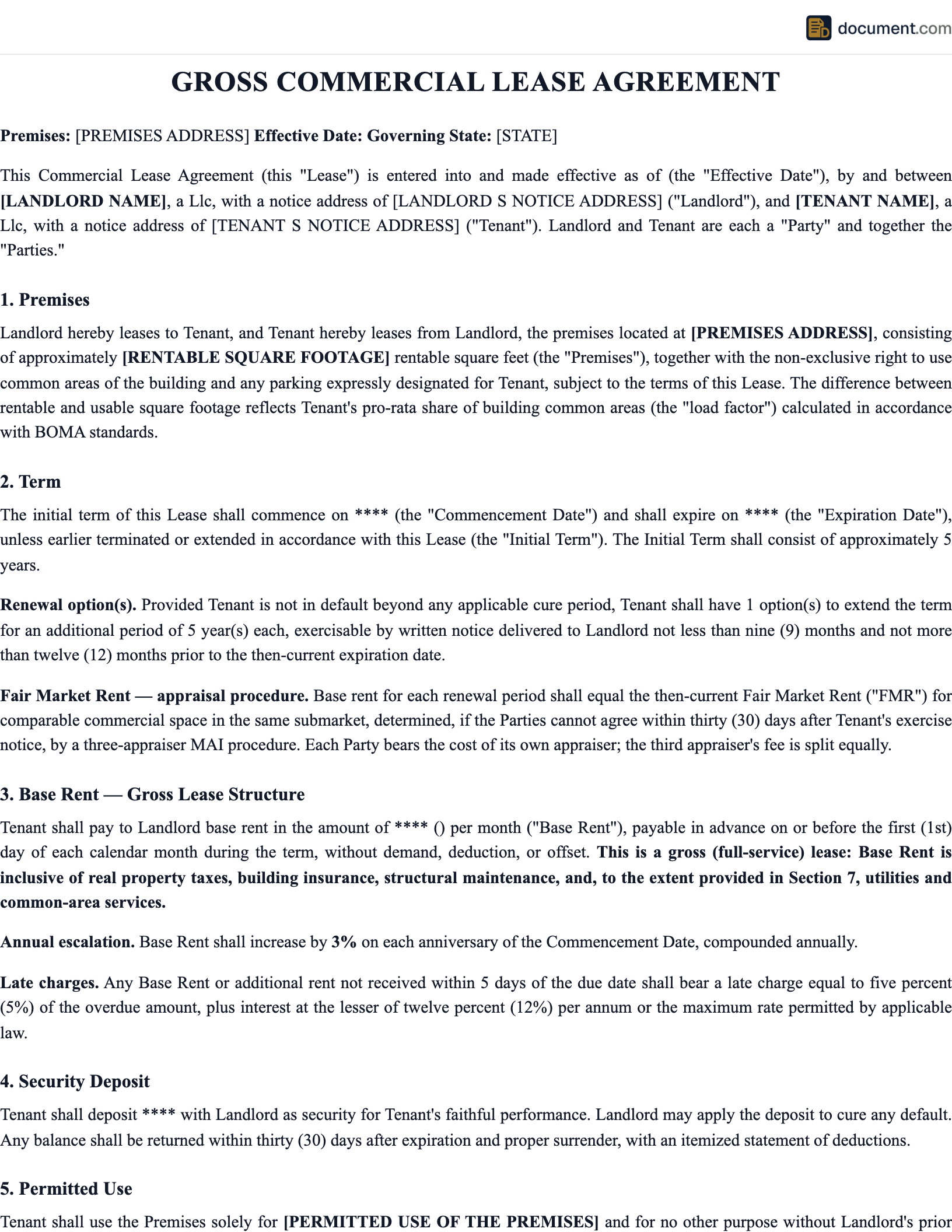



California Gross Commercial Lease Agreement Overview
California gross commercial leases are common in Class A and Class B office buildings throughout the state, particularly in LA, San Francisco, and San Diego. The landlord covers operating expenses within the base rent, which in California means absorbing some of the highest property taxes, insurance premiums, and maintenance costs in the country. Expense stop provisions are standard in California multi-year office leases and can substantially shift cost exposure over a 5 to 10 year term.
California's Proposition 13 affects how property tax is embedded in gross lease pricing, and the Unruh Civil Rights Act creates potential ADA compliance obligations that can generate disputes about whether accessibility upgrade costs are building operating expenses covered by the landlord or tenant-specific improvements the tenant must fund. Gross leases in California require careful drafting of the operating expense coverage scope to address these state-specific issues.
$15
Filing fee
Required
Notarization
0
Witnesses required
County
Filing office
California Requirements
California commercial lease law is contract-based with no special commercial tenant statutes governing gross lease terms. However, the state's Unruh Civil Rights Act, Cal/OSHA requirements, and Prop 13 property tax structure all create California-specific issues that affect how gross lease operating expense provisions should be drafted.
California Specific Note
In California gross leases, the expense stop base year interacts with Proposition 13 in an important way. If the building has not been sold recently, the landlord's property tax basis may be very low, making taxes a small component of the expense stop baseline. A future sale could reset the tax basis dramatically and push operating expenses well above the stop threshold, shifting substantial cost to the tenant. Tenants in long-term California gross leases should negotiate a cap on how much of any Prop 13 reassessment increase flows through the expense stop.
Key Provisions in a California Gross Lease
- Expense Coverage List: Specific itemization of which operating costs are included in gross rent, including property taxes, insurance, maintenance, and common area utilities
- Expense Stop and Base Year: Base year selection reflecting representative operating costs, with explicit exclusion of capital expenditures and Prop 13 reassessment spikes
- ADA and Unruh Act Allocation: Written statement of whether accessibility compliance costs are included in operating expenses or the landlord's separate capital responsibility
- Gross-Up Occupancy Floor: Confirmation of how the gross-up occupancy percentage is calculated and that it only applies to variable expense categories
- Cal/OSHA Maintenance Scope: Clarification of which building system compliance and safety upgrade costs are landlord responsibilities versus operating expenses passed through under the expense stop
How to File in California
California gross commercial leases require more diligence than similar structures in other states, given the state's property tax system and regulatory environment. Here is a practical sequence.
Review the Building's Operating Cost History and Tax Basis
Request two to three years of actual operating expense records plus the current property tax bill. Determine whether the property has been recently sold or is likely to be sold during the lease term. A post-sale Prop 13 reassessment could significantly increase the expense stop overage the tenant pays.
Negotiate California-Specific Expense Exclusions
Push for written exclusions for: Prop 13 reassessment increases triggered by ownership changes, seismic retrofit capital costs, ADA compliance structural upgrades, Cal/OSHA building system compliance costs, and any extraordinary insurance premium spikes. These are California-specific issues that standard national lease forms handle poorly.
Confirm Gross-Up Provision and Occupancy Floor
Review how the gross-up clause works and confirm the occupancy floor percentage used for calculations. Make sure the gross-up only applies to variable expenses, not fixed costs like property taxes and insurance that do not actually change with occupancy levels.
Have California Counsel Review the Lease
California gross commercial leases involve enough state-specific complexity, from Prop 13 to Unruh Act exposure, that attorney review by California-licensed commercial real estate counsel is strongly recommended for any meaningful multi-year commitment.
Execute and Retain Executed Copies
Both parties sign the final lease. Each party retains a fully executed original. California commercial leases do not require notarization to be enforceable between the parties, though some financing arrangements require a recorded memorandum of lease.
California Fees & Costs
California gross lease occupancy costs are among the highest in the US. Here is a breakdown of the main cost components tenants should budget for.
| Fee / Cost | Typical Amount |
|---|---|
| Base Gross Rent | Includes landlord's operating expenses; LA and SF Class A office gross rents among highest in the US |
| Expense Stop Overages (if any) | Tenant pays operating cost increases above base year stop; insurance and property tax post-sale spikes are common drivers in California |
| Separately Billed Utilities | If not included in gross rent; California electricity rates are above national averages, particularly in PG&E and SoCal Edison service areas |
| Attorney Review (strongly recommended) | $1,000 - $5,000+ for California gross commercial lease review by California-licensed commercial real estate counsel |
Sample California Gross Commercial Lease Agreement
Below is a preview of our California-specific template. Your customized document will include all fields and provisions required for filing in any California county.
GROSS COMMERCIAL LEASE AGREEMENT
STATE OF CALIFORNIA
Legal Document Template
LANDLORD
Name: [Full Legal Name]
Address: [Business Address]
Contact: [Phone/Email]
TENANT
Name: [Full Legal Name / Entity]
Address: [Current Address]
Tax ID: [EIN/SSN]
PREMISES
Address: [Property Address]
Suite: [Number]
Rentable SF: [Square Feet]
Usable SF: [Square Feet]
FINANCIAL TERMS
Base Rent: $[Amount]/month
Expense Stop: $[Amount]/SF
Security Deposit: $[Amount]
Escalation: [%]/year
California Gross Commercial Lease Agreement FAQ
Answers to common questions about filing a gross commercial lease agreement in California, including requirements, fees, and procedures.
Official California Resources
Use these official state resources to verify requirements, find your local filing office, and access government forms for California.
Related California Documents
Depending on your situation, you may need additional documents alongside your California gross commercial lease agreement.
Create your California Commercial Gross Lease Agreement in under 5 minutes.
Answer a few questions and download a California-compliant document, ready for the state agency.