
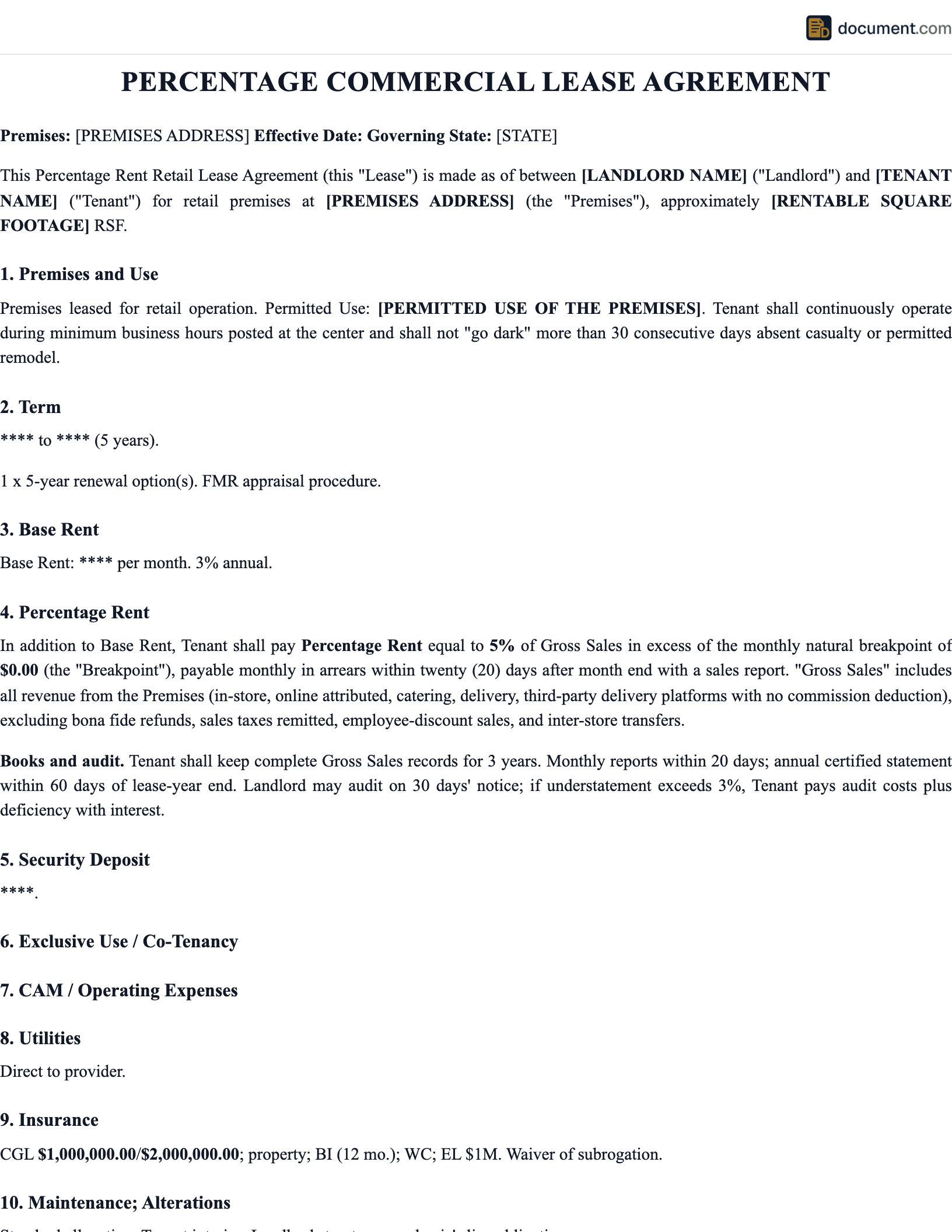



What Is a Percentage Lease Agreement?
A percentage lease agreement is a commercial lease structure in which the tenant pays a base rent plus a percentage of their gross sales revenue above a specified threshold, known as the breakpoint. This type of lease is most commonly used in retail settings, particularly shopping centers, malls, and high-traffic retail locations, where the landlord wants to participate in the tenant's success while providing a lower guaranteed base rent.
The percentage lease aligns the interests of landlord and tenant: the landlord is motivated to maintain an attractive property that drives customer traffic, and the tenant benefits from a lower base rent during slower periods. When the tenant's sales exceed the breakpoint, both parties benefit from the increased revenue. This structure is particularly common for restaurants, retail stores, and entertainment venues in shopping centers.
Critical elements of a percentage lease include the definition of gross sales (what counts and what is excluded), the breakpoint calculation method (natural or artificial), the percentage rate (typically 5-10% depending on the business type), sales reporting requirements, landlord audit rights, and exclusive use provisions that protect the tenant from direct competition within the same property.
Percentage lease negotiations require careful attention to the definition of gross sales, as this directly affects the amount of percentage rent owed. Common exclusions include sales tax collected, returns and allowances, employee discounts, gift card sales (counted when redeemed), and inter-company transfers. Both parties should have legal counsel review these definitions.
Percentage Lease Agreement Form Preview
Our percentage lease agreement form includes all the fields required for a valid document. Below is a preview of the key sections. Your customized document will be tailored to your state's specific requirements.
PERCENTAGE LEASE AGREEMENT
Legal Document Template
LANDLORD
Name: [Full Legal Name / Entity]
Property: [Shopping Center Name]
Address: [Property Address]
TENANT
Name: [Business Entity Name]
Trade Name: [DBA / Store Name]
Address: [Current Address]
Tax ID: [EIN]
PREMISES
Suite: [Number]
GLA: [Gross Leasable Area SF]
Use: [Permitted Retail Use]
Exclusive: [Product Category]
FINANCIAL TERMS
Base Rent: $[Amount]/month
Percentage Rate: [%]
Breakpoint: $[Amount]/year
CAM: $[Amount]/SF
Deposit: $[Amount]
Key Provisions
A percentage lease agreement requires several important provisions to be legally effective and protect all parties involved. Review each provision carefully.
Breakpoint Calculation
Define the breakpoint method: natural breakpoint (base rent divided by percentage rate) or artificial breakpoint (a negotiated dollar amount). The breakpoint determines when percentage rent kicks in.
Gross Sales Definition
Precisely define what constitutes gross sales, including inclusions and exclusions. Common exclusions include sales tax, returns, employee discounts, and online sales not fulfilled from the premises.
Reporting Requirements
Establish monthly and annual sales reporting obligations, report format, submission deadlines, certification requirements, and the point-of-sale systems or accounting standards to be used.
Audit Rights
Grant the landlord the right to audit tenant sales records, specify audit frequency, notice requirements, audit cost allocation, and the consequences of finding underreported sales.
Exclusive Use Clause
Protect the tenant from direct competition within the shopping center by restricting the landlord from leasing to competing businesses in the same product or service category.
Co-Tenancy Requirements
Include co-tenancy provisions that allow rent adjustments if anchor tenants leave or if occupancy drops below a specified percentage, protecting the tenant from reduced foot traffic.
When to Use A Percentage Lease Agreement
Understanding when to use a percentage lease agreement helps ensure you select the right document for your situation. Below are the most common use cases.
Retail in Shopping Centers
Retail stores in malls and shopping centers where foot traffic generated by the property directly impacts tenant sales, making percentage rent a natural alignment of interests.
Restaurant Tenants
Restaurant and food service operations in high-traffic locations where sales volume correlates with the quality of the location and the property's customer draw.
Entertainment Venues
Movie theaters, bowling alleys, arcades, and other entertainment businesses where patron volume is driven by the property's visibility and co-tenants.
Pop-Up and Seasonal Retail
Temporary retail operations where a lower base rent with percentage rent reduces the risk of testing a new concept or seasonal product line.
How to Draft A Percentage Lease Agreement
Drafting a percentage lease agreement involves several steps to ensure the document is legally sound, complete, and enforceable in your state. Follow these steps for a thorough and professional document.
Gather Required Information
Collect all necessary details including party names, addresses, property or subject matter descriptions, financial terms, and any state-specific requirements for your jurisdiction.
Select Your State
Choose your state to ensure the document includes all required provisions, disclosures, and formatting requirements mandated by your jurisdiction's laws.
Complete All Sections
Fill in every section of the document carefully, including all parties, terms, conditions, and any special provisions relevant to your specific situation.
Review and Sign
Review the completed document for accuracy, have all parties sign, and arrange for notarization or witnesses if required by your state. Keep copies for all parties.
Distribute and Store
Provide signed copies to all parties involved. Store the original in a secure location and file any required copies with the appropriate government offices or recording agencies.
Legal Requirements
Legal requirements for a percentage lease agreement vary by state. Each state has its own statutes governing this type of document, including specific provisions, disclosures, notice periods, and execution requirements. Selecting your state ensures your document meets all local requirements.
Important Legal Notice
This document template is provided for informational purposes and general guidance. While designed to comply with common legal requirements, laws vary by state and locality. For significant transactions or complex situations, consult with a licensed attorney in your jurisdiction to ensure full compliance with applicable laws.
- State Compliance: Each state has specific legal requirements that must be met for this document to be enforceable
- Proper Execution: The document must be properly signed by all parties, with notarization or witnesses as required by your state
- Required Disclosures: Many states mandate specific disclosures or addenda that must accompany this type of document
- Filing Requirements: Some states require filing or recording with government offices for the document to be fully effective
Percentage Lease by State
Select your state for a percentage lease agreement customized to your jurisdiction's specific legal requirements, disclosures, and formatting standards.
Sample Percentage Lease Agreement
Below is a preview of our percentage lease agreement template. Your customized document will include all fields and provisions required for your specific state and situation.
PERCENTAGE LEASE AGREEMENT
Template Preview
LANDLORD
Name: [Full Legal Name / Entity]
Property: [Shopping Center Name]
Address: [Property Address]
TENANT
Name: [Business Entity Name]
Trade Name: [DBA / Store Name]
Address: [Current Address]
Tax ID: [EIN]
PREMISES
Suite: [Number]
GLA: [Gross Leasable Area SF]
Use: [Permitted Retail Use]
Exclusive: [Product Category]
FINANCIAL TERMS
Base Rent: $[Amount]/month
Percentage Rate: [%]
Breakpoint: $[Amount]/year
CAM: $[Amount]/SF
Deposit: $[Amount]
Frequently Asked Questions
Common questions about creating and using a percentage lease agreement, including legal requirements, costs, and best practices.
Create your Commercial Percentage Lease Agreement in under 10 minutes.
Answer a few questions and download a compliant, attorney-drafted document ready for your state.