
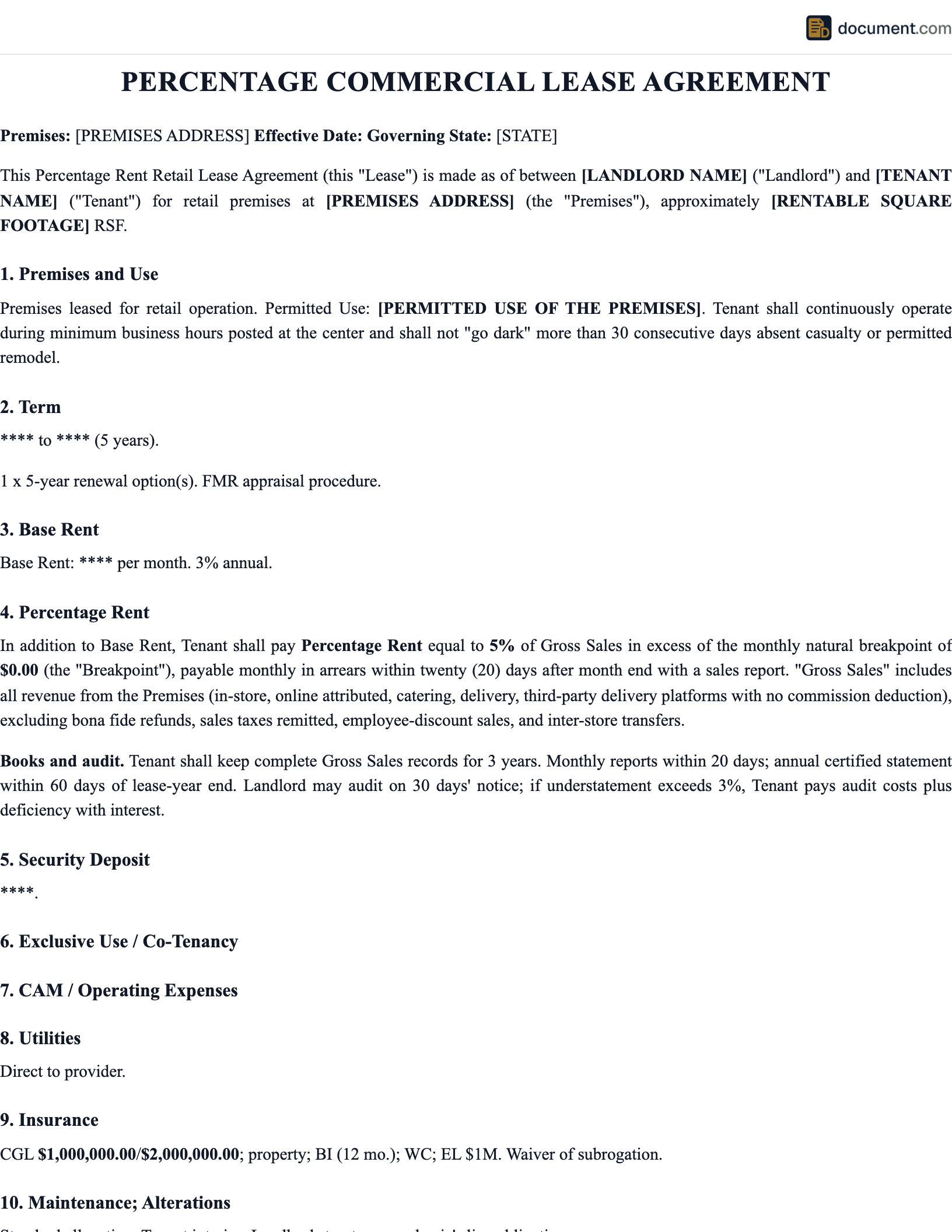



Massachusetts Percentage Lease Agreement Overview
A percentage lease combines a fixed base rent with a percentage of gross sales above a breakpoint. It is the standard structure in Massachusetts regional shopping centers, outlet malls, and high-traffic urban retail locations. The landlord collects base rent as a floor and shares in the tenant's upside when sales are strong. Properties like Natick Mall, Burlington Mall, and South Shore Plaza use percentage leases for most retail tenants, as do destination retail corridors in Boston and Cambridge.
Massachusetts commercial leases are governed by contract law. The percentage rent mechanics, gross sales definitions, breakpoint calculations, and reporting obligations must be written into the lease with precision. Massachusetts's 6.25 percent sales tax should be explicitly excluded from the gross sales definition so tenants are not paying percentage rent on tax revenue. The state's strong retail market, particularly in the Route 128 corridor and Boston metro, means landlords have some leverage on base rent levels but the percentage structure should be negotiated carefully.
$75
Filing fee
Required
Notarization
0
Witnesses required
Registry
Filing office
Massachusetts Requirements
Massachusetts percentage leases are governed by contract law. The parties must precisely define all terms that affect the percentage rent calculation. Ambiguity in the gross sales definition or breakpoint mechanics is the most common source of percentage lease disputes in Massachusetts retail real estate.
Massachusetts Specific Note
Massachusetts imposes a 6.25 percent sales tax on most retail goods. The gross sales definition in the lease must explicitly exclude sales taxes collected from customers. Without this exclusion, tenants effectively pay percentage rent on tax revenue that flows to the state. Massachusetts retail tenants should confirm this exclusion is written into the lease, not assumed.
Key Percentage Lease Provisions for Massachusetts
- Gross sales definition: Negotiate a gross sales definition that excludes sales taxes, employee discounts, returned merchandise, credit card processing fees, and sales from third-party departments. A broad landlord definition increases the percentage rent exposure significantly.
- Natural breakpoint: Push for a natural breakpoint (base rent divided by the percentage rate). This ensures no percentage rent is due until sales have effectively covered the full base rent. Artificial breakpoints set below natural levels mean percentage rent can trigger even in low-sales periods.
- Sales reporting obligations: The lease should specify the reporting period (monthly or annual), the format of gross sales reports, and the consequences for late or inaccurate reporting. Massachusetts retail tenants should retain POS records for the full audit window period.
- Audit rights: Both parties typically have audit rights in a Massachusetts percentage lease. Landlords audit tenant sales records; tenants audit CAM and operating expense reconciliations. The audit window, cost allocation, and dispute resolution process should be written into the lease.
- Co-tenancy and exclusivity: For Massachusetts shopping center locations, negotiate co-tenancy protections and exclusivity clauses. The strength of the co-tenancy provision depends on which anchor stores are named and what the occupancy threshold is for triggering rent reduction rights.
How to File in Massachusetts
Filing a percentage lease agreement in Massachusetts involves preparing the document, getting it properly executed, and filing it with the appropriate county office. Follow these steps.
Analyze the Location and Sales Projections
Before negotiating a Massachusetts percentage lease, research the property's foot traffic, co-tenancy composition, and comparable tenant sales per square foot in the center or corridor. Understanding realistic sales projections helps you evaluate whether the proposed base rent, percentage rate, and breakpoint are reasonable for your business model at that specific location.
Negotiate the Gross Sales Definition and Breakpoint
Push for a gross sales definition that excludes Massachusetts sales taxes, employee discounts, and returned merchandise. Negotiate for a natural breakpoint (base rent divided by the percentage rate). In Massachusetts shopping centers, tenants also commonly negotiate exclusions for online sales where the customer did not visit the store.
Address Co-Tenancy, Exclusivity, and Reporting Terms
Negotiate co-tenancy protections tied to specific anchor tenants for Massachusetts shopping center locations. Request exclusivity provisions appropriate to your retail category. Confirm sales reporting obligations, the frequency of percentage rent payments, and the audit rights that apply to both parties' obligations under the lease.
Have a Massachusetts Retail Lease Attorney Review
Boston-area attorneys familiar with retail lease market standards will identify percentage rent provisions that deviate from local practice and ensure the gross sales definition, breakpoint, and CAM provisions are fair. Given the complexity of Massachusetts percentage leases and the multi-year financial commitment, legal review is essential, not optional. Attorney rates typically run $300 to $600 per hour.
Execute the Lease and Establish Sales Tracking Systems
Sign the lease with all parties and retain executed copies. Set up point-of-sale or accounting systems that track gross sales in the format required by the lease for reporting purposes. Calendar monthly or annual percentage rent reporting deadlines and set up records retention for the full audit window specified in the lease.
Massachusetts Fees & Costs
Below is a breakdown of the typical costs associated with filing this document in Massachusetts. Actual fees may vary by county.
| Fee / Cost | Amount |
|---|---|
| Massachusetts Attorney (hourly) | $300 - $600 per hour |
| Base Rent (annual per sqft) | $30 - $80+/sqft (varies by center and market position) |
| Percentage Rate (above breakpoint) | 2% - 10% depending on retail category |
| CAM Charges (annual per sqft) | $8 - $20+/sqft in major Massachusetts shopping centers |
Sample Massachusetts Percentage Lease Agreement
Below is a preview of our Massachusetts-specific template. Your customized document will include all fields and provisions required for filing in any Massachusetts county.
PERCENTAGE LEASE AGREEMENT
STATE OF MASSACHUSETTS
Legal Document Template
LANDLORD
Name: [Full Legal Name / Entity]
Property: [Shopping Center Name]
Address: [Property Address]
TENANT
Name: [Business Entity Name]
Trade Name: [DBA / Store Name]
Address: [Current Address]
Tax ID: [EIN]
PREMISES
Suite: [Number]
GLA: [Gross Leasable Area SF]
Use: [Permitted Retail Use]
Exclusive: [Product Category]
FINANCIAL TERMS
Base Rent: $[Amount]/month
Percentage Rate: [%]
Breakpoint: $[Amount]/year
CAM: $[Amount]/SF
Deposit: $[Amount]
Massachusetts Percentage Lease Agreement FAQ
Answers to common questions about filing a percentage lease agreement in Massachusetts, including requirements, fees, and procedures.
Official Massachusetts Resources
Use these official state resources to verify requirements, find your local filing office, and access government forms for Massachusetts.
Related Massachusetts Documents
Depending on your situation, you may need additional documents alongside your Massachusetts percentage lease agreement.
Create your Massachusetts Commercial Percentage Lease Agreement in under 5 minutes.
Answer a few questions and download a Massachusetts-compliant document, ready for the state agency.