
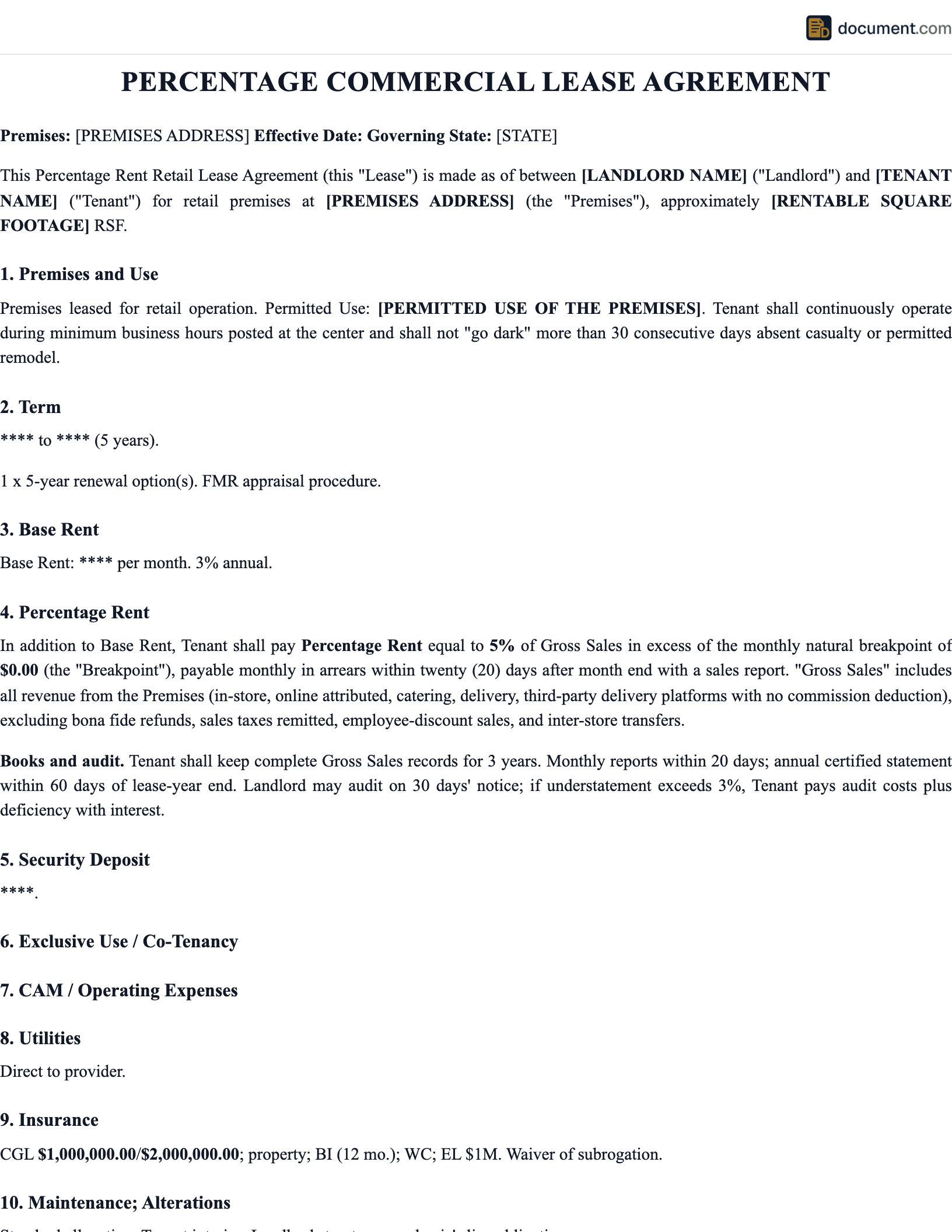



North Carolina Percentage Lease Agreement Overview
A percentage lease in North Carolina combines a guaranteed minimum rent with a variable component tied to the tenant's gross sales. The tenant pays whichever is higher: the base rent, or the percentage of sales calculated against the breakpoint. This structure lets the landlord participate when the retail location performs well, while giving the tenant a lower guaranteed floor during slower periods. Percentage leases are most common in shopping centers, malls, and power centers across North Carolina's major retail markets.
Charlotte, the Research Triangle, and Wilmington are the most active percentage lease markets in North Carolina, with strong regional mall activity and a mix of national and regional retail tenants. The specific structure of a North Carolina percentage lease, including the gross sales definition, breakpoint type, percentage rate, reporting schedule, and co-tenancy provisions, is entirely negotiated. North Carolina commercial lease law imposes no specific requirements on percentage leases beyond general contract enforceability principles.
$26
Filing fee
Required
Notarization
0
Witnesses required
Register
Filing office
North Carolina Percentage Lease Requirements
North Carolina percentage leases are governed by contract law. The lease document must address the gross sales definition, breakpoint calculation, percentage rate, reporting obligations, and audit rights explicitly because the courts will enforce what the parties agreed to in writing.
Gross Sales Definition Is the Central Negotiating Point
The definition of gross sales determines what revenue goes into the percentage rent calculation. Tenants want a narrow definition with broad exclusions. Landlords want a wide definition that captures all store revenue. For North Carolina retailers with online operations, the lease should explicitly address whether internet sales, curbside pickup, buy-online-pick-up-in-store transactions, and gift card redemptions are included or excluded. Ambiguous definitions generate disputes at annual reconciliation time.
Key Lease Provisions
- Gross Sales Definition: Define what is included and excluded with specificity; North Carolina courts will enforce the written definition even if the outcome is commercially unfavorable to one party
- Breakpoint and Percentage Rate: Specify whether the breakpoint is natural (base rent divided by rate) or artificial; confirm the percentage rate in writing by category if different types of sales carry different rates
- Sales Reporting Schedule: Define monthly reporting deadlines, annual certified statement requirements, and the format or supporting documentation the landlord can request
- Landlord Audit Rights: Include a defined audit window, typically 12 to 24 months after the annual statement, and a provision specifying who bears audit costs if an overcharge is discovered
- Co-Tenancy Clause: Retail tenants in North Carolina shopping centers should negotiate co-tenancy protection tied to anchor tenant occupancy, with specific rent reduction or termination remedies if the triggering condition is met
- Exclusivity Provision: Define the exclusive use category and the remedy for landlord violation; without express exclusivity rights, the landlord may lease to competing businesses in the same center
How to Execute a North Carolina Percentage Lease
Negotiating and signing a percentage lease in North Carolina involves a focused economic analysis before the lease terms are finalized. These steps reflect the practical process for retail tenants and landlords.
Project Sales and Model Percentage Rent
Before negotiating the breakpoint and rate, model percentage rent at multiple annual sales scenarios: expected, optimistic, and conservative. This tells you how much incremental rent you would owe at each sales level and whether the base rent is reasonable given that liability.
Negotiate the Gross Sales Definition and Exclusions
Work with your attorney to negotiate a complete gross sales definition that excludes sales tax, returns, employee discounts, gift card proceeds, and any online or omnichannel sales categories applicable to your business. For North Carolina retailers with significant internet revenue, the treatment of online sales is a material economic point.
Set the Breakpoint, Rate, and Co-Tenancy Terms
Agree on the breakpoint type (natural is more favorable to tenants), the percentage rate, and any co-tenancy protection that ties your rent obligation to anchor occupancy. Confirm that the NNN or modified gross pass-throughs that apply alongside the percentage lease are clearly defined.
Have a North Carolina Retail Lease Attorney Review
Percentage lease documentation in NC can be complex, particularly the reporting and audit provisions. An attorney experienced in North Carolina retail leasing can identify landlord-favorable definitions and help negotiate audit procedures that are balanced and workable for your accounting team.
Execute and Set Up Reporting Systems
After signing, set up your point-of-sale and accounting systems to capture and report gross sales as defined in the lease. Implement a monthly reporting process before the lease commencement date so you are not scrambling to comply with early reporting deadlines. Keep all sales records for the audit window period specified in the lease.
North Carolina Fees & Costs
Below is a breakdown of the typical costs associated with filing this document in North Carolina. Actual fees may vary by county.
| Fee / Cost | Amount |
|---|---|
| Minimum Base Rent | Charlotte and Triangle retail: $18-$35/sq ft NNN or modified gross; outlet and power center locations outside major metros: $12-$22/sq ft |
| Percentage Rent Rate | Typically 2%-8% of gross sales above breakpoint; rate depends on retail category and expected sales volume |
| NNN or Modified Gross Pass-Throughs | Most NC percentage leases are structured on a NNN or modified gross base; add $4-$10/sq ft for CAM, taxes, and insurance in shopping center deals |
| North Carolina Sales Tax (Exclusion) | NC state sales tax (4.75% plus local rates, typically 6.75%-7.5% combined) collected and remitted should be explicitly excluded from the gross sales definition |
| Attorney Review | $600-$2,500 for North Carolina retail percentage lease negotiation; co-tenancy and omnichannel provisions add complexity and time |
Sample North Carolina Percentage Lease Agreement
Below is a preview of our North Carolina-specific template. Your customized document will include all fields and provisions required for filing in any North Carolina county.
PERCENTAGE LEASE AGREEMENT
STATE OF NORTH CAROLINA
Legal Document Template
LANDLORD
Name: [Full Legal Name / Entity]
Property: [Shopping Center Name]
Address: [Property Address]
TENANT
Name: [Business Entity Name]
Trade Name: [DBA / Store Name]
Address: [Current Address]
Tax ID: [EIN]
PREMISES
Suite: [Number]
GLA: [Gross Leasable Area SF]
Use: [Permitted Retail Use]
Exclusive: [Product Category]
FINANCIAL TERMS
Base Rent: $[Amount]/month
Percentage Rate: [%]
Breakpoint: $[Amount]/year
CAM: $[Amount]/SF
Deposit: $[Amount]
North Carolina Percentage Lease Agreement FAQ
Answers to common questions about filing a percentage lease agreement in North Carolina, including requirements, fees, and procedures.
Official North Carolina Resources
Use these official state resources to verify requirements, find your local filing office, and access government forms for North Carolina.
Related North Carolina Documents
Depending on your situation, you may need additional documents alongside your North Carolina percentage lease agreement.
Create your North Carolina Commercial Percentage Lease Agreement in under 5 minutes.
Answer a few questions and download a North Carolina-compliant document, ready for the state agency.