
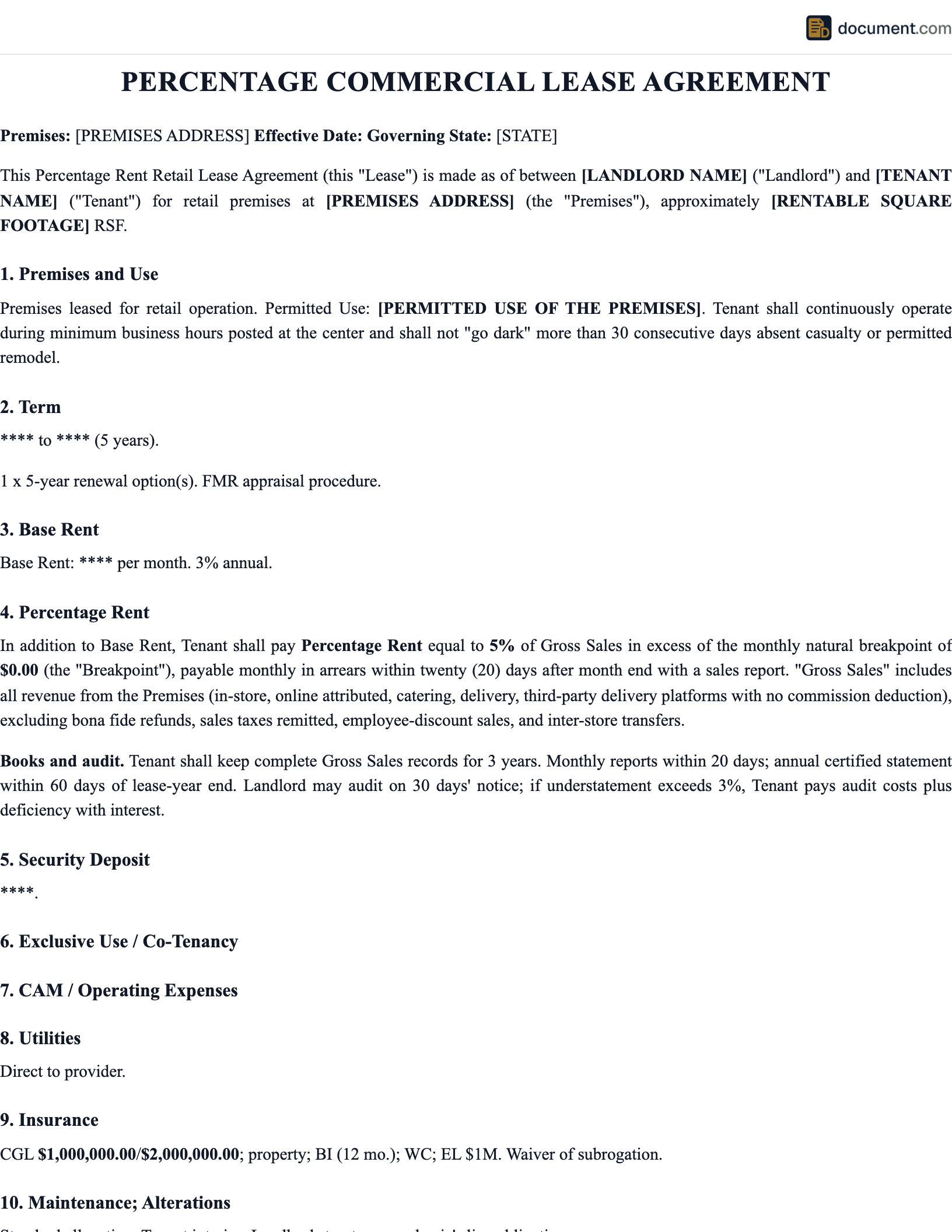



Oregon Percentage Lease Agreement Overview
Oregon percentage leases tie part of the tenant's rent to its business performance, with the tenant paying a base rent plus a percentage of gross sales above a defined breakpoint. The Portland metro area has a strong retail and food service market where percentage leases are particularly common. Oregon's unique position as a no-sales-tax state affects how gross sales are defined and calculated under these leases.
Oregon percentage leases are governed by contract law, with the gross sales definition, breakpoint structure, and audit rights determined entirely by negotiation. Oregon's Corporate Activity Tax adds to the total revenue-based cost burden for high-volume tenants, and the no-sales-tax environment affects the economics of consumer pricing and retail revenue that form the basis for percentage rent calculations.
$15
Filing fee
Required
Notarization
0
Witnesses required
County
Filing office
Oregon Requirements
Oregon percentage leases require careful drafting of the gross sales definition, breakpoint calculation, reporting obligations, and audit rights. There are no mandatory statutory requirements for these provisions in Oregon commercial leases, so their inclusion and scope depend on negotiation.
Oregon Specific Note
Oregon has no statewide sales tax, which simplifies gross sales definitions compared to sales-tax states. However, Oregon's Corporate Activity Tax applies to commercial activity above $1 million, and high-revenue retail tenants face CAT obligations on the same gross sales that drive percentage rent. Oregon percentage lease tenants should account for CAT in their overall occupancy cost analysis. Portland's commercial rent regulation discussions may also affect base rent escalation provisions in long-term leases.
Key Percentage Lease Provisions for Oregon
- Gross Sales Definition: Define included and excluded revenue; in Oregon, confirm whether any local excise taxes or charges should be excluded even without state sales tax
- Breakpoint Structure: Specify natural or artificial breakpoint; confirm percentage rate and calculation methodology
- Reporting Requirements: Set reporting frequency (monthly or quarterly) and confirm the format and records the tenant must maintain
- Audit Rights: Tenant right to audit percentage rent calculations within a defined window; specify cost allocation if no material discrepancy is found
- Co-Tenancy and Exclusivity: Anchor vacancy protections and restrictions on landlord leasing to direct competitors
How to File in Oregon
Oregon percentage leases are private contracts. The process below describes how to structure and execute one properly.
Negotiate Base Rent and Percentage Rate
Agree on the base rent, the percentage rate, and whether the breakpoint is natural or artificial; factor Oregon's CAT into total occupancy cost projections for high-volume retailers
Draft the Gross Sales Definition
Define all included and excluded revenue sources specific to your retail category; in Oregon, note that there is no statewide sales tax to exclude, but confirm whether any local charges apply
Negotiate Co-Tenancy and Exclusivity
If anchor traffic is important to your business, negotiate co-tenancy protections and exclusivity restrictions before signing; Portland-area retail centers typically have these provisions available to negotiate
Execute the Lease
Both parties sign the final lease; Oregon's statute of frauds requires leases over one year to be in writing; confirm authorized signatures for any entity parties
Set Up Gross Sales Reporting Systems
Establish point-of-sale and accounting systems that track gross sales in the format required by the lease; Oregon CAT reporting obligations and percentage rent reporting should be coordinated to avoid double record-keeping
Oregon Fees & Costs
Typical costs for an Oregon percentage lease transaction.
| Fee / Cost | Amount |
|---|---|
| Base Rent | Negotiated; typically lower than gross market rent to account for percentage rent upside |
| Percentage Rent | 3% to 10% of gross sales above the breakpoint depending on retail category |
| Oregon CAT (if applicable) | 0.57% on Oregon commercial activity above $1 million; applies to the same gross sales base as percentage rent |
| County Clerk Recording Fee (if recorded) | Approximately $56 base in Oregon; confirm with county |
| Attorney Review (recommended) | $400 - $900 for review of Oregon percentage lease given gross sales definition complexity |
Sample Oregon Percentage Lease Agreement
Below is a preview of our Oregon-specific template. Your customized document will include all fields and provisions required for filing in any Oregon county.
PERCENTAGE LEASE AGREEMENT
STATE OF OREGON
Legal Document Template
LANDLORD
Name: [Full Legal Name / Entity]
Property: [Shopping Center Name]
Address: [Property Address]
TENANT
Name: [Business Entity Name]
Trade Name: [DBA / Store Name]
Address: [Current Address]
Tax ID: [EIN]
PREMISES
Suite: [Number]
GLA: [Gross Leasable Area SF]
Use: [Permitted Retail Use]
Exclusive: [Product Category]
FINANCIAL TERMS
Base Rent: $[Amount]/month
Percentage Rate: [%]
Breakpoint: $[Amount]/year
CAM: $[Amount]/SF
Deposit: $[Amount]
Oregon Percentage Lease Agreement FAQ
Answers to common questions about filing an percentage lease agreement in Oregon, including requirements, fees, and procedures.
Official Oregon Resources
Use these official state resources to verify requirements, find your local filing office, and access government forms for Oregon.
Related Oregon Documents
Depending on your situation, you may need additional documents alongside your Oregon percentage lease agreement.
Create your Oregon Commercial Percentage Lease Agreement in under 5 minutes.
Answer a few questions and download a Oregon-compliant document, ready for the state agency.