



New Hampshire Percentage Lease Agreement Overview
A percentage lease in New Hampshire combines a base rent obligation with additional rent calculated as a percentage of the tenant's gross sales above a defined breakpoint. New Hampshire does not have dedicated commercial lease statutes governing percentage leases specifically, so the rights and obligations of both parties are determined almost entirely by the written lease agreement. Courts in New Hampshire apply standard contract principles when resolving disputes, and they will hold both parties to the exact terms they negotiated.
New Hampshire's retail markets concentrate along the Seacoast corridor around Portsmouth, in the southern Hillsborough County cities of Manchester and Nashua, and at major retail corridors in the Lakes Region. The state's lack of a sales tax makes it a destination for cross-border shopping from Massachusetts and Maine, which creates genuine upside for retail tenants and makes percentage rent provisions meaningful in high-traffic locations. Because gross sales definitions, breakpoints, and audit rights are all negotiated rather than statutory, both landlords and tenants benefit from careful drafting.
$26
Filing fee
Required
Notarization
0
Witnesses required
Register
Filing office
New Hampshire Percentage Lease Requirements
New Hampshire does not impose a statutory framework specific to percentage leases, so the lease document itself must cover every material term. A well-drafted agreement defines gross sales precisely, sets out breakpoint calculations, specifies reporting schedules, and addresses audit rights. Courts enforce what the parties wrote; gaps in the lease tend to favor the position that is less burdensome to enforce.
No Sales Tax in New Hampshire
New Hampshire collects no general sales tax. This simplifies the gross sales definition because there is no tax component to exclude. It also means tenant revenues in NH are generally higher in nominal terms relative to neighboring states, which can affect natural breakpoint negotiations. Cross-border shoppers from Massachusetts and Maine often drive higher per-store sales volumes at New Hampshire retail locations, particularly near state borders.
Key Lease Provisions
- Gross sales definition: Define what is included and excluded with specificity; New Hampshire has no sales tax exclusion to account for, but returns, employee sales, and gift card redemption rules all need drafting
- Breakpoint and percentage rate: State whether the breakpoint is natural or artificial, confirm the annual sales threshold, and specify the percentage rate clearly by tenant category
- Sales reporting obligations: Specify reporting frequency (monthly, quarterly, or annual), format, and whether an officer or CPA must certify the annual statement
- Audit rights: Define audit windows, record retention requirements, and who pays audit costs when a material discrepancy is found
- Co-tenancy provisions: Larger New Hampshire retail centers often include co-tenancy clauses tying percentage rent obligations to occupancy levels or anchor tenant status; confirm whether these apply to your location
How to Execute a New Hampshire Percentage Lease
Entering a percentage lease involves more diligence than a standard fixed-rent lease because both parties need reliable baseline data before committing to a structure that depends on tenant sales performance. Work through these steps before signing.
Research the Location's Sales Potential
Before negotiating percentage rent terms, gather traffic counts, co-tenant rosters, and any available sales data for the center or corridor. New Hampshire's no-sales-tax environment drives meaningful cross-border shopping, especially near the Massachusetts border in Nashua and Salem. That dynamic affects what breakpoint makes economic sense for your business.
Negotiate the Core Financial Terms
Settle on the base rent, percentage rate, and breakpoint structure. Confirm whether the breakpoint is natural or artificial. For co-tenancy concerns at Seacoast or Hillsborough County retail centers, negotiate the trigger conditions and remedy language in this phase before drafting begins.
Draft the Percentage Lease with NH-Specific Terms
Use a New Hampshire-compliant template that reflects the agreed-upon gross sales definition (without sales tax exclusions, since NH has no sales tax), breakpoint structure, reporting schedule, audit rights, and any co-tenancy provisions. Include governing law referencing New Hampshire and specify the appropriate superior court for any dispute arising in your county.
Execute the Agreement
Both parties sign. Commercial leases in New Hampshire do not require notarization to be binding between the parties, though notarization is required if you intend to record. Each party retains an original or complete copy. If either party is an entity, confirm that the signatory has corporate or LLC authority to bind the organization.
Establish Sales Reporting and Tracking Systems
Set up your point-of-sale tracking to capture gross sales as defined in the lease from day one of operations. Configure your bookkeeping system to produce reports in the format and on the schedule required. Maintain all supporting records for the period specified in the audit rights provision, typically two to three years after each lease year ends.
New Hampshire Percentage Lease Costs
Costs for a New Hampshire percentage lease include base rent, percentage rent above the breakpoint, and any applicable operating expense obligations depending on whether the lease is structured as a gross, modified gross, or NNN deal underneath the percentage component.
| Fee / Cost | Amount |
|---|---|
| Base Rent (Portsmouth Seacoast and Southern NH) | $18 to $38 per SF annually depending on location and format |
| Percentage Rent | 1 to 10% of gross sales above the natural or negotiated breakpoint; rate varies by retail category |
| Attorney Review and Lease Drafting | $1,000 to $3,500 depending on complexity; percentage leases require more drafting time than fixed-rent structures |
| Operating Expense Pass-Throughs (if applicable) | Property tax, insurance, and CAM pass-throughs if the deal has a NNN component; municipal property tax rates vary significantly by NH town |
| No Commercial Rent Tax | New Hampshire imposes no commercial rent tax and no state sales tax; percentage rent calculations are not affected by tax-related gross sales exclusions |
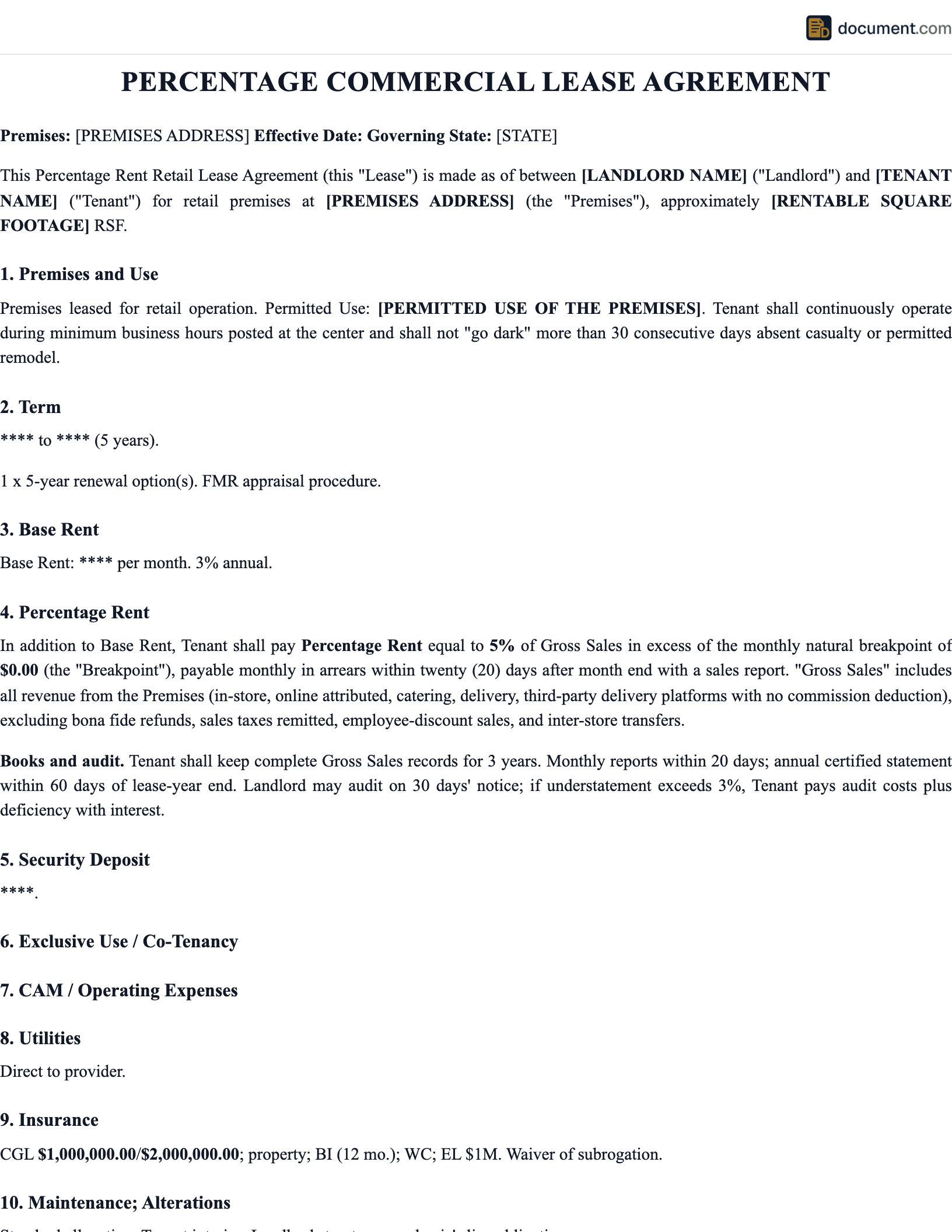
Sample New Hampshire Percentage Lease Agreement
Below is a preview of our New Hampshire-specific template. Your customized document will include all fields and provisions required for filing in any New Hampshire county.
PERCENTAGE LEASE AGREEMENT
STATE OF NEW HAMPSHIRE
Legal Document Template
LANDLORD
Name: [Full Legal Name / Entity]
Property: [Shopping Center Name]
Address: [Property Address]
TENANT
Name: [Business Entity Name]
Trade Name: [DBA / Store Name]
Address: [Current Address]
Tax ID: [EIN]
PREMISES
Suite: [Number]
GLA: [Gross Leasable Area SF]
Use: [Permitted Retail Use]
Exclusive: [Product Category]
FINANCIAL TERMS
Base Rent: $[Amount]/month
Percentage Rate: [%]
Breakpoint: $[Amount]/year
CAM: $[Amount]/SF
Deposit: $[Amount]
New Hampshire Percentage Lease Agreement FAQ
Answers to common questions about filing a percentage lease agreement in New Hampshire, including requirements, fees, and procedures.
Official New Hampshire Resources
Use these official state resources to verify requirements, find your local filing office, and access government forms for New Hampshire.
Related New Hampshire Documents
Depending on your situation, you may need additional documents alongside your New Hampshire percentage lease agreement.
Create your New Hampshire Commercial Percentage Lease Agreement in under 5 minutes.
Answer a few questions and download a New Hampshire-compliant document, ready for the state agency.