
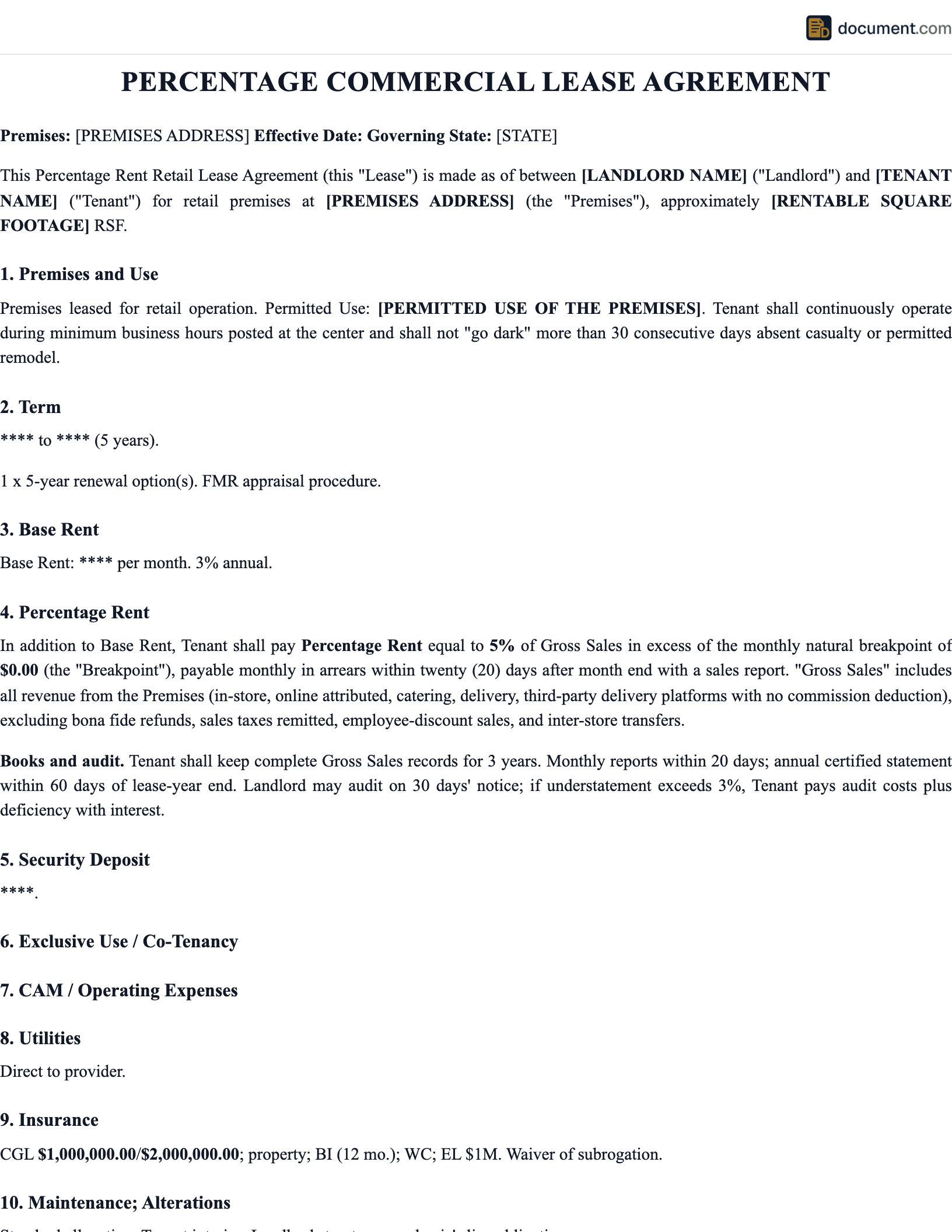



Delaware Percentage Lease Overview
A Delaware percentage lease combines a fixed monthly base rent with a variable percentage rent tied to the tenant's gross sales above a defined breakpoint. The landlord receives the base rent regardless of sales performance and earns additional rent only when the tenant's annual sales exceed the threshold. This structure is found in Delaware's retail shopping centers, including the major retail corridors in New Castle County and the resort-adjacent retail markets in Sussex County near Rehoboth Beach and Dewey Beach.
Delaware has no sales tax and no commercial rent tax, which means percentage rent payments are treated as straightforward income and do not trigger any state sales tax complications. Delaware's Court of Chancery applies strict contract interpretation standards, so the written gross sales definition and breakpoint calculation method control the financial outcome of the lease throughout the entire term. Imprecise gross sales language or an unspecified breakpoint type creates risk for the party that would benefit from a clearer definition.
$33
Filing fee
Required
Notarization
0
Witnesses required
Recorder
Filing office
Delaware Percentage Lease Requirements
Delaware's statute of frauds requires commercial leases for terms over one year to be in writing. There are no Delaware statutes specifically governing percentage lease mechanics, so the gross sales definition, breakpoint formula, reporting schedule, and audit rights are entirely determined by what the parties write in the lease.
Gross Sales Definition Is the Financial Foundation
Delaware courts interpret percentage lease gross sales definitions as written with no implied carve-outs or exclusions. Omnichannel Delaware retailers should be particularly careful to address how the definition handles online orders placed through the store's local system, warehouse fulfillments initiated at the store level, and cross-location returns credited to the Delaware location. Without explicit exclusion language, Delaware courts may include these revenue streams in the gross sales base, increasing the percentage rent obligation beyond what either party intended.
Key Delaware Percentage Lease Provisions
- Gross Sales Definition: Draft a specific inclusion list and a specific exclusion list; do not rely on general "all revenue" language
- Breakpoint Type and Calculation: Specify whether the breakpoint is natural (base rent divided by percentage rate) or artificial (a fixed negotiated amount), and document the exact threshold
- Sales Reporting Calendar: Set monthly report deadlines and an annual certified statement due date; specify the tenant's record retention period
- Audit Rights: Negotiate mutual audit rights with a defined window, documentation requirements, and cost-allocation provisions
- Co-Tenancy and Exclusivity: For Delaware shopping center locations dependent on anchor traffic, negotiate anchor co-tenancy protections and direct competition exclusivity provisions
How to Negotiate a Delaware Percentage Lease
Percentage lease negotiations in Delaware require upfront modeling and careful definition work because the gross sales definition and breakpoint mechanics will control the financial relationship for the full lease term. Work through these steps before entering negotiations.
Model the Breakpoint and Percentage Rate
Before negotiating, calculate the natural breakpoint for the proposed base rent and percentage rate and run projections at conservative, base-case, and optimistic annual sales levels. For a Delaware shopping center location, obtain market data on comparable sales per square foot for your retail category. Understanding the full range of potential percentage rent obligations before signing prevents unwelcome surprises in the first strong sales year.
Negotiate the Gross Sales Definition with Specific Exclusions
Draft a complete inclusion list and a complete exclusion list. Standard Delaware percentage lease exclusions include sales tax, refunds and exchanges, employee discounts, gift card proceeds at issuance, sales from catering or off-premises events, internet orders fulfilled from outside the Delaware location, and returns credited from other locations. Delaware courts will not imply any exclusion that is not written in the lease, so every exclusion the tenant cares about should appear in the document.
Secure Co-Tenancy and Exclusivity Protections
For Delaware shopping center locations where anchor tenants drive foot traffic, negotiate a co-tenancy clause specifying what constitutes a triggering vacancy, the period the landlord has to replace the anchor, and the rent reduction or termination right available to the tenant if the anchor is not replaced in time. Negotiate an exclusivity zone within the center prohibiting the landlord from leasing to a directly competing business during the lease term.
Establish Reporting and Audit Procedures
Set monthly reporting deadlines, an annual certified statement due date, and a minimum record retention period. Negotiate mutual audit rights with a defined window after the annual statement is delivered. Address cost allocation for the audit: if the audit reveals an underpayment of more than 3 to 5 percent, the tenant bears the audit cost; otherwise, the landlord pays. Delaware courts enforce these procedures as written.
Execute and Retain Originals
Both parties should execute the lease with original signatures. Delaware commercial leases do not require notarization to be binding between the parties, but filing with the county Recorder of Deeds (optional at $33 base) protects the tenant against subsequent encumbrances. Each party should retain a fully executed original of the lease and all exhibits for the full lease term plus three years.
Delaware Percentage Lease Transaction Costs
Percentage lease negotiations in Delaware require more attorney time than fixed-rent leases because of the gross sales definition complexity and the long-term financial implications of the breakpoint structure. Budget appropriately before entering negotiations.
| Fee / Cost | Amount |
|---|---|
| Attorney Review (Tenant) | $1,000 – $4,500 |
| Breakpoint and Sales Modeling | $500 – $1,500 (financial consultant) |
| Annual Sales Reporting Preparation | $300 – $800 (accountant) |
| Audit Defense (if landlord audits) | $1,000 – $4,000 depending on scope |
| Optional Recorder of Deeds Filing | $33 base (varies by county) |
Sample Delaware Percentage Lease Agreement
Below is a preview of our Delaware-specific template. Your customized document will include all fields and provisions required for filing in any Delaware county.
PERCENTAGE LEASE AGREEMENT
STATE OF DELAWARE
Legal Document Template
LANDLORD
Name: [Full Legal Name / Entity]
Property: [Shopping Center Name]
Address: [Property Address]
TENANT
Name: [Business Entity Name]
Trade Name: [DBA / Store Name]
Address: [Current Address]
Tax ID: [EIN]
PREMISES
Suite: [Number]
GLA: [Gross Leasable Area SF]
Use: [Permitted Retail Use]
Exclusive: [Product Category]
FINANCIAL TERMS
Base Rent: $[Amount]/month
Percentage Rate: [%]
Breakpoint: $[Amount]/year
CAM: $[Amount]/SF
Deposit: $[Amount]
Delaware Percentage Lease Agreement FAQ
Answers to common questions about filing a percentage lease agreement in Delaware, including requirements, fees, and procedures.
Official Delaware Resources
Use these official state resources to verify requirements, find your local filing office, and access government forms for Delaware.
Related Delaware Documents
Depending on your situation, you may need additional documents alongside your Delaware percentage lease agreement.
Create your Delaware Commercial Percentage Lease Agreement in under 5 minutes.
Answer a few questions and download a Delaware-compliant document, ready for the state agency.