
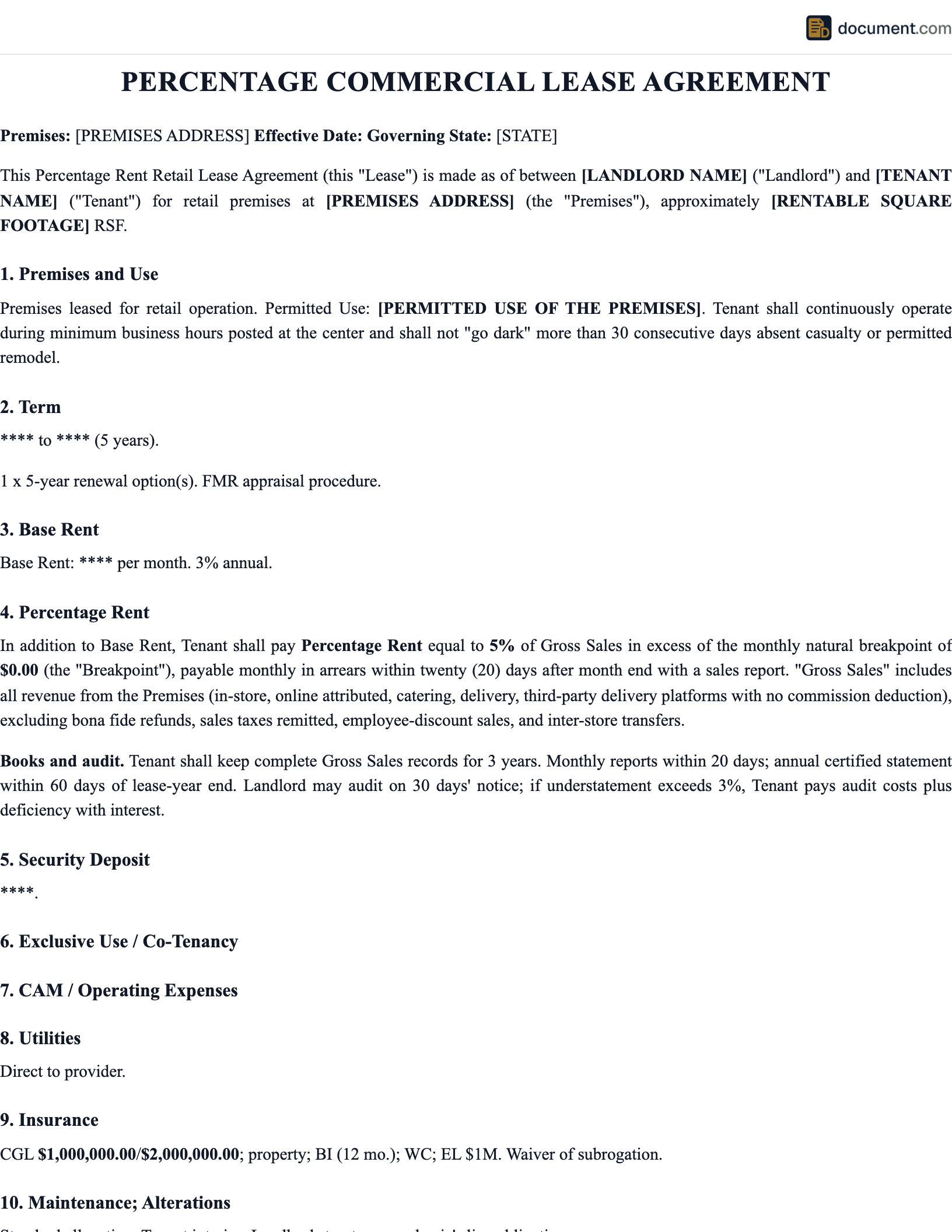



Connecticut Percentage Lease Overview
A percentage lease in Connecticut combines a fixed base rent with a variable additional rent tied to the tenant's gross sales performance. The tenant pays the base rent every month and owes percentage rent only when annual sales exceed the agreed breakpoint. This structure is found primarily in Connecticut's retail shopping centers, ranging from Fairfield County's upscale boutique districts to the large suburban shopping centers serving Hartford and New Haven.
Connecticut commercial leases are governed by contract law, so the gross sales definition, breakpoint calculation method, reporting schedule, and audit rights are whatever the parties negotiate and write into the lease. Connecticut has no commercial rent tax, so the percentage rent structure does not trigger any special state tax filing beyond the standard income tax treatment. The major Connecticut retail markets, particularly in Fairfield County, have seen strong sales volumes in luxury and specialty categories that make percentage leases attractive to landlords seeking upside from premium locations.
$60
Filing fee
Required
Notarization
2
Witnesses required
Town
Filing office
Connecticut Percentage Lease Requirements
Connecticut requires commercial leases over one year to be in writing. For percentage leases, the written gross sales definition is the financial foundation of the entire rent obligation. Courts will enforce the definition as written, so imprecise language favors whichever party benefits from the ambiguity.
Connecticut Sales Definition Warning
Connecticut retail tenants with omnichannel sales models should pay close attention to how the gross sales definition handles internet orders processed at the Connecticut store location but fulfilled from a central warehouse. Without explicit exclusion language, Connecticut courts may treat such revenue as part of store gross sales, creating a percentage rent obligation on sales where the store provided minimal operating value.
Key Connecticut Percentage Lease Provisions
- Gross Sales Definition: Include a specific list of inclusions and a specific list of exclusions; do not rely on general language
- Breakpoint Type: Specify whether the breakpoint is natural or artificial and document the exact annual sales threshold
- Sales Reporting Calendar: Set monthly reporting deadlines and the annual certified statement due date, and specify what records the tenant must retain
- Audit Rights: Establish mutual audit rights with defined windows and cost-allocation provisions for the audit process
- Co-Tenancy and Exclusivity: For Connecticut shopping center locations, negotiate anchor co-tenancy protections and direct competition exclusivity provisions
How to Negotiate a Connecticut Percentage Lease
Percentage leases require more upfront negotiation than standard fixed-rent commercial leases because the financial outcome depends heavily on the definitions and mechanics written into the document. These steps apply whether you are negotiating a Fairfield County shopping center deal or a Hartford area retail location.
Model the Breakpoint Before Signing
Calculate both a natural breakpoint (base rent divided by percentage rate) and any artificial breakpoint the landlord proposes. For a Fairfield County luxury retail location with high base rent, even a modest percentage rate can produce meaningful additional rent at realistic sales volumes. Run the numbers at conservative, moderate, and optimistic sales projections before agreeing to the structure.
Negotiate the Gross Sales Definition in Detail
Draft a specific inclusion list and a specific exclusion list. Standard exclusions include sales tax collected and remitted, returns and refunds, employee sales at discount, gift card sales at time of issuance, and internet orders fulfilled from outside Connecticut. For omnichannel retailers, include explicit language treating warehouse-fulfilled online orders as excluded regardless of where the order was placed.
Secure Co-Tenancy and Exclusivity Protections
Connecticut shopping center leases sometimes include co-tenancy clauses tied to anchor tenant occupancy. If the anchor vacates, the tenant's percentage rate or base rent should adjust downward to reflect reduced traffic. Negotiate a direct competition exclusivity zone within the shopping center to protect your gross sales base from cannibalizing tenants.
Establish Reporting and Audit Procedures
Set specific monthly reporting deadlines, an annual certified statement due date, and a record retention period of at least three years. Negotiate audit rights for both parties with a defined window after the annual statement is delivered. Address cost allocation: if a landlord audit reveals an underpayment of more than 3 to 5 percent, the tenant should bear the audit cost; otherwise, the landlord pays.
Execute and Retain Copies
Both landlord and tenant should execute the agreement with original signatures. Connecticut does not require notarization for a commercial lease to be enforceable between the parties, but recording with the town clerk (optional at $60 per document) protects the tenant against subsequent encumbrances. Each party should retain a fully executed original and keep it with the tenant's sales records for the full lease term plus three years.
Connecticut Percentage Lease Costs
Percentage lease negotiations in Connecticut, particularly in Fairfield County, typically involve more attorney time than standard fixed-rent deals because of the complexity of the gross sales definition and breakpoint mechanics. Budget accordingly before entering negotiations.
| Fee / Cost | Amount |
|---|---|
| Attorney Review (Tenant) | $1,000 – $5,000 (higher end for Fairfield County deals) |
| Breakpoint Modeling and Analysis | $500 – $1,500 (financial or retail consultant) |
| Annual Sales Reporting and Reconciliation | $300 – $800 (accountant preparation) |
| Audit Defense (if landlord audits) | $1,000 – $4,000 depending on scope |
| Optional Town Clerk Recording | $60 first page |
Sample Connecticut Percentage Lease Agreement
Below is a preview of our Connecticut-specific template. Your customized document will include all fields and provisions required for filing in any Connecticut county.
PERCENTAGE LEASE AGREEMENT
STATE OF CONNECTICUT
Legal Document Template
LANDLORD
Name: [Full Legal Name / Entity]
Property: [Shopping Center Name]
Address: [Property Address]
TENANT
Name: [Business Entity Name]
Trade Name: [DBA / Store Name]
Address: [Current Address]
Tax ID: [EIN]
PREMISES
Suite: [Number]
GLA: [Gross Leasable Area SF]
Use: [Permitted Retail Use]
Exclusive: [Product Category]
FINANCIAL TERMS
Base Rent: $[Amount]/month
Percentage Rate: [%]
Breakpoint: $[Amount]/year
CAM: $[Amount]/SF
Deposit: $[Amount]
Connecticut Percentage Lease Agreement FAQ
Answers to common questions about filing a percentage lease agreement in Connecticut, including requirements, fees, and procedures.
Official Connecticut Resources
Use these official state resources to verify requirements, find your local filing office, and access government forms for Connecticut.
Related Connecticut Documents
Depending on your situation, you may need additional documents alongside your Connecticut percentage lease agreement.
Create your Connecticut Commercial Percentage Lease Agreement in under 5 minutes.
Answer a few questions and download a Connecticut-compliant document, ready for the state agency.