
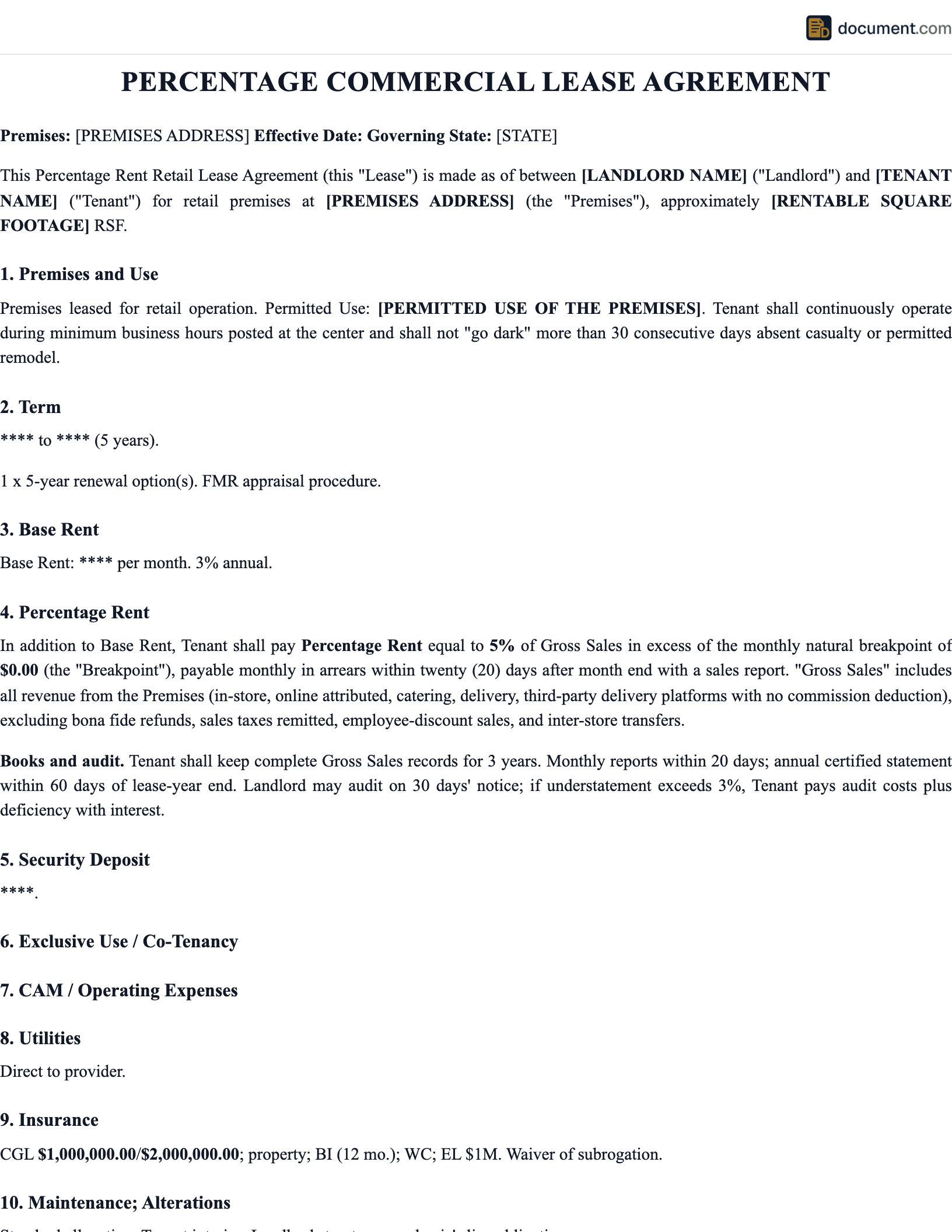



Vermont Percentage Lease Agreement Overview
A Vermont percentage lease combines a fixed base rent with variable percentage rent tied to the tenant's gross sales above a defined breakpoint. This structure is most common in Vermont's multi-tenant retail centers, including Burlington's Church Street Marketplace corridor, South Burlington's Williston Road retail strip, and the regional shopping center anchors in Chittenden County. Vermont does not have a specific percentage lease statute, so the document is entirely governed by contract law and the terms the parties negotiate.
Vermont's retail market is small by national standards, with Burlington as the primary commercial hub and secondary markets in Montpelier, Rutland, and St. Johnsbury. The state's seasonal tourism economy, including ski season, fall foliage, and summer recreation, creates concentrated retail demand in resort communities and along the Route 2 and Interstate 89 corridors. Vermont imposes no commercial rent tax, but its 6 percent state sales tax and 9 percent meals and rooms tax must be excluded from the gross sales definition in any percentage lease.
6%
State sales tax (exclude from gross sales)
None
State rent tax
Contract
Governing law
Seasonal
Ski and tourism market
Vermont Requirements
Vermont imposes no special statutory requirements on commercial percentage leases. The structure, definitions, and reporting obligations are all a matter of negotiation. The following provisions are essential for a well-functioning Vermont percentage lease.
Vermont Sales Tax and Meals Tax Exclusion
Vermont's 6 percent state sales tax and 9 percent meals and rooms tax must be expressly excluded from the gross sales definition. Failure to exclude these amounts means the tenant would pay percentage rent on money collected for the state, significantly overstating the tenant's actual revenue. Vermont food service tenants in Burlington's Church Street and resort communities face the largest exposure because of the high meals and rooms tax rate.
Key Provisions for Vermont Percentage Leases
- Gross Sales Definition: Exclude Vermont state sales tax (6%), meals and rooms tax (9%), returns and exchanges, gift card sales until redemption, and specify whether e-commerce sales from the leased premises are included
- Breakpoint Structure: Specify whether natural or artificial breakpoint; Vermont ski and resort community tenants should consider monthly breakpoints given the seasonally concentrated revenue pattern
- Percentage Rate: Negotiate by retail category; food service in Burlington typically runs 6 to 8 percent while specialty retail is 5 to 6 percent; confirm the rate applies only above the breakpoint, not to all sales
- Sales Reporting Schedule: Monthly or quarterly reports with annual reconciliation; Vermont landlords often align reporting with Vermont sales tax filing periods for easy cross-reference
- Audit Rights: Landlord right to inspect sales records and Vermont sales tax returns, typically within 12 to 24 months after annual reconciliation delivery, with tenant reimbursement of audit costs if underreporting exceeds a defined threshold
- Co-Tenancy Clause: Vermont shopping centers are small and anchor departures significantly affect traffic; negotiate a co-tenancy provision reducing base rent or allowing early termination if an anchor tenant closes or the occupancy rate falls below a threshold
How to Use a Vermont Percentage Lease
Vermont percentage leases require careful drafting and operational compliance. These steps cover the key decision points from negotiation through lease administration for Vermont retail tenants and landlords.
Negotiate the Gross Sales Definition and Vermont Tax Exclusions
Define gross sales to expressly exclude Vermont state sales tax and the meals and rooms tax before negotiating rates or breakpoints. Agree on how online and omnichannel sales are handled. Vermont's smaller retail market means the gross sales definition disputes can significantly affect the economics of the deal.
Set the Breakpoint and Percentage Rate
Negotiate whether to use a natural or artificial breakpoint. Vermont ski and resort community tenants should discuss monthly breakpoints given the concentration of sales in peak season months. Confirm the percentage rate by retail category and verify it applies only to sales above the breakpoint, not to all gross sales.
Confirm Reporting, Audit Rights, and Co-Tenancy
Agree on the sales reporting schedule aligned with Vermont sales tax filing periods. Negotiate audit rights with a reasonable lookback window and cost-shifting provision. For Vermont shopping center tenants, include a co-tenancy clause in case an anchor tenant closes or occupancy falls.
Execute the Lease
Vermont does not require notarization between the parties for a commercial lease to be enforceable, but notarization is needed if the lease will be recorded at the Vermont town land records office. Ensure authorized representatives of both parties sign and that all parties receive fully executed copies.
Configure Point-of-Sale Systems for Vermont Tax Compliance
Set up your POS or accounting system to track gross sales separately from Vermont sales tax and meals tax collections. Vermont's meals and rooms tax requires a specific line item that should map directly to your lease's exclusion definition. Accurate records are essential for annual reconciliation and any landlord audit.
Vermont Fees and Costs
Vermont percentage lease costs include fixed base rent, variable percentage rent tied to gross sales, and applicable taxes. Vermont does not impose a commercial rent tax, keeping ongoing costs relatively straightforward.
| Cost Item | Typical Amount or Note |
|---|---|
| Base Rent | Fixed monthly payment; Burlington retail ranges from $20 to $40 per square foot annually depending on location and co-tenancy |
| Percentage Rent | Typically 2 to 8 percent of gross sales above the breakpoint; rate varies by retail category; no percentage rent owed until breakpoint is exceeded |
| Vermont Sales Tax on Retail | 6 percent state sales tax collected from customers and remitted to Vermont; must be excluded from gross sales definition in the lease |
| Vermont Meals and Rooms Tax | 9 percent on prepared food and lodging; food service tenants must exclude this from gross sales to avoid paying percentage rent on tax collections |
| State Commercial Rent Tax | None; Vermont does not impose a tax on commercial rent payments |
| Attorney Review | $500 to $1,500 typical for Vermont commercial retail lease review; recommended given the complexity of gross sales definitions and breakpoint structures |
Sample Vermont Percentage Lease Agreement
Below is a preview of our Vermont-specific template. Your customized document will include all fields and provisions required for filing in any Vermont county.
PERCENTAGE LEASE AGREEMENT
STATE OF VERMONT
Legal Document Template
LANDLORD
Name: [Full Legal Name / Entity]
Property: [Shopping Center Name]
Address: [Property Address]
TENANT
Name: [Business Entity Name]
Trade Name: [DBA / Store Name]
Address: [Current Address]
Tax ID: [EIN]
PREMISES
Suite: [Number]
GLA: [Gross Leasable Area SF]
Use: [Permitted Retail Use]
Exclusive: [Product Category]
FINANCIAL TERMS
Base Rent: $[Amount]/month
Percentage Rate: [%]
Breakpoint: $[Amount]/year
CAM: $[Amount]/SF
Deposit: $[Amount]
Vermont Percentage Lease Agreement FAQ
Answers to common questions about filing a percentage lease agreement in Vermont, including requirements, fees, and procedures.
Official Vermont Resources
These Vermont state resources provide information on sales tax, business registration, and commercial real estate for percentage lease participants.
Vermont Department of Taxes: Sales and Use Tax
Sales tax rates and meals and rooms tax information
Vermont Landlord-Tenant Law: Title 9, Chapter 137
Vermont commercial lease statutes and landlord-tenant provisions
Vermont Secretary of State: Business Registration
Entity registration and good standing verification for Vermont businesses
Vermont Agency of Commerce: Business Resources
Vermont economic development and business permitting guidance
Related Vermont Commercial Lease Documents
Vermont retail transactions often involve additional documents alongside the percentage lease, including lease amendments, guaranty agreements, and related commercial lease types.
Create your Vermont Commercial Percentage Lease Agreement in under 5 minutes.
Answer a few questions and download a Vermont-compliant document, ready for the state agency.