
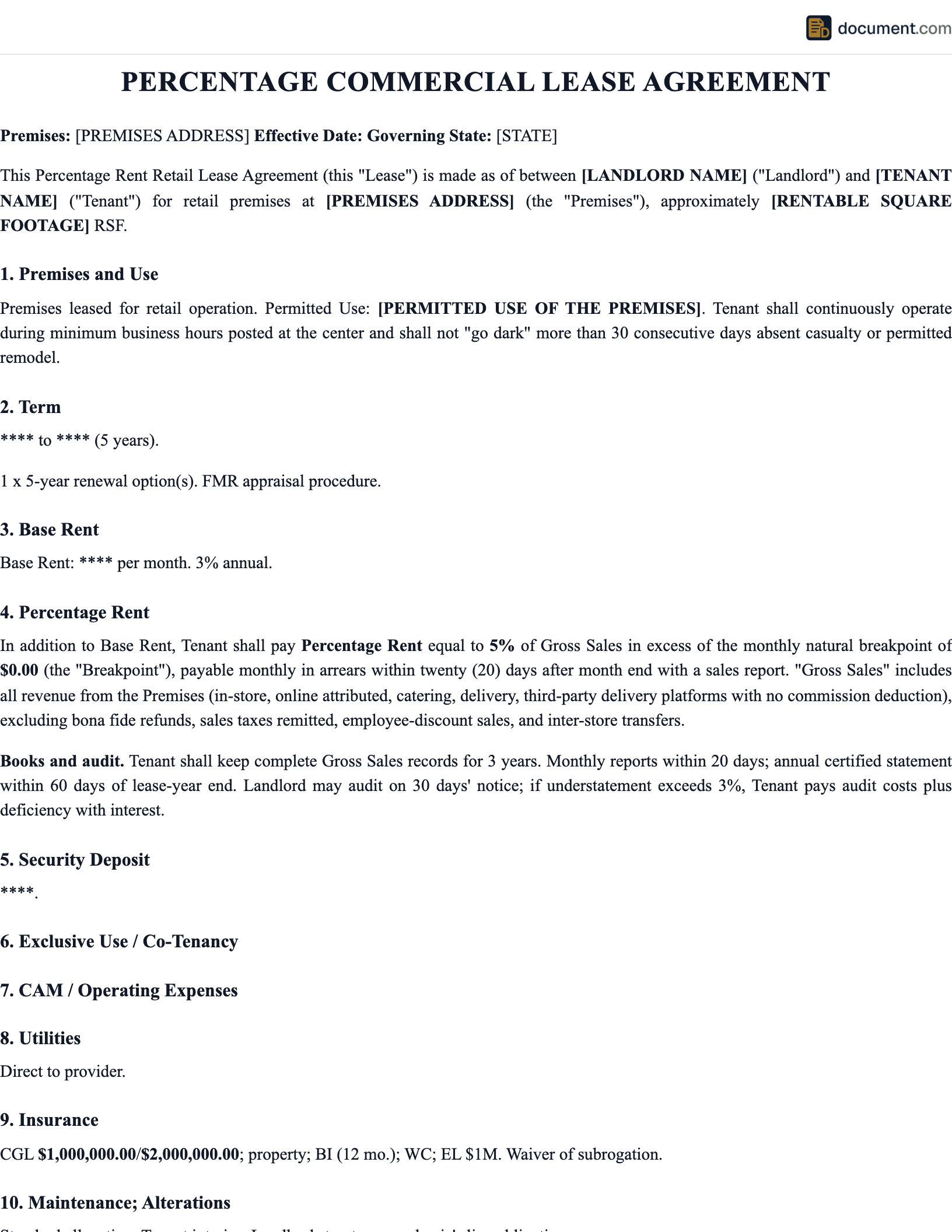



Ohio Percentage Lease Agreement Overview
A percentage lease is a commercial lease structure in which the tenant pays a minimum base rent plus additional rent equal to a defined percentage of gross sales above a calculated breakpoint. Ohio is a retail-active state with three large metro markets in Columbus, Cleveland, and Cincinnati, along with regional markets in Dayton, Toledo, Akron, and Canton where percentage lease structures are used in grocery-anchored centers, lifestyle properties, and restaurant-heavy mixed-use developments. Percentage leases allow landlords to share in the commercial success of high-performing tenants while giving struggling tenants some relief through the minimum base rent floor.
Ohio governs percentage leases entirely through contract. No state statute sets a default gross sales definition, percentage rate, or breakpoint formula. Every material economic term, including what counts as gross sales, which revenue categories are excluded, how the breakpoint is calculated, and what audit rights each party holds, must be negotiated and documented in the lease. Ohio courts enforce commercial lease terms as written, which means vague or missing provisions tend to be resolved in costly litigation rather than by statutory default rules.
1%-8%
Typical percentage rate
Contract
Governs all terms
Monthly
Sales reporting typical
3 Cities
Columbus, Cleveland, Cincinnati
Ohio Percentage Lease Requirements
Ohio percentage leases are governed by contract law with no statutory defaults for any substantive term. The provisions below represent the key commercial issues that must be addressed before execution to protect both landlords and tenants throughout the lease term.
Gross Sales Definition Is the Central Negotiating Point
In Ohio percentage leases, the gross sales definition determines every percentage rent calculation made over the entire lease term. Ohio courts enforce commercial lease definitions as written, so an imprecise or incomplete definition will not be corrected by a judge. Tenants with omnichannel sales, loyalty programs, or gift card revenue should negotiate explicit treatment of each revenue category before signing.
Key Lease Provisions to Address
- Gross Sales Definition: Define all included revenue categories and all exclusions; address Ohio sales tax collected and remitted, returns and allowances, employee discounts, online orders, and delivery charges
- Breakpoint and Rate: Specify whether the breakpoint is natural or artificial, state the exact calculation method, and confirm whether the rate varies by sales tier or is a flat percentage above the breakpoint
- Sales Reporting: Set the reporting frequency, submission deadline, and form of the annual certified reconciliation; define what constitutes adequate documentation for audit purposes
- Audit Rights: Define who may audit, how much advance notice is required, how long audit rights survive the lease year end, who bears the audit cost, and what happens when an audit reveals material underreporting
- Co-Tenancy Clause: Name specific anchor tenants whose departure triggers relief, define the occupancy threshold for co-tenancy failure, and set the remedy including whether the tenant gets a rent reduction, a termination right, or both
- Exclusivity Provision: For category-specific retail concepts, define the protected category clearly, apply it to all tenant types in the center, and include a meaningful remedy for violation
How to Negotiate an Ohio Percentage Lease
A percentage lease negotiation in Ohio requires advance preparation by both parties. Here is a practical sequence for getting it right.
Project Sales and Model the Breakpoint
Tenants should build a detailed sales projection for the Ohio location before entering negotiations. Calculate the natural breakpoint at the proposed base rent and rate, then model percentage rent exposure at several sales levels to understand the total occupancy cost in good and bad scenarios. Ohio landlords with existing comparable tenants should share aggregated productivity data to support their breakpoint proposals.
Negotiate the Gross Sales Definition and Exclusions
Work through each revenue category the tenant generates from or attributable to the Ohio location. Ohio sales tax (5.75% state rate plus local options) must be excluded. Online orders fulfilled from store inventory, gift card sales versus redemptions, loyalty reward program offsets, and employee discounts should each be addressed explicitly. Ohio retail tenants with strong e-commerce operations should negotiate a specific definition of what constitutes an in-store sale versus a digital sale.
Set the Breakpoint, Rate, Co-Tenancy, and Exclusivity Terms
Confirm whether the breakpoint is natural or artificial and document the calculation in the lease body. Agree on the percentage rate. Ohio shopping center tenants should push for co-tenancy protection naming specific anchor tenants and for exclusivity protection covering their retail category. Both provisions should include remedies that give the tenant meaningful relief rather than merely a right to complain.
Have an Ohio Retail Lease Attorney Review the Draft
A Columbus, Cleveland, or Cincinnati commercial real estate attorney with retail lease experience should review the full lease, not just the economic terms. Pay particular attention to the definition mechanics, the default and cure structure, any radius restriction or exclusivity obligations on the tenant, and the renewal option language. Attorney fees for Ohio retail lease review typically run $600 to $2,500 depending on lease complexity.
Execute and Set Up Reporting Systems
Both parties sign. The tenant should immediately configure point-of-sale and accounting systems to track gross sales using exactly the definition in the signed lease. Set calendar reminders for monthly or quarterly reporting deadlines and for the annual certified statement due date. Keep all supporting records for the full audit window, typically three to four years.
Ohio Percentage Lease Costs
Cost ranges below reflect typical Ohio percentage lease transactions in Columbus, Cleveland, and Cincinnati shopping centers and mixed-use developments. Actual amounts depend on submarket, property class, tenant credit, and negotiated terms.
| Fee / Cost | Amount |
|---|---|
| Minimum Base Rent (Columbus lifestyle / power center) | $20 - $40 per sq ft annually |
| Minimum Base Rent (Cleveland / Cincinnati retail) | $16 - $32 per sq ft annually |
| Percentage Rent Rate | 1% - 8% of gross sales above breakpoint (by retail category) |
| NNN or Modified Gross Pass-Throughs | $4 - $10 per sq ft annually |
| Ohio Sales Tax (excluded from gross sales) | 5.75% state + local option; confirm exclusion in lease definition |
| Attorney Review | $600 - $2,500 |
Sample Ohio Percentage Lease Agreement
Below is a preview of our Ohio-specific template. Your customized document will include all fields and provisions required for filing in any Ohio county.
PERCENTAGE LEASE AGREEMENT
STATE OF OHIO
Legal Document Template
LANDLORD
Name: [Full Legal Name / Entity]
Property: [Shopping Center Name]
Address: [Property Address]
TENANT
Name: [Business Entity Name]
Trade Name: [DBA / Store Name]
Address: [Current Address]
Tax ID: [EIN]
PREMISES
Suite: [Number]
GLA: [Gross Leasable Area SF]
Use: [Permitted Retail Use]
Exclusive: [Product Category]
FINANCIAL TERMS
Base Rent: $[Amount]/month
Percentage Rate: [%]
Breakpoint: $[Amount]/year
CAM: $[Amount]/SF
Deposit: $[Amount]
Ohio Percentage Lease Agreement FAQ
Answers to common questions about filing an percentage lease agreement in Ohio, including requirements, fees, and procedures.
Official Ohio Resources
Use these official state resources to verify requirements, find your local filing office, and access government forms for Ohio.
Related Ohio Documents
Depending on your situation, you may need additional documents alongside your Ohio percentage lease agreement.
Create your Ohio Commercial Percentage Lease Agreement in under 5 minutes.
Answer a few questions and download a Ohio-compliant document, ready for the state agency.