
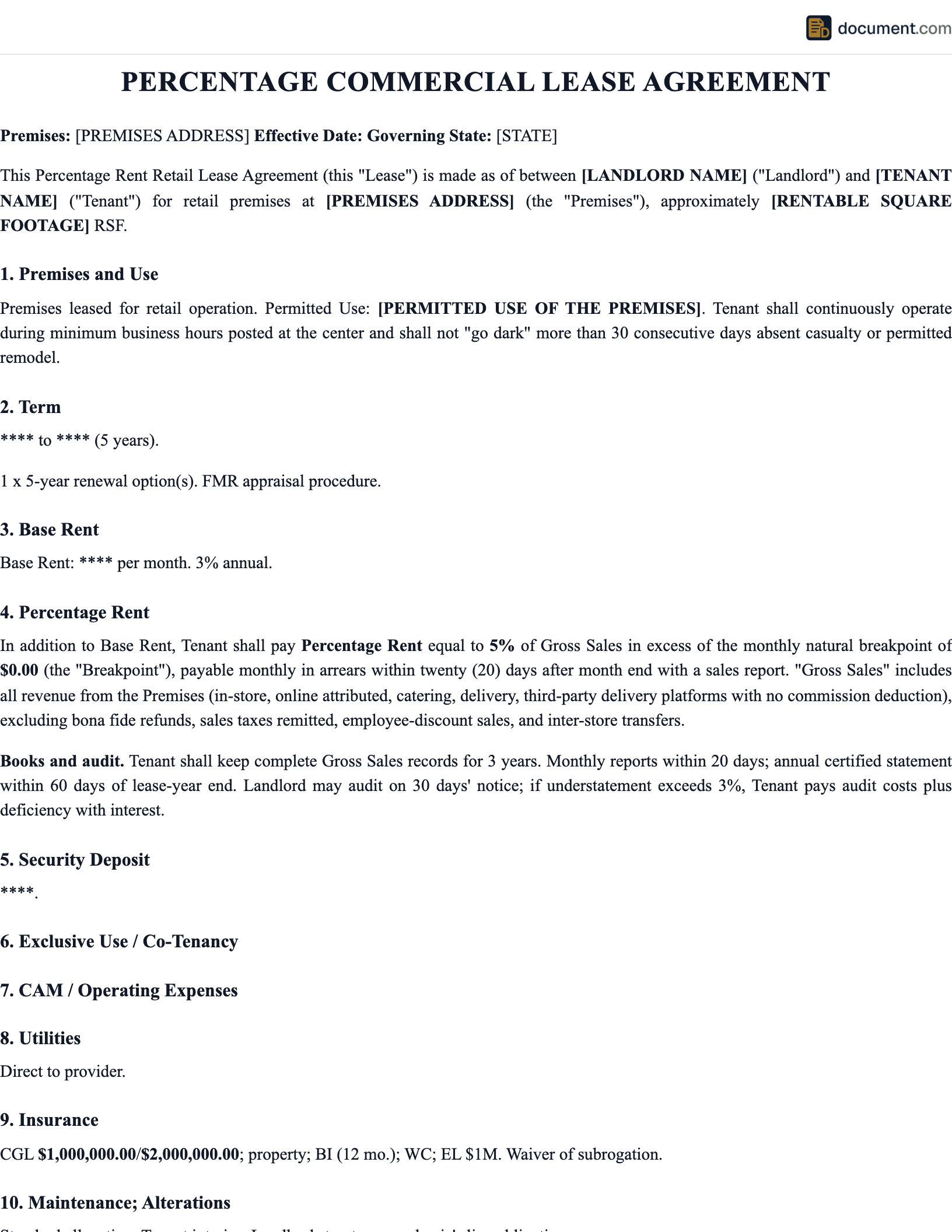



California Percentage Lease Agreement Overview
A California commercial percentage lease pairs a fixed base rent with percentage rent on gross sales above a breakpoint. California is home to some of the country's most active retail real estate markets, including the Los Angeles metro, San Francisco Bay Area, San Diego, and the Inland Empire. Percentage leases are standard in California mall, lifestyle center, and strip retail settings. California contract law governs the structure, and all provisions must be written into the document precisely.
California's growing omnichannel retail environment has made the gross sales definition more complex than in previous decades. Whether buy-online-pick-up-in-store transactions, in-store returns of online orders, and tablet-based orders processed in-store count toward gross sales are points of active negotiation in California retail leases. Parties should address these issues specifically rather than relying on a general definition. California also has varied local tax rates that should be addressed in the sales tax exclusion language.
$15
Filing fee
Required
Notarization
0
Witnesses required
County
Filing office
California Requirements
California has specific requirements for this type of legal document. Meeting these requirements ensures your document is accepted by the county recorder and is legally enforceable.
California Specific Note
California percentage leases must address omnichannel sales attribution, California state sales tax and applicable local tax exclusions from gross sales, and audit rights. California Civil Code Section 1624 requires leases over one year to be in writing. The Unruh Civil Rights Act creates broader accessibility liability than federal ADA, and the lease should address who bears ADA compliance costs. Attorney review by a California commercial real estate attorney is strongly recommended for any California percentage lease.
Document Requirements
- Statute of Frauds: California Civil Code Section 1624 requires leases for more than one year to be in writing; leases for 10 years or more have additional formality requirements under Section 1091
- Gross Sales Definition: Must address California state sales tax and local tax exclusions, omnichannel transaction attribution, gift cards, returns, and any employee or affiliate sales that should be excluded
- Breakpoint and Percentage Rate: The lease must state the breakpoint amount, whether natural or artificial, the percentage rate, and whether the breakpoint adjusts proportionately to rent escalations
- Reporting and Audit Rights: Monthly and annual reporting schedules and explicit landlord audit rights must be included; California courts will not imply audit rights absent contractual agreement
- ADA and Unruh Act Compliance: The lease should assign responsibility for accessibility modifications, which under California's Unruh Civil Rights Act extends beyond federal ADA in scope and liability exposure
How to File in California
California percentage leases require special attention to the gross sales definition given the complexity of modern retail and California's multi-tiered sales tax structure. These steps cover the key considerations.
Negotiate the Economic Structure
Set base rent at an amount reflecting the California market. California retail rents are among the highest in the country in premium locations. Negotiate the percentage rate and breakpoint type. California mall landlords typically negotiate natural breakpoints for established national retailers but may offer artificial breakpoints for new or smaller concepts. Food and beverage tenants generally see rates in the six to eight percent range.
Draft the Gross Sales Definition with Omnichannel Provisions
Write the gross sales definition to include baseline in-store revenues, then address omnichannel transactions specifically. Define whether BOPIS (buy online pick up in store) counts as store sales, how in-store returns of online purchases are treated, and whether tablet-assisted orders processed by store staff are included. Exclude California state and local sales taxes, returns and allowances, employee discounts, and gift card proceeds at issuance.
Include Reporting and Audit Rights
Set monthly reporting deadlines and require annual certified sales statements. Write explicit audit rights specifying notice requirements, cost allocation, and the remedy for under-reporting above a threshold. California courts will not supply absent audit provisions. For large California retail leases, some landlords require quarterly reconciliations in addition to monthly estimates.
Address Unruh Act and Operating Covenant
Include an operating covenant requiring the tenant to remain open during agreed hours and operate in a manner expected to generate sales at the leased premises. Address Unruh Civil Rights Act responsibility for accessibility modifications. For California retail spaces in high-pedestrian locations, specify the consequences of extended closures or reduced operations since these affect both the landlord's percentage rent income and the overall performance of the shopping center.
Execute and Consider Recording
Both parties execute through authorized representatives. For leases of 10 years or more, California Civil Code Section 1091 imposes additional formality requirements. Recording with the county recorder requires notarization. Long-term California retail leases are frequently recorded to protect the tenant's leasehold interest from subsequent encumbrances.
California Fees & Costs
Below is a breakdown of the typical costs associated with filing this document in California. Actual fees may vary by county.
| Fee / Cost | Amount |
|---|---|
| Base Rent (LA/SF premium retail) | $40 - $150+ per sq ft annually |
| Percentage Rent Rate | 4% - 8% of gross sales above breakpoint |
| CAM Charges | $5 - $15 per sq ft annually |
| Attorney Lease Review (CA commercial) | $1,500 - $5,000 |
Sample California Percentage Lease Agreement
Below is a preview of our California-specific template. Your customized document will include all fields and provisions required for filing in any California county.
PERCENTAGE LEASE AGREEMENT
STATE OF CALIFORNIA
Legal Document Template
LANDLORD
Name: [Full Legal Name / Entity]
Property: [Shopping Center Name]
Address: [Property Address]
TENANT
Name: [Business Entity Name]
Trade Name: [DBA / Store Name]
Address: [Current Address]
Tax ID: [EIN]
PREMISES
Suite: [Number]
GLA: [Gross Leasable Area SF]
Use: [Permitted Retail Use]
Exclusive: [Product Category]
FINANCIAL TERMS
Base Rent: $[Amount]/month
Percentage Rate: [%]
Breakpoint: $[Amount]/year
CAM: $[Amount]/SF
Deposit: $[Amount]
California Percentage Lease Agreement FAQ
Answers to common questions about filing a percentage lease agreement in California, including requirements, fees, and procedures.
Official California Resources
Use these official state resources to verify requirements, find your local filing office, and access government forms for California.
Related California Documents
Depending on your situation, you may need additional documents alongside your California percentage lease agreement.
Create your California Commercial Percentage Lease Agreement in under 5 minutes.
Answer a few questions and download a California-compliant document, ready for the state agency.