
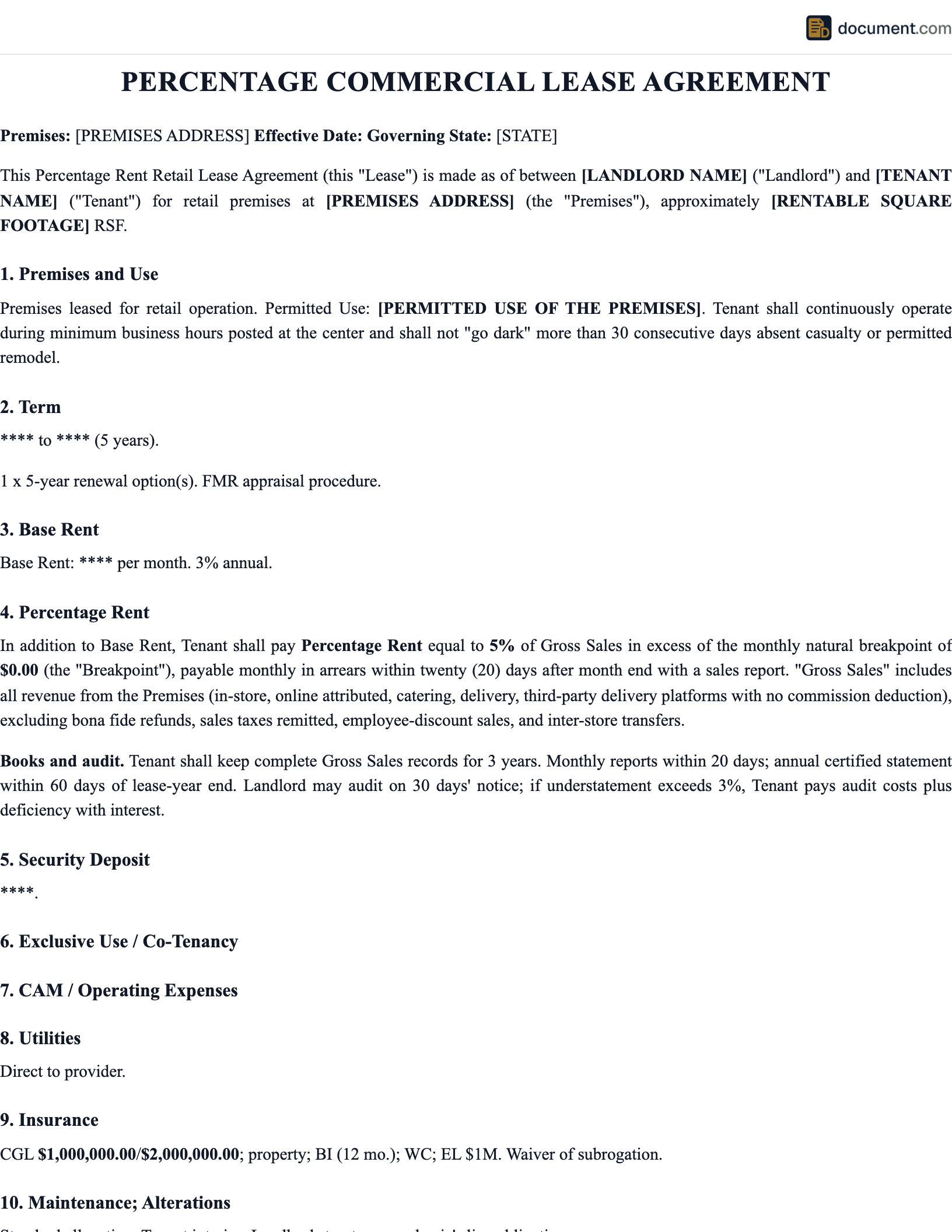



South Carolina Percentage Lease Agreement Overview
A percentage lease in South Carolina sets the tenant's rent as a combination of a fixed base rent plus a percentage of gross sales above a defined breakpoint. The structure links the landlord's return to the tenant's commercial performance, which makes percentage leases common in South Carolina retail shopping centers, tourism markets, and food and beverage locations where sales volumes can vary significantly by season or economic cycle. South Carolina commercial leases are governed entirely by contract law, giving the parties flexibility to define gross sales, set breakpoints, and structure reporting requirements according to the specific retail context.
South Carolina's retail and tourism markets create distinct percentage lease dynamics. Myrtle Beach and the Grand Strand host one of the busiest tourism corridors in the Southeast, where retail and restaurant tenants see enormous seasonal swings between summer peak and off-season trough. Hilton Head Island carries premium retail rents tied to resort visitor traffic. The Columbia retail market, centered around Columbiana Centre and other suburban centers, serves a stable regional population with consistent year-round sales patterns. Haywood Mall in Greenville anchors the Upstate retail market. In each of these settings, the breakpoint structure and gross sales definition need to reflect the specific revenue characteristics of that market. South Carolina imposes a 6% state sales and use tax that must be excluded from the gross sales calculation, and the state levies no commercial rent tax on top of the percentage rent structure.
$15
Filing fee
Required
Notarization
2
Witnesses required
Register
Filing office
South Carolina Percentage Lease Requirements
A South Carolina percentage lease is only as reliable as the definitions and reporting structures that underpin it. The following requirements address the critical provisions every South Carolina percentage lease should include.
South Carolina Sales Tax Exclusion
South Carolina imposes a 6% state sales and use tax on retail transactions, along with local hospitality taxes and other levies that vary by municipality. These government-collected taxes must be explicitly excluded from the gross sales definition in the percentage lease. Failing to exclude them overstates gross sales and inflates percentage rent calculations. For tourism-driven tenants in Myrtle Beach, Hilton Head, or Kiawah Island, where hospitality tax layers add to the 6% base rate, this exclusion is particularly important.
Key Percentage Lease Provisions
- Gross Sales Definition: Define what counts as gross sales and what is excluded. Include all revenue-generating channels from the premises, and explicitly exclude South Carolina state sales tax, applicable local taxes, employee sales at cost, returns and refunds, and any delivery platform fees or gratuities for food service tenants.
- Breakpoint Structure: Set the breakpoint explicitly as either a natural breakpoint (annual base rent divided by the percentage rate) or a negotiated artificial breakpoint. For South Carolina seasonal markets, consider whether a single annual breakpoint is appropriate or whether a monthly or quarterly structure better matches the revenue distribution at that location.
- Sales Reporting: Require monthly or quarterly gross sales reports from the tenant with an annual reconciliation. Define the format, content, and delivery method. Specify the audit rights of both parties and the process for resolving disputed reconciliation amounts.
- Audit Rights: Confirm in writing that the landlord (and in some structures the tenant) has the right to audit reported sales within a defined window after delivery of each annual report. South Carolina does not have a statutory audit right for commercial percentage leases; it must be negotiated and written into the lease.
- Co-Tenancy and Exclusivity: Retail tenants in South Carolina shopping centers should negotiate co-tenancy protections in case anchor tenants depart and exclusivity clauses preventing the landlord from adding a direct competitor to the center. These protections are particularly important in smaller South Carolina markets where center traffic depends heavily on specific anchors.
How to Draft a South Carolina Percentage Lease
Drafting a South Carolina percentage lease requires careful work on the financial structure before the parties negotiate other terms. The gross sales definition, breakpoint, and reporting requirements determine how much the landlord ultimately collects and how the tenant plans its finances. Work through these steps before presenting a final lease for signature.
Negotiate the Base Rent and Percentage Rate
Agree on the base rent and applicable percentage rate for the retail category. Consider market conditions in the specific South Carolina location, whether the property is in a tourism-driven market like Myrtle Beach or a year-round suburban market like Greenville's Woodruff Road corridor. Set the natural breakpoint or negotiate the artificial breakpoint based on projected first-year gross sales for that location.
Draft the Gross Sales Definition
Write a specific gross sales definition that includes all revenue channels from the premises and excludes South Carolina state sales tax (6%), applicable local hospitality and accommodation taxes in tourist markets, employee sales, returns and refunds, and layaway deposits not yet collected. For food and beverage tenants in Charleston's King Street or the Grand Strand, confirm the treatment of gratuities and third-party delivery platform fees, which are increasingly significant revenue items that tenants do not retain in full.
Negotiate Co-Tenancy and Exclusivity Protections
Retail tenants in South Carolina shopping centers should push for co-tenancy clauses that reduce base rent or allow early termination if anchor tenants depart or center occupancy falls significantly. Negotiate exclusivity provisions that prevent the landlord from leasing adjacent space to a direct competitor. In smaller South Carolina markets where center traffic depends on a handful of anchors, these protections are particularly important and should be documented in detail.
Execute the Lease Agreement
Both parties sign the completed percentage lease. South Carolina commercial leases for terms exceeding one year must be in writing under S.C. Code Ann. § 27-5-10. Retain executed originals for each party. Confirm that the lease includes a clearly drafted sales reporting schedule and that both parties understand the reconciliation timeline and audit procedures.
Establish Sales Reporting Systems and Consider Recording
Set up point-of-sale reporting systems that track gross sales in the categories required by the lease and can produce the reports needed for monthly or quarterly submissions. For leases of three or more years, consider recording a memorandum of lease at the Register of Deeds in the applicable South Carolina county to protect the tenant's leasehold interest against future purchasers and lenders.
South Carolina Percentage Lease Costs
Typical costs for a South Carolina retail percentage lease. Percentage rent varies significantly by retail category, location, and sales performance.
| Cost Item | Typical Amount |
|---|---|
| Base Rent | Fixed monthly amount; reflects location, size, and South Carolina market; tourism-driven locations in Myrtle Beach and Hilton Head carry premium rates |
| Percentage Rent | 3% to 10% of gross sales above the breakpoint; varies by retail category; specialty retail typically 4% to 7%, food service 5% to 8% |
| NNN or Operating Pass-Throughs | If applicable, county property tax, building insurance (higher in coastal markets), and CAM pass-throughs in addition to base and percentage rent |
| County Register of Deeds Recording Fee | Varies by county; typically $10 to $25 for a memorandum of lease; optional but protective for longer-term leases |
| Attorney Review | $400 to $800 for a South Carolina commercial percentage lease review; includes gross sales definition and breakpoint analysis |
Sample South Carolina Percentage Lease Agreement
Below is a preview of our South Carolina-specific template. Your customized document will include all fields and provisions required for filing in any South Carolina county.
PERCENTAGE LEASE AGREEMENT
STATE OF SOUTH CAROLINA
Legal Document Template
LANDLORD
Name: [Full Legal Name / Entity]
Property: [Shopping Center Name]
Address: [Property Address]
TENANT
Name: [Business Entity Name]
Trade Name: [DBA / Store Name]
Address: [Current Address]
Tax ID: [EIN]
PREMISES
Suite: [Number]
GLA: [Gross Leasable Area SF]
Use: [Permitted Retail Use]
Exclusive: [Product Category]
FINANCIAL TERMS
Base Rent: $[Amount]/month
Percentage Rate: [%]
Breakpoint: $[Amount]/year
CAM: $[Amount]/SF
Deposit: $[Amount]
South Carolina Percentage Lease Agreement FAQ
Answers to common questions about filing a percentage lease agreement in South Carolina, including requirements, fees, and procedures.
Official South Carolina Resources
Use these official state resources to verify requirements, find your local filing office, and access government forms for South Carolina.
Related South Carolina Documents
Depending on your situation, you may need additional documents alongside your South Carolina percentage lease agreement.
Create your South Carolina Commercial Percentage Lease Agreement in under 5 minutes.
Answer a few questions and download a South Carolina-compliant document, ready for the state agency.