
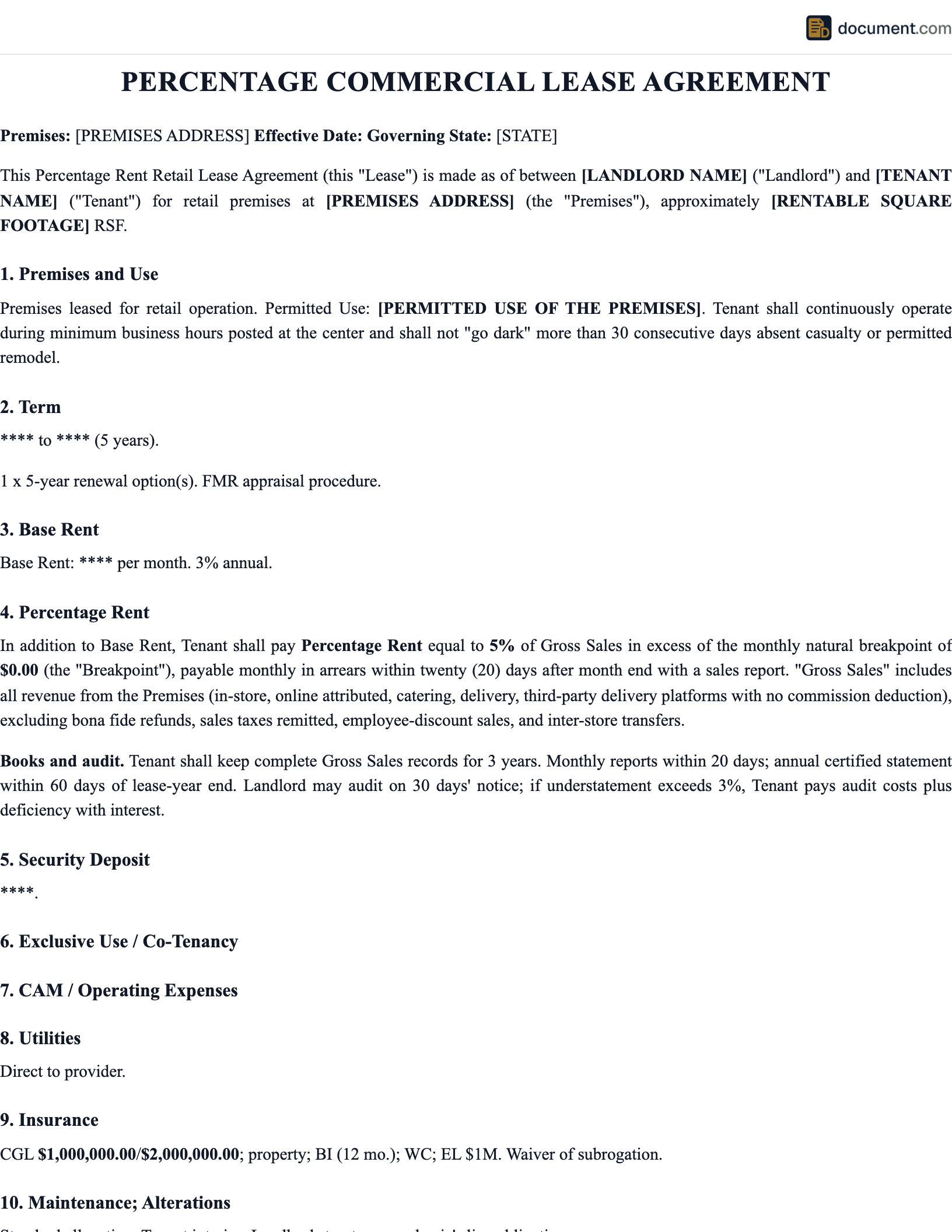



Illinois Percentage Lease Agreement Overview
An Illinois percentage lease combines a fixed base rent with a percentage rent component that is triggered once the tenant's gross sales exceed a defined breakpoint. This structure is used primarily in retail settings where sales performance is measurable and the landlord wants to participate in the tenant's commercial success. Shopping centers in Chicago's suburbs, including properties in Cook, DuPage, Lake, and Will counties, use percentage leases for national and regional retail tenants on a routine basis.
Illinois has no commercial rent tax at the state level, which means there is no additional layer of state taxation on the rent itself. However, Illinois retailers face a combined state and local sales tax rate that can exceed 10 percent in Chicago and some Cook County municipalities. The gross sales definition in the lease must be written to exclude Illinois retailers' occupation taxes collected and remitted to the state, otherwise the percentage rent calculation can be inflated by pass-through tax amounts.
No state
Commercial rent tax
10%+
Sales tax rate (Chicago)
Monthly
Sales reporting common
Common
In suburban IL malls
Illinois Percentage Lease Requirements
Illinois percentage leases are governed by contract law under the Illinois Compiled Statutes. Leases for more than one year must be in writing to satisfy the statute of frauds. Beyond that threshold, the key provisions that define an Illinois percentage lease are entirely negotiated.
Illinois Sales Tax and Gross Sales Definition
Illinois imposes retailers' occupation taxes (commonly called sales tax) at the state, county, and municipal level. In Chicago the combined rate can exceed 10 percent. Your gross sales definition must expressly exclude these collected taxes, otherwise the percentage rent calculation overstates the tenant's actual sales revenue and inflates the percentage rent obligation.
Required Lease Provisions
- Gross Sales Definition: Define exactly what is included and excluded from gross sales; expressly exclude Illinois retailers' occupation taxes collected and remitted to state and local authorities
- Breakpoint Specification: State whether the breakpoint is natural (calculated from base rent divided by rate) or artificial (negotiated to a different dollar threshold); specify the annual dollar amount and how it applies to each lease year
- Reporting Obligations: Set the frequency and format of gross sales reports (monthly is standard in Illinois retail centers); specify the deadline after each reporting period and the consequence for late or missing reports
- Audit Rights: Give the landlord audit rights exercisable within two to three years of each annual period; specify record retention requirements and who bears audit costs if understatements exceed a threshold
- Co-Tenancy Clause: Include co-tenancy protections keyed to anchor tenant presence or minimum occupancy for the center; specify the remedy, whether reduced rent, lease termination option, or both
- Exclusivity: Define the retail category in which the tenant has exclusive rights within the center; be specific enough to provide real protection without being so broad that it is unenforceable
How to Prepare an Illinois Percentage Lease
Preparing a percentage lease for an Illinois retail property involves more than filling in a base rent and a percentage rate. The breakpoint, gross sales definition, and reporting framework each need to be worked out before the lease is signed.
Research Illinois Market Sales Volumes
Review sales per square foot benchmarks for the specific retail category in comparable Illinois shopping centers. Sales volumes in Chicago suburbs differ meaningfully from downstate retail markets. The breakpoint should be calibrated to realistic Illinois sales projections rather than national averages that may not reflect local consumer behavior.
Agree on Gross Sales Definition and Illinois Sales Tax Treatment
Draft the gross sales definition to expressly exclude Illinois retailers' occupation taxes, refunds, employee sales, and any online sales not fulfilled from the leased premises. In Chicago and Cook County, the combined sales tax rate often exceeds 10 percent, so omitting the exclusion can meaningfully increase the reported sales figure used to calculate percentage rent.
Set Up Reporting and Audit Procedures
Define the reporting schedule (monthly reports are standard for Illinois retail centers), the format for reports, record retention requirements, and the landlord's audit rights. Include specific consequences for late reporting and a defined cost-allocation rule if an audit reveals significant understatements.
Negotiate Co-Tenancy and Exclusivity
Request co-tenancy protections tied to anchor tenant presence or a minimum occupancy percentage for the Illinois shopping center. Negotiate an exclusivity clause that defines your retail category precisely. These are commercially standard requests for retail tenants in Illinois and should not be treated as unusual asks.
Execute the Lease
Both parties sign the completed lease. Provide executed copies to all parties. For longer-term leases, consider recording a memorandum of lease with the county recorder of deeds to protect the tenant's leasehold interest in the event the property is sold or refinanced during the lease term.
Illinois Percentage Lease Costs
Typical costs associated with an Illinois percentage lease. Percentage rent is the most variable item and may not be triggered if annual sales stay below the breakpoint.
| Cost Item | Typical Amount |
|---|---|
| Base Rent | Negotiated; varies by Illinois submarket and center quality |
| Percentage Rent | 1-2% grocery/drug; 4-6% general retail; 6-10% food and beverage |
| Illinois Retailers' Occupation Tax | 6.25% state rate; up to 10%+ combined rate in Chicago |
| Attorney Review | $500 - $2,500+ for retail lease review in Illinois |
| Memorandum of Lease Recording (optional) | County recorder per-page fees |
Sample Illinois Percentage Lease Agreement
Below is a preview of our Illinois-specific template. Your customized document will include all fields and provisions required for filing in any Illinois county.
PERCENTAGE LEASE AGREEMENT
STATE OF ILLINOIS
Legal Document Template
LANDLORD
Name: [Full Legal Name / Entity]
Property: [Shopping Center Name]
Address: [Property Address]
TENANT
Name: [Business Entity Name]
Trade Name: [DBA / Store Name]
Address: [Current Address]
Tax ID: [EIN]
PREMISES
Suite: [Number]
GLA: [Gross Leasable Area SF]
Use: [Permitted Retail Use]
Exclusive: [Product Category]
FINANCIAL TERMS
Base Rent: $[Amount]/month
Percentage Rate: [%]
Breakpoint: $[Amount]/year
CAM: $[Amount]/SF
Deposit: $[Amount]
Illinois Percentage Lease Agreement FAQ
Answers to common questions about filing an percentage lease agreement in Illinois, including requirements, fees, and procedures.
Official Illinois Resources
Use these official state resources to verify requirements, find your local filing office, and access government forms for Illinois.
Related Illinois Documents
Depending on your situation, you may need additional documents alongside your Illinois percentage lease agreement.
Create your Illinois Commercial Percentage Lease Agreement in under 5 minutes.
Answer a few questions and download a Illinois-compliant document, ready for the state agency.