
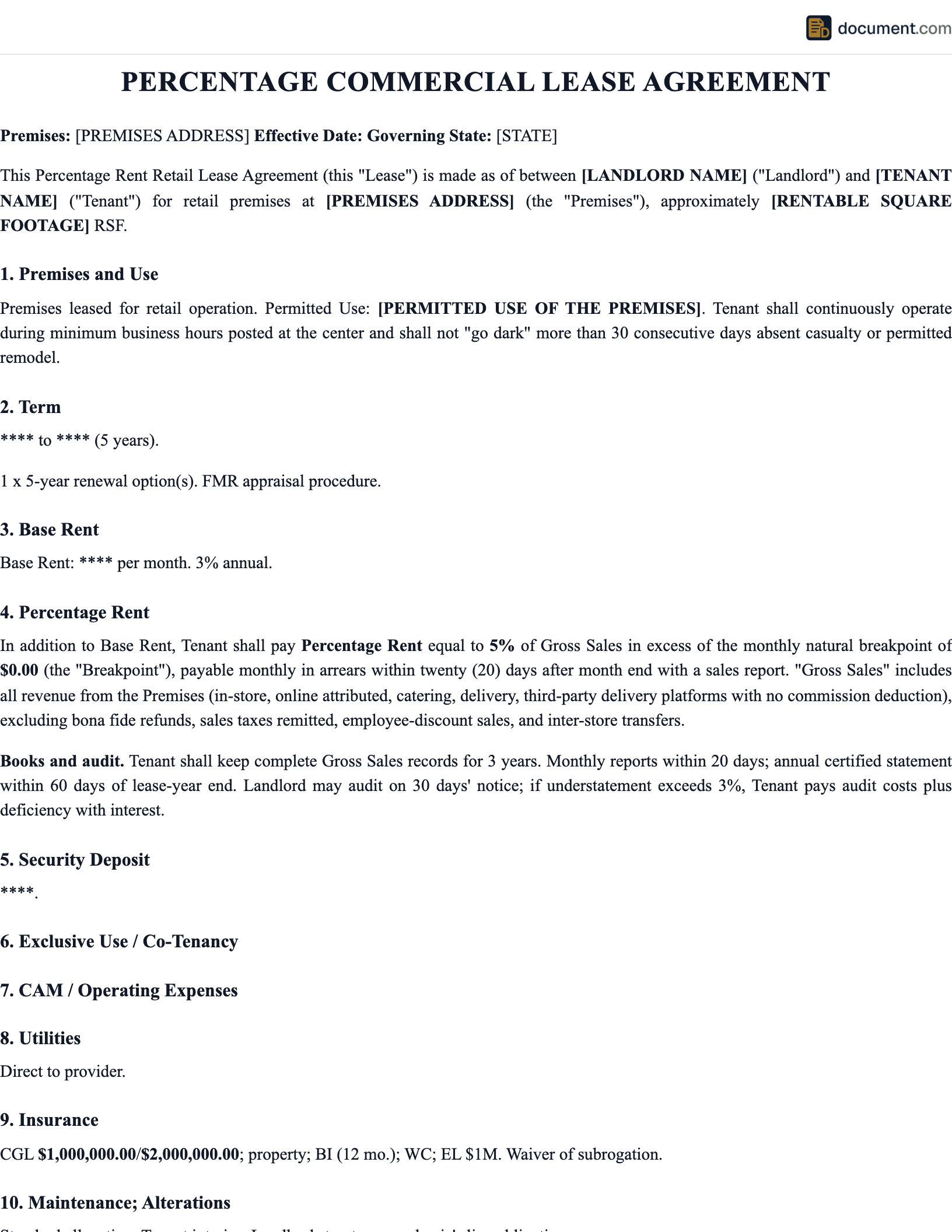



Indiana Percentage Lease Agreement Overview
A percentage lease ties a retail tenant's rent to their actual sales performance. The tenant pays a fixed base rent plus a percentage of gross sales above an agreed breakpoint. Indiana retail landlords use this structure most often in shopping centers across the Indianapolis metro, including established centers in Castleton, Greenwood, and the rapidly growing Hamilton County suburbs. Indiana does not impose a state commercial rent tax, so the only tax consideration that affects the gross sales calculation is the state's 7% flat sales tax rate.
Indiana's contract law governs percentage leases, and courts will enforce the agreement as written. That makes careful drafting of the gross sales definition, the breakpoint, and the reporting and audit provisions especially important. A vague gross sales definition creates disputes, and a poorly written co-tenancy clause may not hold up the way the tenant intended. Indiana's 7% state sales tax with no local add-ons makes the tax exclusion calculation simpler than in some other states, which is one reason percentage leases in Indiana tend to be more straightforward to administer once the key commercial terms are agreed.
No state
Commercial rent tax
7% flat
Indiana sales tax
Monthly
Sales reporting
Contract law
Governs enforcement
Indiana Requirements
An Indiana percentage lease is a private contract governed by Indiana contract law. There is no recording requirement and no state-level form. The key drafting obligations are commercial and practical rather than regulatory. The following provisions are the ones most likely to cause disputes if left vague.
Indiana Sales Tax Treatment
Indiana charges a flat 7% state sales tax with no city or county surcharges. Any sales tax collected from customers must be explicitly excluded from the gross sales definition so that tenants are not paying percentage rent on tax amounts they collect on behalf of the state. Confirm this exclusion is in writing.
Key Lease Provisions
- Gross Sales Definition: Define what is included and excluded precisely. Standard exclusions are sales tax, returns, employee sales, and gift card issuances. Indiana courts will enforce the definition as written.
- Breakpoint: State whether the breakpoint is natural (base rent divided by rate) or artificial. Specify whether it is calculated on a lease-year or calendar-year basis, and address proration for partial years.
- Reporting Obligations: Require monthly gross sales reports within 15 to 30 days after each month ends plus an annual certified statement within 60 to 90 days after the lease year closes. Specify who must sign the annual certification.
- Audit Rights: Give the landlord the right to audit the tenant's books within two to four years after each lease year. Specify who bears audit costs and what underreporting threshold triggers cost-shifting.
- Co-Tenancy Clause: Tenants in Indiana shopping centers should negotiate co-tenancy rights tied to anchor occupancy. Define the anchor, the occupancy threshold, the cure period, and the remedy, whether reduced rent, termination rights, or both.
- Exclusivity: Retail tenants should negotiate exclusive use rights within the center to prevent the landlord from leasing to a direct competitor. Indiana courts enforce exclusivity provisions as written contract obligations.
How to File in Indiana
Drafting an Indiana percentage lease requires agreement on commercial terms before anyone puts language in a document. Working through these steps in order avoids the most common renegotiation problems.
Research Indiana Market Sales Volumes
Before setting a breakpoint, review comparable sales data for similar tenants in the same Indianapolis submarket or regional center. Hamilton County centers typically support higher breakpoints than rural markets. Use industry benchmarks as a starting point but anchor them to local performance data where possible.
Define Gross Sales and Exclude Indiana Sales Tax
Draft a precise gross sales definition that lists both inclusions and exclusions. Indiana's 7% flat sales tax must be excluded so tenants do not pay percentage rent on tax collections. Also exclude returns, layaways paid but not picked up, sales to employees, and gift card issuances. Ambiguity here causes audit disputes.
Set Reporting and Audit Terms
Require monthly gross sales statements due within 15 to 30 days after each month. Require an annual certified statement due within 60 to 90 days after the lease year. Give the landlord audit rights covering two to four years back, with cost-shifting to the tenant if underreporting exceeds a stated threshold.
Negotiate Co-Tenancy and Exclusivity
For Indiana shopping center leases, tenants should push for co-tenancy protections tied to anchor occupancy and an exclusivity clause preventing the landlord from leasing nearby space to a direct competitor. Define the anchor by name or category, set an occupancy floor, and specify the cure period before any remedy kicks in.
Execute the Lease and Consider a Memorandum
Both parties sign the lease. Indiana does not require recording, but landlords and tenants with long-term leases sometimes record a memorandum of lease with the County Recorder to establish the tenancy in the public record without disclosing financial terms. The memorandum recording fee in Indiana is $25 for the first page plus $5 per additional page.
Indiana Fees & Costs
Below is a breakdown of the typical costs associated with filing this document in Indiana. Actual fees may vary by county.
| Fee / Cost | Amount |
|---|---|
| Base Rent | Negotiated; typically $15 to $35/SF/year depending on center and location |
| Percentage Rent | 1% to 10% of gross sales above the breakpoint, depending on retail category |
| Indiana Retailers' Occupation Tax (Sales Tax) | 7% flat state rate; no local add-ons; must be excluded from gross sales definition |
| Attorney Review | $750 to $2,500 depending on lease complexity and negotiation |
| Memorandum of Lease Recording (optional) | $25 first page plus $5 per additional page at the County Recorder |
Sample Indiana Percentage Lease Agreement
Below is a preview of our Indiana-specific template. Your customized document will include all fields and provisions required for filing in any Indiana county.
PERCENTAGE LEASE AGREEMENT
STATE OF INDIANA
Legal Document Template
LANDLORD
Name: [Full Legal Name / Entity]
Property: [Shopping Center Name]
Address: [Property Address]
TENANT
Name: [Business Entity Name]
Trade Name: [DBA / Store Name]
Address: [Current Address]
Tax ID: [EIN]
PREMISES
Suite: [Number]
GLA: [Gross Leasable Area SF]
Use: [Permitted Retail Use]
Exclusive: [Product Category]
FINANCIAL TERMS
Base Rent: $[Amount]/month
Percentage Rate: [%]
Breakpoint: $[Amount]/year
CAM: $[Amount]/SF
Deposit: $[Amount]
Indiana Percentage Lease Agreement FAQ
Answers to common questions about filing an percentage lease agreement in Indiana, including requirements, fees, and procedures.
Official Indiana Resources
Use these official state resources to verify requirements, find your local filing office, and access government forms for Indiana.
Related Indiana Documents
Depending on your situation, you may need additional documents alongside your Indiana percentage lease agreement.
Create your Indiana Commercial Percentage Lease Agreement in under 5 minutes.
Answer a few questions and download a Indiana-compliant document, ready for the state agency.