
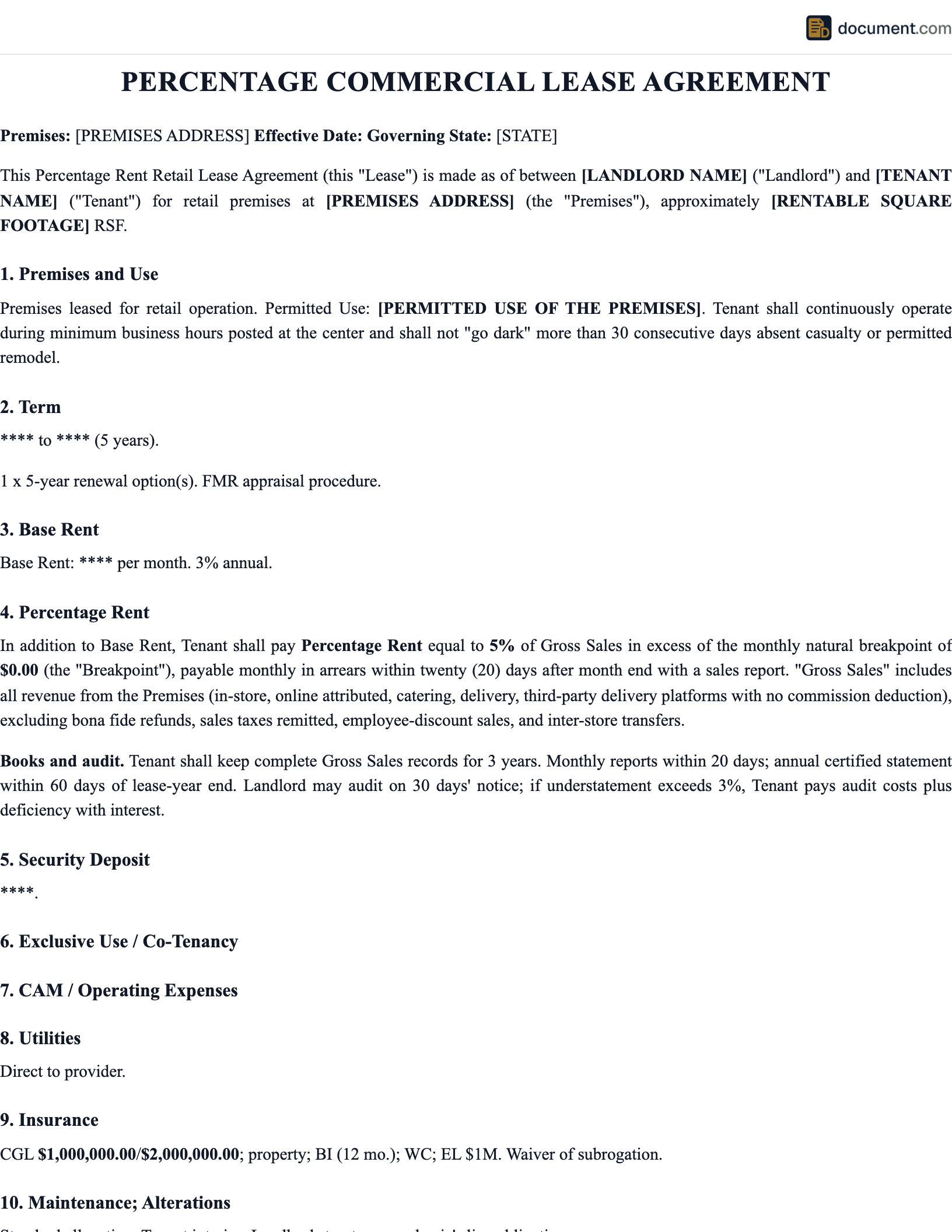



Maryland Percentage Lease Agreement Overview
A Maryland percentage lease agreement pairs a fixed base rent with an additional rent component tied to a percentage of the tenant's gross sales above an agreed breakpoint. This structure is common across Montgomery County, Prince George's County, and the Baltimore metro area, where high consumer spending makes retail revenue a meaningful metric for landlords. Maryland governs commercial leases as general contracts under state common law, and the parties have wide latitude to define exactly which revenue streams count toward gross sales and how the breakpoint is calculated.
One factor that makes Maryland percentage leases more complex than in most other states is the recordation and transfer tax. Maryland imposes recordation tax and transfer tax on commercial leases of seven years or longer when recorded in the county land records. For a long-term percentage lease, parties must decide whether to record the full agreement (and pay tax based on the total rent consideration) or record a short memorandum of lease instead to limit the taxable consideration while still providing public notice. Either way, the lease must be drafted with awareness of SDAT reassessment cycles, since property tax escalation directly affects base rent competitiveness in high-value Montgomery County submarkets like Bethesda and Rockville.
Varies
Recordation tax
Optional
Recording
Contract
Governing law
Land Records
Recording office
Maryland Requirements
Maryland commercial leases are governed by general contract law. There is no specific commercial lease statute mandating particular lease terms, so the drafting requirements come from contract law principles, the Statute of Frauds (leases longer than one year must be in writing and signed by both parties), and from the practical demands of the percentage rent structure itself. If the parties intend to record the lease in county land records, Maryland's recordation and transfer tax rules will also shape execution requirements.
Maryland Recordation and Transfer Tax Alert
Maryland imposes recordation tax and county transfer tax on commercial leases of seven years or more when recorded in the county land records. This is unusual nationally. Most parties either record a short memorandum of lease (to limit the taxable rent consideration) or decline to record the lease at all. Your Maryland attorney should analyze the recordation tax exposure before signing and decide on the recording strategy that makes most sense for the transaction.
Document Requirements
- Writing and signatures: The Statute of Frauds requires a signed written agreement for any lease longer than one year. Both landlord and tenant must sign, and entity signatories must have proper authority documented.
- Gross sales definition: The lease must specify exactly which revenue streams constitute gross sales, including treatment of returns, discounts, online sales fulfilled from the premises, and excluded categories such as sales tax collected from customers.
- Breakpoint: Specify whether the breakpoint is natural (base rent divided by the percentage rate) or artificial. A natural breakpoint of $1,200,000 at a 5% rate on $60,000 annual base rent is easy to compute; artificial breakpoints require separate negotiation.
- SDAT property tax provisions: Maryland's SDAT conducts triennial reassessments. If the landlord passes property taxes through to the tenant as an additional charge, the lease should establish a base-year tax figure and cap annual increases or at minimum require SDAT appeal cooperation when values spike.
- Sales reporting and audit rights: Require monthly or quarterly gross sales reports and an annual certified sales statement. Include an audit right giving the landlord the ability to inspect the tenant's books, and specify the cure period and consequences if gross sales are found to be understated.
- Recordation strategy: Decide before execution whether to record the full lease or a memorandum of lease in the county land records. If recording the full lease for a term of seven years or more, both parties should acknowledge the document before a notary to facilitate recording.
How to File in Maryland
Drafting and executing a Maryland percentage lease involves careful preparation around the gross sales structure, Maryland's SDAT tax cycle, and the recordation tax decision. Work through these steps before signing.
Research Maryland Retail Sales Data and SDAT Assessment History
Before setting the base rent and percentage rate, landlords should review comparable retail sales per square foot for the submarket, whether Montgomery County retail, Baltimore City mixed-use, or a Prince George's County power center. At the same time, review the property's SDAT assessment history to understand whether a reassessment is approaching during the lease term, since property tax escalation can significantly affect the overall rent burden.
Negotiate the Gross Sales Definition and Percentage Rate
Agree on what counts as gross sales, including online orders fulfilled from the premises and any carve-outs for returns, voids, sales tax collected, and wholesale transactions. Set the percentage rate (typically 4% to 7% for Maryland retail) and decide on a natural or artificial breakpoint. Natural breakpoints are simpler to administer and are generally preferred for mid-size tenants in Montgomery County corridor locations.
Decide on Recording Strategy and Calculate Recordation Tax Exposure
This step is unique to Maryland among most states. If the lease term is seven years or more, recording the full agreement triggers Maryland recordation tax (currently $4.95 per $500 of consideration in most counties) and county transfer tax. Calculate the total taxable consideration and compare it to the cost and risks of recording only a memorandum of lease or not recording at all. For a Bethesda flagship store with high base rent and a 10-year term, the tax can be substantial. Your Maryland attorney should run this analysis.
Draft Reporting, Audit, and Record-Keeping Provisions
Build in monthly or quarterly gross sales reports, an annual certified statement, and landlord audit rights with a minimum three-year records retention requirement. Include a provision allocating audit costs: the tenant pays if gross sales are found to be understated by more than a threshold (commonly 3% to 5%), and the landlord pays if the audit shows the tenant's reports were accurate. This encourages good-faith reporting and discourages speculative audits.
Execute and Record in County Land Records
Both parties sign the lease or the memorandum of lease. If recording, take the executed document to the county land records office (part of the Circuit Court Clerk's office in Maryland counties). Pay the applicable recordation and transfer taxes at recording. Retain fully executed originals and confirm any co-tenancy or landlord-consent notice obligations are satisfied before the tenant opens for business.
Maryland Fees & Costs
Below is a breakdown of the typical costs associated with filing this document in Maryland. Actual fees may vary by county.
| Fee / Cost | Amount |
|---|---|
| Base Rent | $28 - $60/sqft/year (Montgomery County and DC-suburb retail); $16 - $28/sqft/year (Baltimore metro and suburban Maryland) |
| Percentage Rent Rate | 4% - 7% of gross sales above the breakpoint; food and beverage tenants typically 6% - 8% |
| Maryland Recordation Tax (if recorded) | $4.95 per $500 of total rent consideration (state rate); county transfer tax varies by county (Montgomery County: 1% of consideration) |
| SDAT Property Tax Pass-Through | $1.00 - $3.00/sqft/year overage above base-year tax in Montgomery County and Prince George's County; lower in rural counties |
| Attorney Fees | $1,000 - $4,000 for lease drafting and recordation tax analysis; Bethesda and downtown Baltimore market attorneys typically at the higher end |
| Land Records Recording Fee | $20 - $60 for the memorandum of lease or full lease (recording fee only, separate from recordation and transfer taxes) |
Sample Maryland Percentage Lease Agreement
Below is a preview of our Maryland-specific template. Your customized document will include all fields and provisions required for filing in any Maryland county.
PERCENTAGE LEASE AGREEMENT
STATE OF MARYLAND
Legal Document Template
LANDLORD
Name: [Full Legal Name / Entity]
Property: [Shopping Center Name]
Address: [Property Address]
TENANT
Name: [Business Entity Name]
Trade Name: [DBA / Store Name]
Address: [Current Address]
Tax ID: [EIN]
PREMISES
Suite: [Number]
GLA: [Gross Leasable Area SF]
Use: [Permitted Retail Use]
Exclusive: [Product Category]
FINANCIAL TERMS
Base Rent: $[Amount]/month
Percentage Rate: [%]
Breakpoint: $[Amount]/year
CAM: $[Amount]/SF
Deposit: $[Amount]
Maryland Percentage Lease Agreement FAQ
Answers to common questions about filing a percentage lease agreement in Maryland, including requirements, fees, and procedures.
Official Maryland Resources
Use these official state resources to verify requirements, find your local filing office, and access government forms for Maryland.
Related Maryland Documents
Depending on your situation, you may need additional documents alongside your Maryland percentage lease agreement.
Create your Maryland Commercial Percentage Lease Agreement in under 5 minutes.
Answer a few questions and download a Maryland-compliant document, ready for the state agency.