
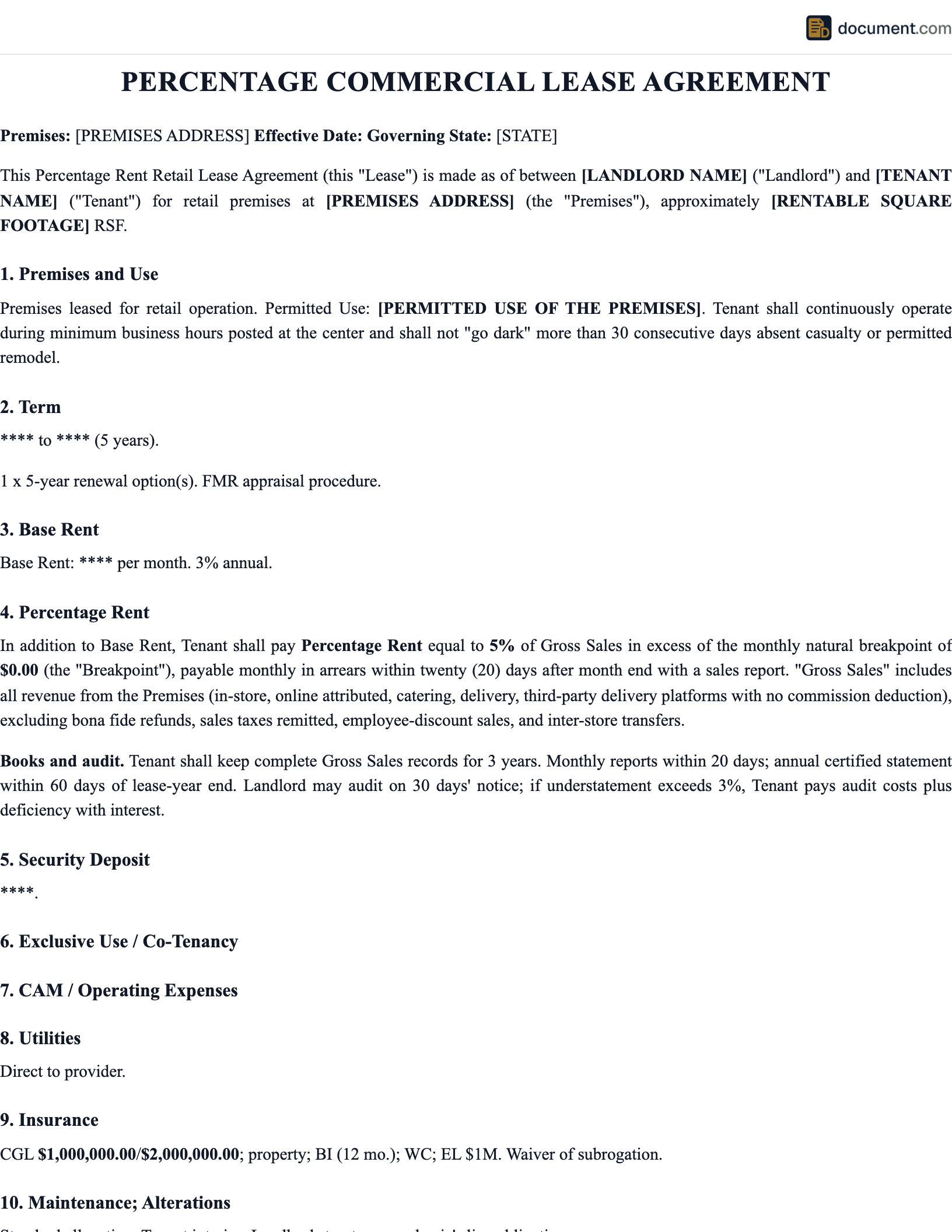



New Jersey Percentage Lease Agreement Overview
A percentage lease in New Jersey ties a tenant's rent obligation to sales performance by combining a base rent with additional rent calculated as a percentage of gross sales above a defined breakpoint. New Jersey has no dedicated statute governing percentage leases, so the structure is entirely contractual. Courts enforce the specific language of the written lease, making precise drafting of the gross sales definition, breakpoint calculation, reporting obligations, and audit rights essential to avoid future disputes.
New Jersey retail percentage leases are concentrated at regional malls, power centers, and transit-adjacent retail corridors throughout the state. Major percentage lease markets include Garden State Plaza and Bergen County retail in the north, Livingston Mall, Woodbridge Center, and Monmouth Mall in the central region, and the Cherry Hill and Marlton corridors in South Jersey. New Jersey imposes a 6.625 percent state sales tax, which must be explicitly excluded from gross sales definitions in percentage leases to avoid overstating tenant revenue.
$15
Filing fee
Required
Notarization
0
Witnesses required
County
Filing office
New Jersey Percentage Lease Requirements
New Jersey has no commercial lease statute specific to percentage leases, so all legal requirements come from the written agreement. A well-structured New Jersey percentage lease covers the gross sales definition, breakpoint structure, reporting obligations, audit rights, and any co-tenancy provisions specific to the shopping center or retail location.
Exclude New Jersey Sales Tax from Gross Sales
New Jersey imposes a 6.625 percent state sales tax on most retail transactions. Your percentage lease gross sales definition must explicitly exclude New Jersey sales tax collected from customers. This exclusion is not implied by law; it must be written into the definition. Without it, the tenant's reported gross sales will include sales tax collected on behalf of the state, inflating the percentage rent calculation above what the parties intended.
Key Lease Provisions
- Gross sales definition: Define what is included and excluded, with explicit carve-outs for NJ sales tax, returns and refunds, employee discounts, gift card redemption rules, and sales of capital assets
- Breakpoint and percentage rate: Specify whether the breakpoint is natural or artificial, state the annual gross sales threshold clearly, and confirm the applicable percentage rate for each revenue category if the tenant has multiple product lines
- Reporting obligations: Define the frequency (monthly, quarterly, or annual), format, and certification requirements for gross sales statements; NJ regional mall landlords often require annual CPA-certified statements
- Audit rights: Include audit windows of 12 to 24 months after each lease year, record retention requirements, and a provision allocating audit costs when a material discrepancy is found
- Co-tenancy provisions: For New Jersey enclosed malls and major power centers, confirm whether co-tenancy protections apply, who qualifies as an anchor tenant, and what percentage rent reduction or termination right is triggered if occupancy thresholds fall
How to Execute a New Jersey Percentage Lease
Entering a percentage lease in New Jersey requires sales performance data and careful diligence before committing to the financial structure. Work through these steps before signing.
Analyze the Location's Sales Potential
Gather traffic count data, co-tenant occupancy information, and available sales comparables for the shopping center or retail corridor. For New Jersey regional mall locations at Garden State Plaza, Willowbrook, or Monmouth Mall, occupancy and anchor tenant status directly affect foot traffic and achievable sales levels. Confirm co-tenancy clause rights before committing to percentage rent terms at any enclosed mall location.
Negotiate Core Financial Terms and Co-Tenancy Protections
Agree on base rent, percentage rate, and breakpoint structure. Determine whether the breakpoint is natural or artificial. For enclosed mall and power center locations, negotiate co-tenancy trigger conditions, cure periods, and the rent reduction formula before drafting begins. In NJ markets that have experienced anchor closures, co-tenancy protections are a real economic safeguard rather than theoretical language.
Draft the Percentage Lease with NJ-Specific Provisions
Use a New Jersey-specific template that includes an explicit NJ sales tax exclusion from gross sales, the agreed breakpoint and percentage rate, certified reporting requirements, audit rights with defined windows and cost-allocation, co-tenancy provisions if applicable, and a governing law clause designating New Jersey with the appropriate county Superior Court as the dispute venue.
Execute the Agreement
Both parties sign. Commercial leases in New Jersey do not require notarization to be binding between the parties; notarization is required only if recording a memorandum of lease. Confirm entity signing authority. Each party retains an original or complete copy.
Configure Sales Reporting and Tracking
Set up your point-of-sale system to track gross sales as defined in the lease from the first day of operations, with NJ sales tax stripped out of reported revenue figures. Configure accounting records to produce reports in the frequency and format required. Maintain records for the full audit period specified in the lease, typically two to three years after each lease year ends.
New Jersey Percentage Lease Costs
Percentage lease costs in New Jersey include base rent, percentage rent above the breakpoint, and any NNN pass-through obligations if the deal is structured as a percentage-on-top-of-NNN arrangement.
| Fee / Cost | Amount |
|---|---|
| Base Rent (NJ Regional Mall and Power Center Inline Space) | $30 to $75 per SF annually for inline retail space at major centers; anchor pad and end-cap rents vary significantly by center and location |
| Percentage Rent | 1 to 10% of gross sales above the natural or negotiated breakpoint; rate varies by retail category with food and beverage at the high end and anchors at the low end |
| Attorney Review and Lease Drafting | $1,000 to $3,500 depending on complexity; percentage leases with co-tenancy provisions and detailed gross sales definitions require more drafting time |
| NNN Pass-Throughs (if applicable) | If the percentage lease is layered on a NNN structure, NJ property taxes, insurance, and CAM are additional obligations; NJ municipal property taxes can be substantial depending on the location |
| New Jersey Sales Tax on Gross Sales | NJ imposes 6.625% state sales tax on most retail goods; this amount must be excluded from gross sales definitions in the lease so it does not inflate percentage rent calculations |
Sample New Jersey Percentage Lease Agreement
Below is a preview of our New Jersey-specific template. Your customized document will include all fields and provisions required for filing in any New Jersey county.
PERCENTAGE LEASE AGREEMENT
STATE OF NEW JERSEY
Legal Document Template
LANDLORD
Name: [Full Legal Name / Entity]
Property: [Shopping Center Name]
Address: [Property Address]
TENANT
Name: [Business Entity Name]
Trade Name: [DBA / Store Name]
Address: [Current Address]
Tax ID: [EIN]
PREMISES
Suite: [Number]
GLA: [Gross Leasable Area SF]
Use: [Permitted Retail Use]
Exclusive: [Product Category]
FINANCIAL TERMS
Base Rent: $[Amount]/month
Percentage Rate: [%]
Breakpoint: $[Amount]/year
CAM: $[Amount]/SF
Deposit: $[Amount]
New Jersey Percentage Lease Agreement FAQ
Answers to common questions about filing a percentage lease agreement in New Jersey, including requirements, fees, and procedures.
Official New Jersey Resources
Use these official state resources to verify requirements, find your local filing office, and access government forms for New Jersey.
Related New Jersey Documents
Depending on your situation, you may need additional documents alongside your New Jersey percentage lease agreement.
Create your New Jersey Commercial Percentage Lease Agreement in under 5 minutes.
Answer a few questions and download a New Jersey-compliant document, ready for the state agency.