
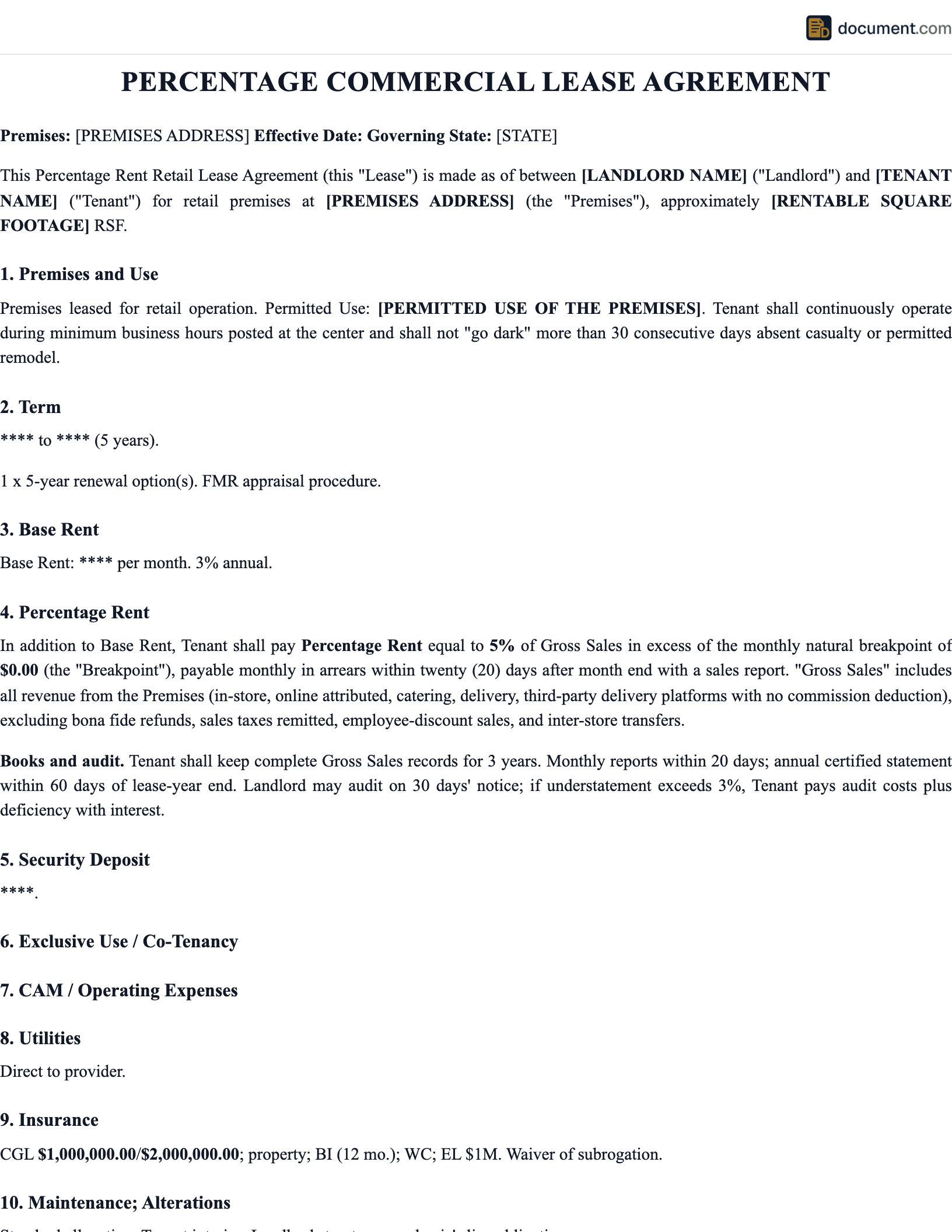



Utah Percentage Lease Agreement Overview
Percentage leases in Utah are primarily found in retail properties, shopping centers, and resort-adjacent commercial space, particularly in the Salt Lake City metro, Provo/Orem corridor, and Park City area. Under this lease structure, the tenant pays a fixed base rent plus a percentage of gross sales once sales exceed a defined breakpoint. Utah has no statute specifically governing percentage lease terms, so the gross sales definition, breakpoint type, reporting schedule, audit rights, and co-tenancy protections all depend entirely on the lease contract itself.
Utah's combined state and local sales tax rate varies by county, ranging from the state base of 4.85 percent up to roughly 9 percent in some locations. Because this sales tax is collected by the tenant and remitted to the Utah State Tax Commission, a properly drafted Utah percentage lease excludes collected sales tax from the gross sales calculation. Failing to address this can result in the landlord effectively receiving a percentage of tax pass-throughs, which was not the intent of either party.
4.85%+
State sales tax rate
None
State rent tax
Contract
Governing law
Seasonal
Park City market
Utah Requirements
Utah percentage leases are governed entirely by contract law because the state has no dedicated percentage lease statute. Every critical economic term, including the gross sales definition, reporting obligations, audit rights, and breakpoint calculation method, must be clearly written into the agreement. Utah courts enforce commercial lease terms as written and generally will not imply protections that were not negotiated into the contract.
Utah Sales Tax Exclusion Requirement
Utah's combined state and local sales tax rates vary by county. Salt Lake County, Utah County, Davis County, and Summit County (home to Park City) each have different combined rates. Because the tenant collects and remits this tax to the Utah State Tax Commission, the lease must explicitly state that Utah sales tax is excluded from gross sales. A lease that is silent on this point could be interpreted to include collected sales tax in the base for calculating percentage rent, which would be a windfall to the landlord and was not the parties' intent.
Key Lease Provisions
- Gross Sales Definition: Specify all inclusions and exclusions, including explicit exclusion of Utah state and local sales tax collected from customers; also address online and click-and-collect sales for Utah store locations
- Breakpoint Type: Designate whether the breakpoint is natural (base rent divided by rate) or artificial (a higher negotiated threshold), and whether it is measured monthly or annually; Park City seasonal leases may require monthly calculations
- Percentage Rate: State the percentage rate applicable to gross sales above the breakpoint; rates typically range from 4 to 10 percent depending on retail category and Utah submarket
- Sales Reporting Schedule: Require monthly gross sales reports and an annual certified statement; specify the deadline for delivery and the consequence of late reporting
- Audit Rights: Grant the landlord a right to audit the tenant's sales records within a defined period; include provisions addressing who bears audit costs if results vary materially from reported figures
- Co-Tenancy Protection: For Utah tenants in multi-tenant retail centers, include co-tenancy rights that allow rent reduction or termination if an anchor tenant closes; relevant for shopping centers in the Salt Lake City and Provo markets
How to Negotiate a Utah Percentage Lease
Structuring a Utah percentage lease requires careful attention to the gross sales definition, breakpoint mechanics, and reporting obligations. Getting each step right protects both the tenant's cash flow and the landlord's participation interest.
Negotiate the Gross Sales Definition
Start by agreeing on exactly what revenue counts as gross sales. For a Utah retail tenant, explicitly exclude Utah state and local sales tax, returns and refunds, employee discounts, and sales at other locations. For omnichannel retailers, address whether online orders fulfilled from or shipped to the Utah store are included.
Set the Breakpoint and Percentage Rate
Determine whether the breakpoint will be natural or artificial, and whether annual or monthly calculations apply. Park City and other Utah resort market tenants should evaluate monthly versus annual breakpoints carefully due to extreme seasonal revenue patterns. Confirm the percentage rate aligns with Utah retail norms for the specific retail category.
Confirm Reporting, Audit, and Co-Tenancy Rights
Establish the monthly reporting deadline and required format for gross sales submissions. Add the landlord's audit right with a defined lookback window. For Utah tenants in anchored retail centers, negotiate co-tenancy language before signing; after execution, landlords have little incentive to add this protection.
Execute the Lease
Both landlord and tenant must sign through authorized representatives. Utah commercial leases do not require notarization to be enforceable between the parties unless they elect to record the lease with the county recorder. Distribute fully executed copies to all parties and store securely for the lease term.
Configure Point-of-Sale Tracking for Utah Tax Compliance
Set up your point-of-sale and accounting system to separately track Utah sales tax collected, returns, and any excluded revenue categories before the lease term starts. Accurate gross sales records are essential both for percentage rent reporting and for verifying Utah State Tax Commission sales tax filings match amounts reported to the landlord.
Utah Percentage Lease Costs
The ongoing cost structure of a Utah percentage lease includes both fixed and variable components. Tenants should budget for base rent, potential percentage rent in high-sales periods, and Utah sales tax obligations.
| Fee / Cost | Amount |
|---|---|
| Base Rent | Fixed monthly amount; varies by Utah submarket and retail center type |
| Percentage Rent | 2 to 10% of gross sales above the breakpoint, depending on retail category; excluded from Utah sales tax calculation |
| Utah Sales Tax on Retail Sales | 4.85% state rate plus local additions; collected from customers and remitted to the Utah State Tax Commission; excluded from gross sales for percentage rent purposes |
| Notarization (if lease recorded) | $5 - $25 per signature; only required if parties elect to record the lease with the Utah county recorder |
| Attorney Review (recommended) | $400 - $1,000; Salt Lake City and Park City retail lease attorneys are familiar with percentage rent structures and Utah sales tax implications |
Sample Utah Percentage Lease Agreement
Below is a preview of our Utah-specific template. Your customized document will include all fields and provisions required for filing in any Utah county.
PERCENTAGE LEASE AGREEMENT
STATE OF UTAH
Legal Document Template
LANDLORD
Name: [Full Legal Name / Entity]
Property: [Shopping Center Name]
Address: [Property Address]
TENANT
Name: [Business Entity Name]
Trade Name: [DBA / Store Name]
Address: [Current Address]
Tax ID: [EIN]
PREMISES
Suite: [Number]
GLA: [Gross Leasable Area SF]
Use: [Permitted Retail Use]
Exclusive: [Product Category]
FINANCIAL TERMS
Base Rent: $[Amount]/month
Percentage Rate: [%]
Breakpoint: $[Amount]/year
CAM: $[Amount]/SF
Deposit: $[Amount]
Utah Percentage Lease Agreement FAQ
Answers to common questions about filing an percentage lease agreement in Utah, including requirements, fees, and procedures.
Official Utah Resources
These official resources are relevant to Utah retail tenants and landlords entering percentage lease arrangements, including sales tax guidance and business registration requirements.
Utah State Tax Commission - Sales Tax
Utah sales tax rates by county and filing requirements for retail businesses
Utah Property Rights Ombudsman
Dispute resolution for Utah commercial property matters
Utah Division of Corporations
Entity registration and good standing for retail tenants and landlords
Utah.gov Business Portal
Business licensing, permits, and compliance information for Utah retailers
Related Utah Commercial Lease Documents
Utah retail transactions often require additional documents alongside a percentage lease, including operating agreements, co-tenancy addenda, and lease guaranty agreements.
Create your Utah Commercial Percentage Lease Agreement in under 5 minutes.
Answer a few questions and download a Utah-compliant document, ready for the state agency.