



Wisconsin Percentage Lease Agreement Overview
A Wisconsin percentage lease charges the tenant a base rent plus an additional amount calculated as a percentage of gross sales once those sales exceed a defined breakpoint. The arrangement is designed for retail tenants whose sales volumes are large enough that the landlord benefits from sharing in the upside. Regional malls, grocery-anchored centers, and power centers in Milwaukee, Madison, and the Fox Valley corridor are the primary markets where percentage lease structures appear in Wisconsin.
Wisconsin percentage leases are entirely contract-driven. The gross sales definition, the breakpoint structure, and the reporting requirements are all negotiated points with significant financial consequences. Wisconsin does not impose a commercial rent tax, so the tenant's only additional cost beyond base rent is the percentage rent amount calculated under the lease. Getting the gross sales definition right, and understanding what is and is not counted toward the breakpoint, is the most important financial analysis a retail tenant can do before signing.
Base + %
Rent structure
Breakpoint
Sales threshold
Retail
Primary use case
Audit rights
Standard protection
Wisconsin Percentage Lease Requirements
Wisconsin percentage leases are governed by contract law. The key provisions that determine financial exposure are the gross sales definition, the breakpoint structure, and the reporting and audit framework. These all need to be negotiated and documented before execution.
Wisconsin Gross Sales Definition Note
Wisconsin does not have a sales tax on commercial rent, so the percentage rent calculation in a Wisconsin lease is based purely on the gross sales definition in the contract. A broad definition that includes online orders fulfilled from the store, catering revenue, and employee sales will generate a higher percentage rent obligation than a narrower definition. Review and negotiate this provision carefully before signing.
Key Percentage Lease Provisions
- Gross Sales Definition: The lease must precisely define what counts as gross sales and what is excluded, such as sales tax, returns, employee discounts, and orders placed online but fulfilled elsewhere
- Natural vs. Artificial Breakpoint: Confirm whether the breakpoint is natural (derived from dividing base rent by the rate) or artificial (set independently by negotiation), and model the financial impact of each scenario
- Reporting Schedule: The lease should specify the frequency of sales reports, the format required, and the deadline for the annual certified statement
- Audit Rights: Both parties should have audit rights with stated windows and procedures, including a limit on how often audits may be conducted and a requirement that the auditing party bear its own costs unless a material discrepancy is found
- Co-Tenancy and Exclusivity: Retail tenants in Wisconsin shopping centers should negotiate co-tenancy protections tied to anchor occupancy and exclusivity provisions that prevent the landlord from leasing to direct competitors in the same center
How to Negotiate and Execute a Wisconsin Percentage Lease
Percentage lease negotiations in Wisconsin require financial modeling and careful document review. The following steps outline how to approach the process.
Model the Financial Structure
Before engaging with the landlord's lease form, model the percentage rent math using your projected sales at different breakpoint levels. Determine what percentage rate and breakpoint combination produces an acceptable total rent obligation at both your expected sales volume and at a downside scenario.
Negotiate the Gross Sales Definition
Work through the gross sales definition provision line by line. Push for exclusions of sales tax collected and remitted, returned merchandise, employee sales, and any revenues unrelated to in-store retail operations. Online or delivery sales are increasingly significant and should be addressed explicitly in Wisconsin retail leases.
Address Co-Tenancy and Exclusivity
If you are leasing in a Wisconsin shopping center, negotiate co-tenancy rights tied to anchor occupancy and an exclusivity provision that restricts direct competitors from operating in the same center. In Milwaukee and Madison retail markets, anchor stores are critical traffic drivers and their departure can materially affect a smaller tenant's sales.
Wisconsin Attorney Review and Execution
Have a Wisconsin commercial real estate attorney with retail leasing experience review the lease before you sign. They can evaluate the breakpoint structure, the gross sales exclusions, the operating expense pass-through (if NNN), and the reporting requirements to make sure the deal is appropriately balanced.
Set Up Sales Reporting Systems
Once the lease is executed, set up your POS and bookkeeping systems to track gross sales in the categories defined by the lease. Accurate monthly tracking makes the annual certified statement much easier to produce and prepares you to respond to any landlord audit.
Wisconsin Percentage Lease Fees & Costs
Total occupancy cost under a Wisconsin percentage lease includes base rent, percentage rent above the breakpoint, and any NNN charges if the lease is structured as triple-net. The table below reflects typical Wisconsin retail market ranges.
| Cost Item | Typical Range |
|---|---|
| Base Rent | $10 to $30 per sq ft annually (varies by market and center quality) |
| Percentage Rent | 2 to 8 percent of gross sales above breakpoint (rate varies by use) |
| NNN Charges (if applicable) | $3 to $8 per sq ft annually for taxes, insurance, and CAM |
| CPA Certification of Annual Sales | $500 to $2,000 annually depending on business complexity |
| Attorney Review | $2,000 to $5,000 for complex retail lease review and negotiation |
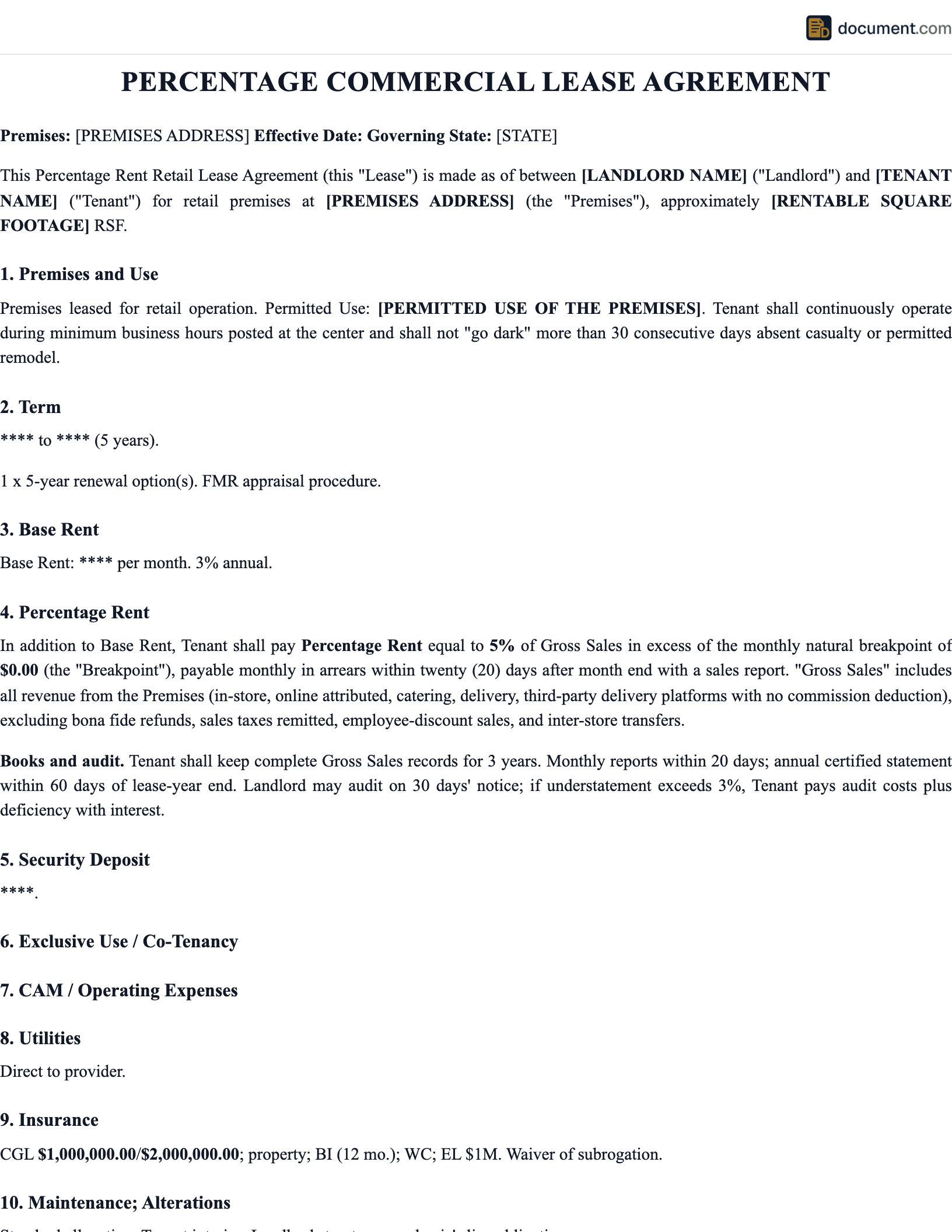
Sample Wisconsin Percentage Lease Agreement
Below is a preview of our Wisconsin-specific template. Your customized document will include all fields and provisions required for filing in any Wisconsin county.
PERCENTAGE LEASE AGREEMENT
STATE OF WISCONSIN
Legal Document Template
LANDLORD
Name: [Full Legal Name / Entity]
Property: [Shopping Center Name]
Address: [Property Address]
TENANT
Name: [Business Entity Name]
Trade Name: [DBA / Store Name]
Address: [Current Address]
Tax ID: [EIN]
PREMISES
Suite: [Number]
GLA: [Gross Leasable Area SF]
Use: [Permitted Retail Use]
Exclusive: [Product Category]
FINANCIAL TERMS
Base Rent: $[Amount]/month
Percentage Rate: [%]
Breakpoint: $[Amount]/year
CAM: $[Amount]/SF
Deposit: $[Amount]
Wisconsin Percentage Lease Agreement FAQ
Answers to common questions about filing a percentage lease agreement in Wisconsin, including requirements, fees, and procedures.
Official Wisconsin Resources
Use these official state resources to verify requirements, find your local filing office, and access government forms for Wisconsin.
Related Wisconsin Documents
Depending on your situation, you may need additional documents alongside your Wisconsin percentage lease agreement.
Create your Wisconsin Commercial Percentage Lease Agreement in under 5 minutes.
Answer a few questions and download a Wisconsin-compliant document, ready for the state agency.