
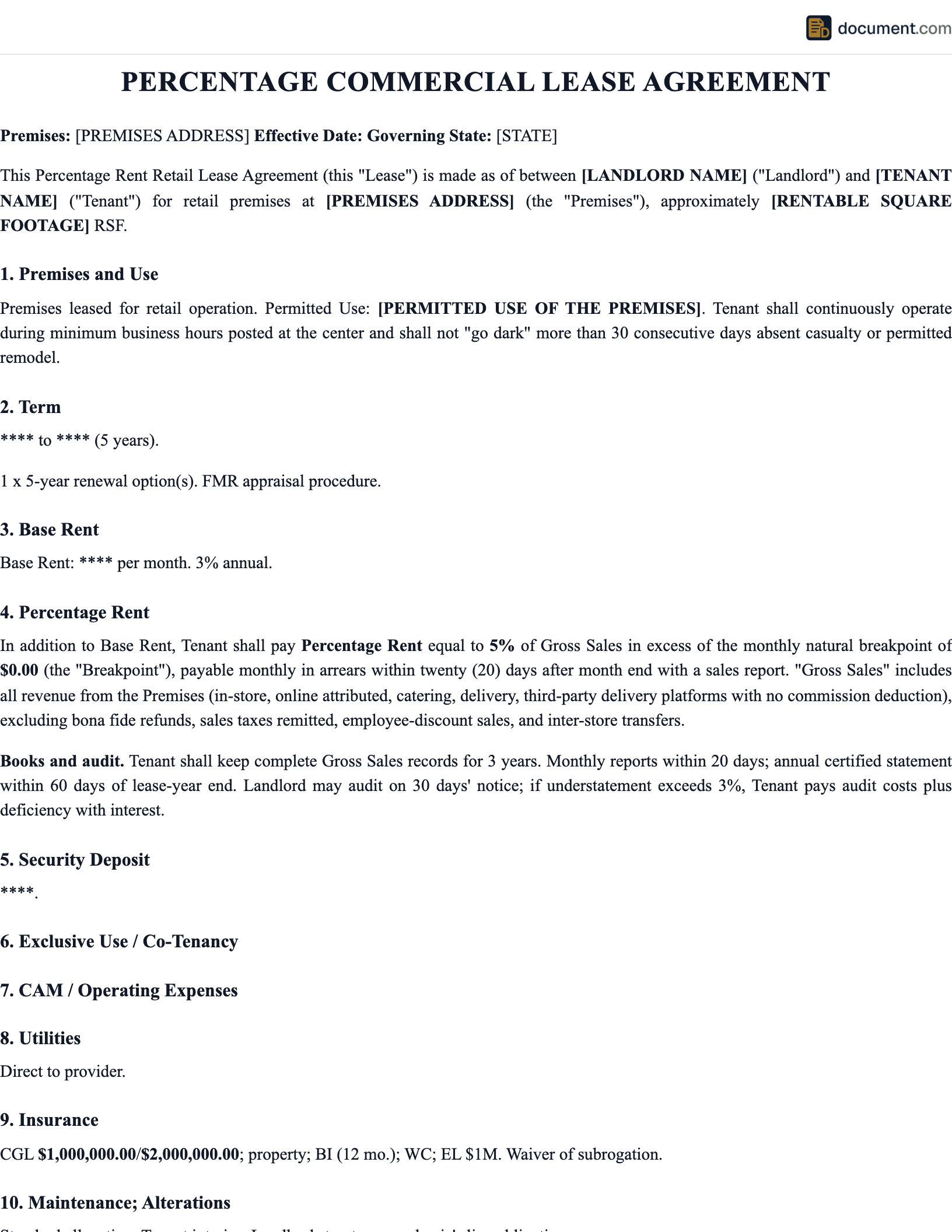



Virginia Percentage Lease Agreement Overview
A percentage lease ties part of the tenant's rent to their sales performance. The tenant pays a fixed base rent plus a percentage of gross sales above a defined breakpoint. For landlords, percentage leases provide upside when the tenant performs well. For tenants, they reduce initial fixed costs and align rent with business performance. Virginia has no statutes specifically regulating percentage lease terms, so the gross sales definition, breakpoint calculation, reporting requirements, and audit rights are all negotiated and defined in the lease document.
Percentage leases in Virginia are concentrated in the Northern Virginia mall and lifestyle center market, where high-traffic locations like Tysons Corner Center and the Mosaic District attract national retailers who expect percentage rent structures. Richmond's Short Pump Town Center and Hampton Roads' MacArthur Center are other significant retail environments where percentage leases are standard for major tenants. Outside of these concentrated retail centers, percentage leases are uncommon in the Virginia commercial market.
Base + %
Rent structure
Breakpoint
% kicks in above
Retail
Primary use case
Audit rights
Key landlord protection
Virginia Percentage Lease Requirements
Virginia percentage leases are governed by contract law. The most important provisions to get right are the gross sales definition, the breakpoint calculation method, the sales reporting schedule, and the landlord's audit rights. These provisions have direct and ongoing financial consequences throughout the lease term, and getting them wrong costs money for either the landlord or the tenant depending on which direction they are skewed.
Virginia Specific Note
Virginia does not impose a statewide commercial rent tax, which simplifies the relationship between the percentage rent calculation and the tenant's tax obligations. However, Virginia localities impose business license taxes based on gross receipts, and tenants should confirm whether gross sales for percentage rent purposes match or differ from gross receipts reported for local business license tax purposes. These definitions do not always align, and a discrepancy can affect both obligations.
Key Percentage Lease Provisions for Virginia
- Gross Sales Definition: Define precisely what is included and excluded from gross sales, negotiating out returns, refunds, sales taxes, employee discounts, and online sales fulfilled remotely
- Natural vs. Artificial Breakpoint: Push for a natural breakpoint unless the negotiated base rent is already reduced in exchange for a lower breakpoint threshold
- Reporting Schedule: Negotiate a reasonable monthly and annual reporting cadence with clear formatting requirements so the tenant knows exactly what sales data the landlord expects
- Audit Rights and Scope: Define the landlord's audit window, the tenant's right to dispute findings, and the consequences of a material discrepancy
- Co-Tenancy Protections: Include co-tenancy language in mall and lifestyle center leases that reduces rent or allows termination if anchor occupancy falls below a defined threshold
- Exclusivity and Radius Restrictions: Address whether the landlord can bring in competing retailers and whether the tenant's other locations within a defined radius affect the gross sales calculation
How to Negotiate and Execute a Virginia Percentage Lease
Negotiating a Virginia percentage lease requires attention to financial detail that goes beyond standard commercial lease review. The sales reporting mechanics and gross sales definition will govern the landlord-tenant relationship for the entire lease term.
Model the Percentage Rent Math
Before negotiating, model what the percentage rent will look like at various sales levels. Understand the breakpoint and what happens to total rent if sales significantly exceed or fall short of projections. This helps frame your negotiating priorities.
Negotiate the Gross Sales Definition
Work through the gross sales definition in detail. Identify every revenue stream the business generates and confirm whether it is included or excluded. Returns, taxes, online sales, and service revenue often become disputes if the definition is not precise.
Address Co-Tenancy and Exclusivity
In Virginia mall or lifestyle center leases, confirm whether co-tenancy protections are available and negotiate exclusivity rights to prevent the landlord from leasing nearby space to a direct competitor.
Execute the Lease with Both Parties
Both landlord and tenant sign the final lease. Virginia does not require notarization for enforceability between the parties, but some institutional landlords require it as part of their internal lease execution requirements.
Set Up Sales Reporting Systems
Implement a point-of-sale tracking system that can generate the monthly and annual gross sales reports required by the lease. Accurate and timely reporting protects the tenant from audit exposure and builds trust with the landlord.
Virginia Percentage Lease Fees & Costs
Below are the typical cost components of a Virginia percentage lease, including transaction costs and the variable rent the tenant should budget for.
| Fee / Cost | Typical Amount |
|---|---|
| Base Rent | Fixed per sq ft annually; varies by location and property type; NoVA mall base rents can be substantial |
| Percentage Rent | Typically 2% to 7% of gross sales above the breakpoint; varies by retail category |
| NNN or Operating Charges (if applicable) | Many Virginia retail percentage leases are also NNN or modified gross; confirm the full cost stack |
| Sales Reporting and Accounting | Ongoing internal cost to produce monthly reports and annual certified statements; an external accountant for the annual statement costs $500 to $2,000 |
| Attorney Review (recommended) | $1,500 to $6,000+ for percentage lease review by Virginia counsel; gross sales definition and audit rights alone justify the cost |
Sample Virginia Percentage Lease Agreement
Below is a preview of our Virginia-specific template. Your customized document will include all fields and provisions required for filing in any Virginia county.
PERCENTAGE LEASE AGREEMENT
STATE OF VIRGINIA
Legal Document Template
LANDLORD
Name: [Full Legal Name / Entity]
Property: [Shopping Center Name]
Address: [Property Address]
TENANT
Name: [Business Entity Name]
Trade Name: [DBA / Store Name]
Address: [Current Address]
Tax ID: [EIN]
PREMISES
Suite: [Number]
GLA: [Gross Leasable Area SF]
Use: [Permitted Retail Use]
Exclusive: [Product Category]
FINANCIAL TERMS
Base Rent: $[Amount]/month
Percentage Rate: [%]
Breakpoint: $[Amount]/year
CAM: $[Amount]/SF
Deposit: $[Amount]
Virginia Percentage Lease Agreement FAQ
Answers to common questions about filing a percentage lease agreement in Virginia, including requirements, fees, and procedures.
Official Virginia Resources
Use these official state resources to verify requirements, find your local filing office, and access government forms for Virginia.
Related Virginia Documents
Depending on your situation, you may need additional documents alongside your Virginia percentage lease agreement.
Create your Virginia Commercial Percentage Lease Agreement in under 5 minutes.
Answer a few questions and download a Virginia-compliant document, ready for the state agency.