



West Virginia Percentage Lease Agreement Overview
A percentage lease in West Virginia combines a base rent with a percentage of gross sales above a defined threshold, called the breakpoint. The structure aligns landlord and tenant interests by giving the landlord participation in successful tenant performance. In West Virginia, percentage leases are used primarily in retail settings, particularly in shopping centers in Charleston, Huntington, and Morgantown. The state's smaller population and retail market mean that percentage leases are less common here than in high-traffic states, but they remain the standard tool for institutional retail landlords.
West Virginia commercial leases are governed by contract law, and the gross sales definition in a percentage lease is entirely negotiated between the parties. There is no state statute that defines gross sales or mandates specific reporting requirements. The precision of the lease language controls how revenue is calculated, which expenses are excluded, and how disputes are resolved. Tenants should treat the gross sales definition as a critical negotiating point rather than standard boilerplate.
Base + %
Rent structure
Breakpoint
% kicks in above
Retail
Primary use case
Contract
Law governs
West Virginia Percentage Lease Requirements
West Virginia does not have a commercial landlord-tenant statute that specifically governs percentage leases. The contract controls all terms. That means the gross sales definition, breakpoint, reporting obligations, and audit rights must be negotiated and documented in the lease with care. West Virginia courts interpret commercial lease language literally, so ambiguous provisions will be read by the court based on plain meaning, which may not reflect what either party actually intended.
West Virginia Gross Sales Definition Note
West Virginia retail sales tax collected from customers should be excluded from the gross sales definition. The state's Business and Occupation tax on the tenant's business receipts is a separate obligation and should not be included in the lease's gross sales calculation. Tenants should also address how online or delivery orders fulfilled from the leased premises are treated, as this is increasingly contested in retail percentage leases.
Key West Virginia Percentage Lease Provisions
- Gross Sales Definition: The lease must define gross sales with specificity, including what is included, what is excluded (sales tax, returns, employee sales), and how non-store revenue is treated
- Natural vs Artificial Breakpoint: Model both scenarios before signing to understand at what sales volume percentage rent would be triggered and how much it would cost at your projected revenue
- Reporting Schedule: The lease must define the frequency of gross sales reports, the annual reconciliation deadline, and whether CPA certification is required for the annual statement
- Audit Rights: Landlords retain audit rights for prior-year sales; confirm the scope and lookback period, and negotiate limits on the frequency of audits during the lease term
- Co-Tenancy and Exclusivity: Negotiate co-tenancy protections if the center has anchor tenants that drive traffic, and exclusivity provisions that prevent the landlord from leasing space to direct competitors
How to Negotiate and Execute a West Virginia Percentage Lease
A West Virginia percentage lease requires financial modeling before negotiation and careful documentation of the agreed structure. These five steps cover the process from analysis through execution and ongoing compliance.
Model the Financial Structure Before Negotiating
Build a spreadsheet showing total rent at different sales volume scenarios. Understand what your actual gross sales would need to be before percentage rent is triggered and what the percentage rent obligation would be at your projected revenue. In West Virginia's smaller retail markets, many tenants never reach the breakpoint, making the base rent the primary economic concern
Negotiate the Gross Sales Definition
Push for explicit exclusions of West Virginia retail sales tax, returns, employee sales, and non-store revenue. The gross sales definition is the most commercially significant provision in the lease and should be negotiated with the same attention as the base rent
Address Co-Tenancy and Exclusivity
Request co-tenancy protections if the center has anchor tenants and negotiate exclusivity against direct competitors within the center. These provisions are particularly valuable in West Virginia community shopping centers where anchor vacancies have had significant impact on remaining tenant foot traffic
Have a West Virginia Attorney Review and Execute
A West Virginia commercial real estate attorney should review the gross sales definition, breakpoint structure, and operating expense components before the tenant signs. Once negotiation is complete, both parties execute the lease and it becomes binding
Set Up Sales Reporting From Day One
Configure point-of-sale reporting to track the categories defined in your lease's gross sales definition from the first day of operations. Create a calendar for monthly or quarterly report submissions and the annual reconciliation deadline, so reporting obligations are never missed and audit records are always current
West Virginia Percentage Lease Costs
Total cost under a West Virginia percentage lease includes the base rent, any percentage rent triggered above the breakpoint, and whatever operating expense charges the lease structure includes. The table below covers the main cost categories.
| Cost Item | Typical Range |
|---|---|
| Base Rent (West Virginia retail) | $10 - $30 per sq ft per year (market-dependent) |
| Percentage Rent (above breakpoint) | 3% - 7% of gross sales above breakpoint |
| NNN / Operating Expense Charges | $4 - $12 per sq ft per year (if NNN structure) |
| Sales Reporting / Annual Certification | $300 - $1,500 per year (if CPA-certified) |
| Attorney Review (West Virginia) | $750 - $2,500 |
Sample West Virginia Percentage Lease Agreement
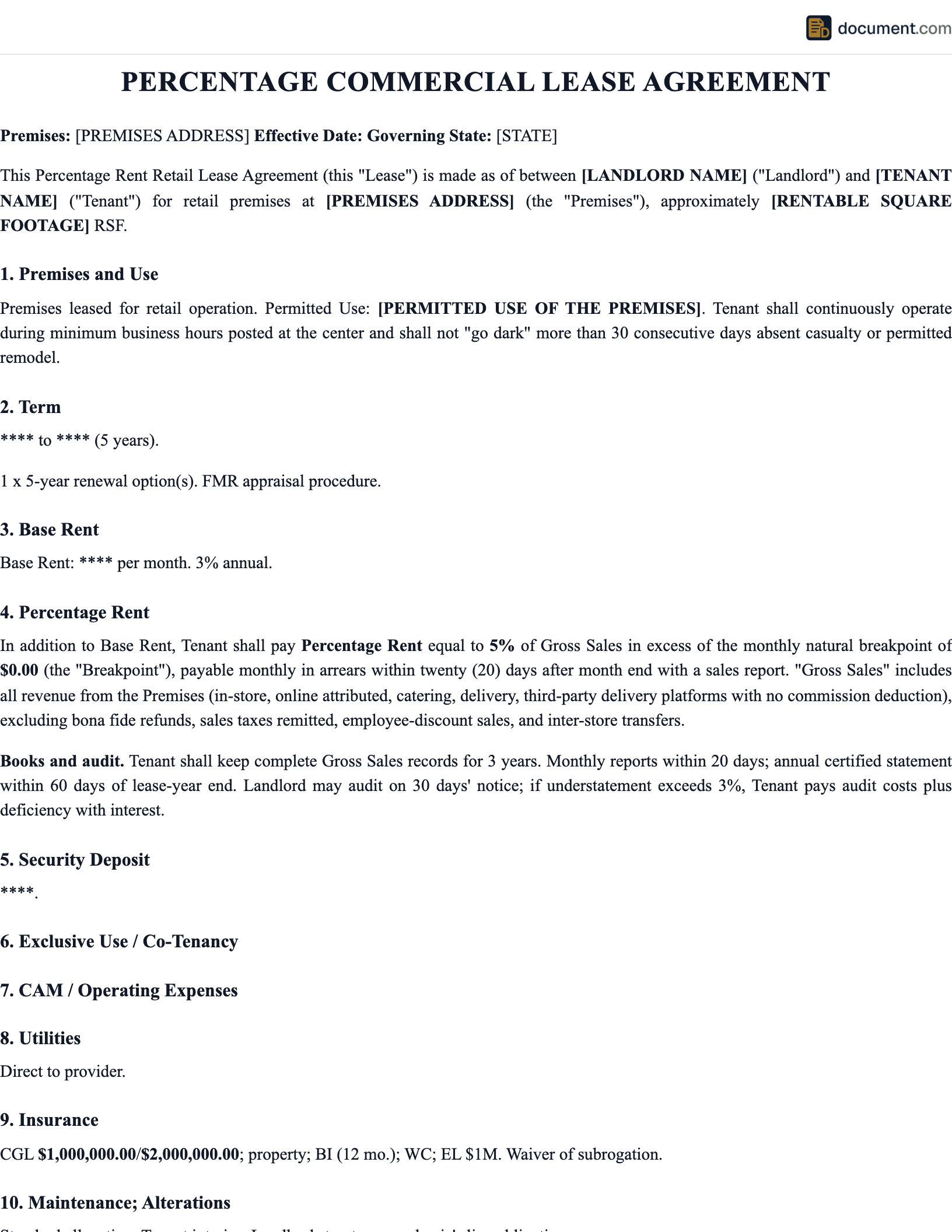
Below is a preview of our West Virginia-specific template. Your customized document will include all fields and provisions required for filing in any West Virginia county.
PERCENTAGE LEASE AGREEMENT
STATE OF WEST VIRGINIA
Legal Document Template
LANDLORD
Name: [Full Legal Name / Entity]
Property: [Shopping Center Name]
Address: [Property Address]
TENANT
Name: [Business Entity Name]
Trade Name: [DBA / Store Name]
Address: [Current Address]
Tax ID: [EIN]
PREMISES
Suite: [Number]
GLA: [Gross Leasable Area SF]
Use: [Permitted Retail Use]
Exclusive: [Product Category]
FINANCIAL TERMS
Base Rent: $[Amount]/month
Percentage Rate: [%]
Breakpoint: $[Amount]/year
CAM: $[Amount]/SF
Deposit: $[Amount]
West Virginia Percentage Lease Agreement FAQ
Answers to common questions about filing a percentage lease agreement in West Virginia, including requirements, fees, and procedures.
Official West Virginia Resources
Use these official state resources to verify requirements, find your local filing office, and access government forms for West Virginia.
Related West Virginia Documents
Depending on your situation, you may need additional documents alongside your West Virginia percentage lease agreement.
Create your West Virginia Commercial Percentage Lease Agreement in under 5 minutes.
Answer a few questions and download a West Virginia-compliant document, ready for the state agency.