



Vermont Restaurant Lease Agreement Overview
Vermont is a small state with a genuinely distinctive restaurant culture. Burlington is the commercial anchor, with a food scene supported by UVM, a regional medical center, and a population that takes local sourcing seriously. Outside Burlington, the restaurant economy runs largely on tourism, and the ski resort corridor from Stowe to Killington to Okemo represents a dramatically different leasing environment from the urban market. A good lease in Stowe is not the same document as a good lease in Burlington, even though both are Vermont.
Vermont's regulatory framework involves VDH food establishment licensing with a pre-opening inspection process that can surface real kitchen infrastructure issues in older buildings, and Vermont Department of Liquor and Lottery on-premise licensing for restaurants serving alcohol. Vermont's 9% meals and rooms tax is a meaningful percentage rent calculation variable that should be defined precisely in the lease. Historic building preservation rules in Burlington, Montpelier, and Brattleboro can constrain the buildout options available to restaurant tenants, adding cost and complexity to projects that would be straightforward in newer commercial space. Our Vermont restaurant lease template covers VDH permitting timelines, DLL license contingencies, meals tax gross sales definitions, ski resort seasonal provisions, farm delivery storage access, and historic building ADA compliance responsibilities.
$15
Filing fee
Required
Notarization
2
Witnesses required
Town
Filing office
Vermont Requirements
Vermont restaurant leases need to address VDH food permitting timelines, DLL on-premise licensing for alcohol service, the 9% meals and rooms tax as a percentage rent variable, and the specific issues that arise from operating in a state with historic commercial building stock and a ski-dependent seasonal economy.
Vermont's 9% Meals Tax Creates a Percentage Rent Definition Problem
Vermont's 9% meals and rooms tax applies to all food and beverage sales at restaurants. For percentage rent leases, the gross sales definition must specify whether the calculation uses pre-tax gross receipts or post-tax net amounts. This is not a minor drafting detail. At 9 percent, an ambiguous definition creates a significant financial dispute risk at annual reconciliation. Address it precisely before signing.
Key Requirements for Vermont Restaurant Leases
- VDH Food Establishment License and Pre-Opening Inspection: Build VDH inspection scheduling and any modification timeline into the rent commencement structure; specify who funds deficiencies identified during inspection
- DLL License Contingency with Defined Timeline: Include a Vermont DLL First Class License contingency with a specific approval timeline and termination right; confirm the correct license category for your concept and seating configuration
- Ski Resort Seasonal Provisions and Low-Snowpack Force Majeure: For Stowe, Killington, or other resort-area leases, negotiate percentage rent breakpoints that reflect actual seasonal revenue patterns and include force majeure coverage for low-traffic resort seasons
- Farm Delivery Access and Cold Storage Adequacy: Confirm loading access, delivery hours, and cold storage specifications support a locally sourced Vermont supply chain before the lease is executed
- Historic Preservation Constraints on Buildout: For National Register or historic district properties, confirm what modifications are permitted by SHPO review and how that affects TI allowance scope and ADA upgrade options
How to File in Vermont
Vermont's regulatory timeline is manageable if you sequence the VDH and DLL processes correctly and do not allow pre-opening costs to accumulate during periods when the space cannot yet operate. For resort-market operators, timing the opening to coincide with early ski season is worth negotiating into the lease structure.
Confirm Zoning, Historic Status, and DLL License Eligibility
Before signing anything, confirm restaurant-use zoning with the local municipality. For Burlington and historic downtown markets, check whether the building is a National Register property or contributing structure in a historic district, and understand what modifications will require SHPO review. Contact the Vermont DLL to verify license availability and any site restrictions for the specific address.
Walk the Kitchen and Assess Hood, Cold Storage, and Delivery Access
Inspect hood systems, grease trap, walk-in capacity, and loading or delivery access before finalizing lease terms. Vermont's farm supply chain requires delivery access that many older buildings do not provide without modification. Use contractor findings to negotiate TI allowance amounts, assign upgrade responsibility, and confirm that the lease permits the delivery hours and frequency your supply chain requires.
Execute Lease with VDH and DLL Contingencies and Precise Meals Tax Definition
Include VDH food license and DLL on-premise contingencies with defined timelines. Nail down the gross sales definition for percentage rent purposes to specify whether Vermont's 9% meals tax is included or excluded. For resort-area leases, negotiate percentage rent breakpoints and tie opening date options to early ski season if winter revenue drives the business plan.
Complete Buildout and Schedule VDH Pre-Opening Inspection
After construction, schedule the VDH pre-opening inspection. VDH will assess kitchen layout, hood systems, food storage, and sanitation configurations. Address any deficiencies before submitting the DLL application. For historic buildings, ensure any modifications made during buildout were consistent with SHPO review outcomes if applicable.
Receive DLL License, Register for Meals Tax, and Open
Submit the DLL application after VDH clearance. Once the DLL license is issued, register for Vermont meals and rooms tax collection with the Vermont Department of Taxes before opening day. Calendar annual renewal dates for both VDH and DLL licenses and establish a hood cleaning and grease system maintenance schedule from the start.
Vermont Fees & Costs
Vermont's restaurant cost structure is straightforward compared to larger states, but the 9% meals and rooms tax is one of the higher state-level rates in New England and has real implications for how percentage rent obligations are calculated over a multi-year lease term.
| Fee / Cost | Amount |
|---|---|
| Vermont Department of Health Food Establishment License (Annual) | $75 to $450 depending on establishment classification and seating capacity; confirm current fee schedule with VDH |
| Vermont DLL First Class On-Premise License (Annual) | $235 to $700 depending on license category and seating; confirm current fees with the Vermont Department of Liquor and Lottery |
| Vermont Meals and Rooms Tax | 9% on all prepared food and beverages sold for on-premise consumption; applies to both food and alcohol sales |
| Vermont Meals Tax Registration | Required before first day of service; register with the Vermont Department of Taxes; no registration fee but failure to register before opening creates liability |
| Attorney Review of Lease | $300 to $700 for Vermont commercial attorney review with DLL contingency drafting, seasonal provisions, and meals tax gross sales definition |
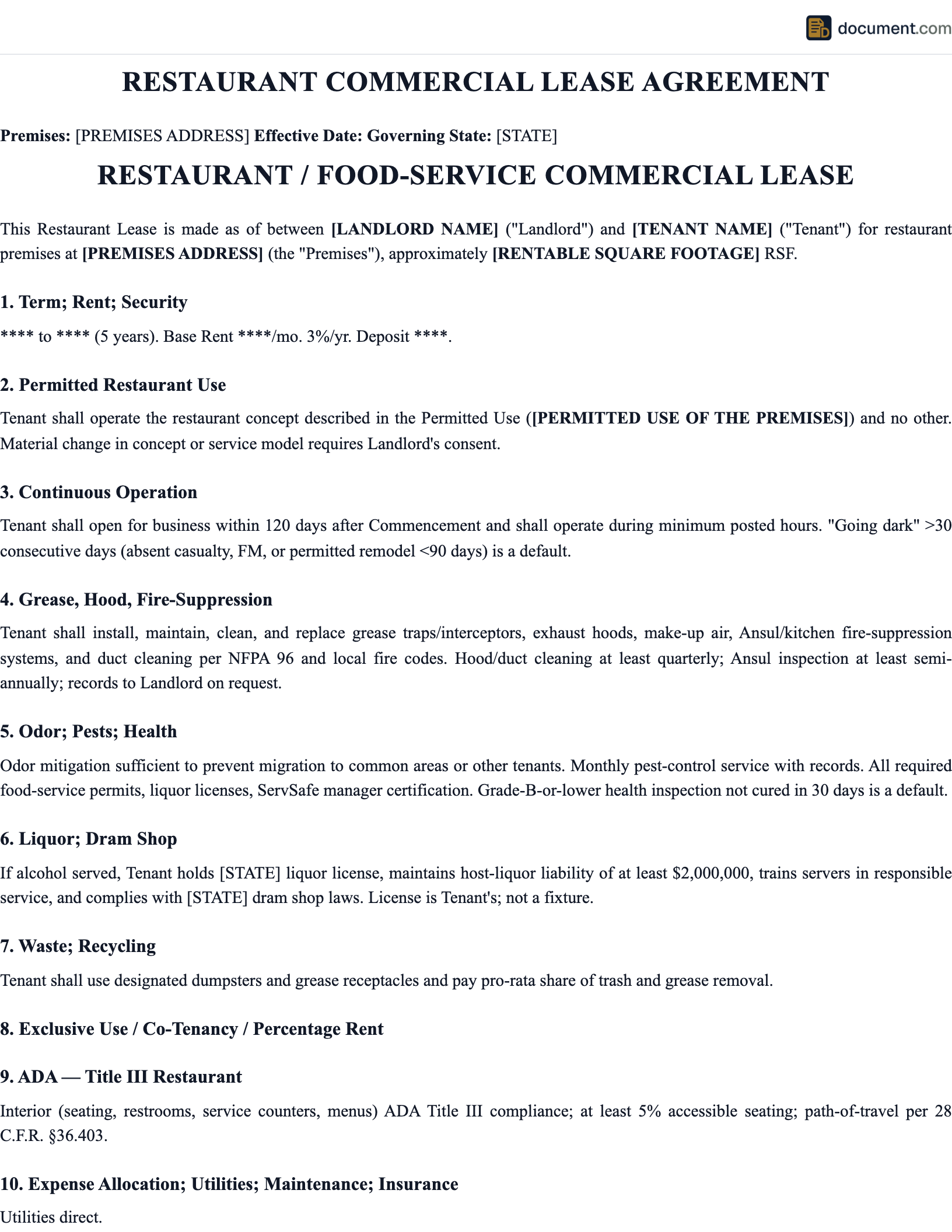
Sample Vermont Restaurant Lease Agreement
Below is a preview of our Vermont-specific template. Your customized document will include all fields and provisions required for filing in any Vermont county.
RESTAURANT LEASE AGREEMENT
STATE OF VERMONT
Legal Document Template
LANDLORD
Name: [Full Legal Name / Entity]
Property: [Building/Center Name]
Address: [Property Address]
TENANT / OPERATOR
Name: [Restaurant Entity Name]
Concept: [Restaurant Name/Concept]
Experience: [Years in Food Service]
Tax ID: [EIN]
PREMISES
Suite: [Number]
Total SF: [Square Feet]
Kitchen SF: [Square Feet]
Dining SF: [Square Feet]
Patio: [Yes/No - SF]
FINANCIAL TERMS
Base Rent: $[Amount]/month
Percentage Rate: [%] above $[Breakpoint]
TI Allowance: $[Amount]
Deposit: $[Amount]
CAM: $[Amount]/month
Vermont Restaurant Lease Agreement FAQ
Answers to common questions about filing a restaurant lease agreement in Vermont, including requirements, fees, and procedures.
Official Vermont Resources
Use these official state resources to verify requirements, find your local filing office, and access government forms for Vermont.
Related Vermont Documents
Depending on your situation, you may need additional documents alongside your Vermont restaurant lease agreement.
Create your Vermont Commercial Restaurant Lease Agreement in under 5 minutes.
Answer a few questions and download a Vermont-compliant document, ready for the state agency.