
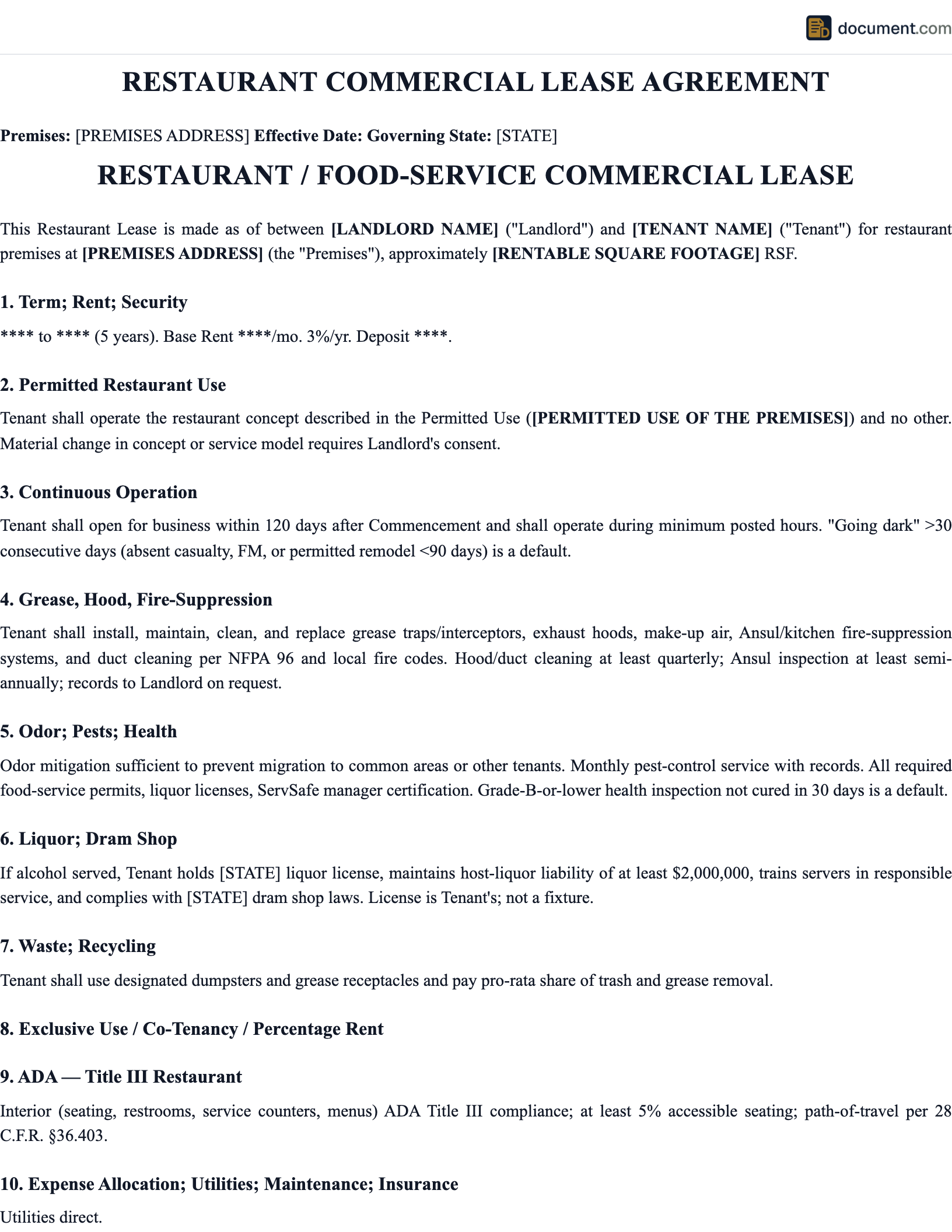



New York Restaurant Lease Agreement Overview
No state in the country has a restaurant leasing environment that divides as sharply between its major city and the rest of the state as New York. In New York City, restaurant leases in prime Manhattan locations routinely represent some of the highest commercial rents on earth, with landlords holding significant leverage, lease terms spanning 10 to 15 years, and personal guarantees expected from every operator regardless of track record. The NYC DOHMH inspection and grading system, the SLA's notoriously complex licensing process, and the city's stringent building and mechanical codes create a regulatory environment that can easily extend a restaurant's opening timeline by six to twelve months beyond what an operator might expect in other markets.
Upstate New York is a fundamentally different market. Albany, Buffalo, Rochester, and Syracuse have active restaurant scenes, but lease rates, regulatory complexity, and landlord leverage are all dramatically lower than in New York City. Upstate restaurants deal with county health departments rather than DOHMH, and SLA processing times while still meaningful are typically shorter and less contentious than in NYC. A restaurant lease negotiated in Rochester should look nothing like a lease negotiated in Midtown Manhattan, and operators should not assume that NYC-market practices apply statewide.
$55
Filing fee
Required
Notarization
0
Witnesses required
County
Filing office
New York Requirements
New York restaurant leases must address the full regulatory stack that applies before any kitchen can open. In New York City, this is especially layered and time-consuming. Skipping due diligence on ventilation approvals, SLA timelines, or DEP pretreatment requirements can cost a tenant months of rent on a space that cannot legally operate.
New York Specific Note
New York City restaurant leases operate in a fundamentally different environment from upstate New York. In NYC, hood installation requires Buildings Department permits that can take weeks to months. DEP grease trap requirements are strictly enforced. The SLA licensing process requires community board notification and can take four to six months or longer. Any NYC restaurant lease should include SLA contingency language and a rent commencement date that is tied to actual access for construction rather than lease execution.
Key Lease Provisions for New York Restaurants
- DOHMH / County Health Department: In NYC, the DOHMH inspects and grades restaurants. Upstate restaurants work with county health departments. The lease should address who prepares the space for the initial health inspection and what constitutes a delivery condition that allows the inspection to proceed
- SLA License Contingency: Include a contingency clause allowing the tenant to defer rent or terminate if an SLA on-premise license cannot be obtained within a defined period, and confirm that the location is not within 200 feet of a school or place of worship
- NYC Buildings Department Permits: For NYC locations, specify who files for and pays the cost of Buildings Department permits for hood installation, gas line work, and any structural changes. These permits can be expensive and slow
- Grease Interceptor (NYC DEP): NYC DEP requires properly sized and maintained grease interceptors. Assign installation cost and ongoing maintenance responsibility clearly, and confirm that the building's plumbing can accommodate the required interceptor size
- Good Guy Guarantee: Negotiate for a Good Guy Guarantee structure that limits the personal guarantee to the period the tenant remains in possession and vacates properly, rather than a full-term guarantee on a 10+ year NYC lease
- ADA Compliance: Assign responsibility for ADA accessibility improvements between landlord and tenant, and confirm that entrances, restrooms, and service areas meet federal requirements
How to Execute a New York Restaurant Lease
Executing a New York restaurant lease requires more pre-signature diligence than in most other states, particularly for NYC locations where the regulatory timeline can define whether your business opens on schedule or burns through months of prepaid rent on a space that cannot yet legally operate.
Engage an Attorney Before Signing
For any NYC restaurant lease, retaining an attorney experienced in New York commercial leasing is essential before signing. For upstate locations, attorney review is strongly advisable. NYC leases in particular contain provisions around Good Guy Guarantees, CAM exclusions, exclusivity, and landlord consent requirements that require professional review.
Confirm SLA Eligibility and Proximity Rules
Before signing, verify that the location is not within 200 feet of a school or house of worship, which triggers SLA proximity restrictions. Check with the local community board about any active objections to new liquor licenses in the area. Begin the SLA application process as early as possible because the timeline is almost always longer than expected.
Assess Ventilation and MEP Capacity
Have a mechanical engineer assess the existing ventilation infrastructure and the feasibility of your proposed kitchen layout. In NYC, determine the Buildings Department permit requirements for hood installation and any ductwork modifications. Confirm DEP grease interceptor requirements and whether the building's plumbing can accommodate the required size.
Negotiate and Execute the Lease
Document all negotiated buildout terms, TI allowances, rent commencement triggers, SLA contingencies, and Good Guy Guarantee structure in the final lease. Ensure rent commencement is tied to actual delivery of possession for construction, not to lease execution. Execute the lease with signatures from all parties and any guarantors.
Begin Regulatory Processes Immediately
File for Buildings Department permits for any required construction work. Submit your SLA license application and community board notification. Engage with DOHMH (NYC) or your county health department (upstate) about pre-opening inspection requirements. The regulatory calendar should drive your construction and opening timeline, not the other way around.
New York Fees & Costs
Below is a breakdown of the typical costs associated with filing this document in New York. Actual fees may vary by county.
| Fee / Cost | Amount |
|---|---|
| Filing Fee | $55 first page |
| Notarization | $5 - $25 per signature |
| Certified Copy | $1 - $10 per page |
| Attorney Review (optional) | $150 - $500 |
Sample New York Restaurant Lease Agreement
Below is a preview of our New York-specific template. Your customized document will include all fields and provisions required for filing in any New York county.
RESTAURANT LEASE AGREEMENT
STATE OF NEW YORK
Legal Document Template
LANDLORD
Name: [Full Legal Name / Entity]
Property: [Building/Center Name]
Address: [Property Address]
TENANT / OPERATOR
Name: [Restaurant Entity Name]
Concept: [Restaurant Name/Concept]
Experience: [Years in Food Service]
Tax ID: [EIN]
PREMISES
Suite: [Number]
Total SF: [Square Feet]
Kitchen SF: [Square Feet]
Dining SF: [Square Feet]
Patio: [Yes/No - SF]
FINANCIAL TERMS
Base Rent: $[Amount]/month
Percentage Rate: [%] above $[Breakpoint]
TI Allowance: $[Amount]
Deposit: $[Amount]
CAM: $[Amount]/month
New York Restaurant Lease Agreement FAQ
Answers to common questions about filing a restaurant lease agreement in New York, including requirements, fees, and procedures.
Tax Implications for New York Restaurant Leases
New York City imposes a Commercial Rent Tax on tenants in certain Manhattan locations whose annual base rent exceeds $250,000. This tax applies to businesses below 96th Street in Manhattan and is calculated as a percentage of the annual rent. It is separate from the base rent obligation and can add several percentage points to the effective cost of occupancy. Upstate New York restaurant tenants are not subject to this tax.
New York State sales tax applies to prepared food and beverage sales, including restaurant meals. The combined state and local rate in New York City is currently 8.875%. Upstate rates vary by county. Restaurant operators must register with the Department of Taxation and Finance and collect and remit sales tax on applicable sales. The lease itself is a deductible business expense for income tax purposes.
Tenant improvement allowances received from landlords may be treated as taxable income in the year received, though the tenant can typically offset this with depreciation deductions on the improvements made. In NYC, the cost of leasehold improvements is often substantial, and the tax treatment of these expenditures warrants attention from a qualified accountant.
Important Considerations for New York Restaurant Tenants
The SLA licensing timeline is one of the most significant practical constraints in NYC restaurant leasing. A restaurant tenant who signs a lease expecting to open in four months and then discovers the SLA process takes eight months will pay rent on a non-operating space. This is common enough that experienced NYC restaurant lawyers routinely include SLA milestone provisions in their clients' leases.
Percentage rent clauses are common in NYC restaurant leases, particularly in high-foot-traffic retail corridors. Tenants should understand how the breakpoint is calculated, whether gross sales include delivery platform revenue, and how the landlord audits reported sales figures. Delivery app revenue has become a significant portion of restaurant gross receipts, and leases written before the delivery economy expanded may not address it clearly.
Upstate New York restaurants deal with a very different leasing reality than NYC operators. Buffalo and Rochester in particular have active restaurant communities with reasonable lease rates and landlords who are often more willing to negotiate improvements and buildout contributions. The upstate market rewards operators who understand local neighborhood dynamics and can negotiate from a position of genuine market knowledge.
NYC Commercial Rent Tax Warning
If you are leasing restaurant space in Manhattan below 96th Street with an annual base rent above $250,000, factor the New York City Commercial Rent Tax into your occupancy cost projections from the outset. Many first-time NYC tenants are surprised to discover this additional cost after signing. Confirm the applicable rate and any available credits with a New York tax professional.
Official New York Resources
These official agencies handle restaurant health permits, liquor licensing, and business tax registration for New York operators.
NYC DOHMH Restaurant Permits
NYC restaurant permit applications and inspection grades
New York State Liquor Authority
On-premise liquor license applications and compliance
NY Department of Taxation and Finance
Sales tax registration and Commercial Rent Tax information
NYC Department of Buildings
Building permits for kitchen equipment and ventilation systems
Related New York Documents
Depending on your situation, you may need additional documents alongside your New York restaurant lease agreement.
Create your New York Commercial Restaurant Lease Agreement in under 5 minutes.
Answer a few questions and download a New York-compliant document, ready for the state agency.