



New Jersey Restaurant Lease Agreement Overview
New Jersey's restaurant market divides into three distinct zones: northern New Jersey's dense urban and suburban markets tied to New York City overflow demand, central New Jersey's transit-corridor towns and suburban retail strips, and southern New Jersey's Shore-driven seasonal market and Atlantic City casino competition. Food service licensing in New Jersey runs through each municipality's local health department rather than a state agency, which means a restaurant's retail food establishment license is site-specific and administered by one of New Jersey's 566 municipalities with its own inspection procedures and fee schedules.
Liquor licensing in New Jersey is among the most complex and restrictive in the country, with license quotas set at the municipal level and active licenses selling on the secondary market for substantial sums. Restaurants unable to secure a liquor license through the ABC quota system often operate as BYO establishments, a model that is common in New Jersey and has its own customer base. A New Jersey restaurant lease must address local health department licensing timelines, the liquor license situation and zoning confirmation, NJ's 6.625% sales tax treatment in percentage rent calculations, and TI allowance terms calibrated to the significant buildout costs common in this market.
$15
Filing fee
Required
Notarization
0
Witnesses required
County
Filing office
New Jersey Requirements
New Jersey has specific requirements for this type of legal document. Meeting these requirements ensures your document is accepted by the county clerk and is legally enforceable.
New Jersey Liquor License and Health Permit Note
New Jersey's liquor license quota system means that restaurants in many municipalities cannot obtain a new license and must purchase one on the secondary market, which can cost $100,000 to $500,000 or more in competitive markets. The lease should address the liquor licensing situation before execution. Health department licenses are site-specific and issued by the local municipality; a pre-opening inspection is required and cannot be waived.
Key Lease Requirements
- Municipal health permit contingency: Lease should be contingent on the tenant receiving a satisfactory pre-opening health inspection and retail food establishment license from the local municipality
- ABC liquor license and zoning confirmation: Confirm the property is in a zone that permits liquor sales, the municipal quota status, and address the tenant's responsibility for securing an ABC license
- Hood and grease system responsibility: Define which party installs, maintains, and replaces the commercial kitchen exhaust system, grease trap, and NFPA 96-compliant fire suppression system
- Sales tax exclusion in percentage rent: Specify that NJ sales tax collected on restaurant sales is excluded from the percentage rent gross sales calculation
- ADA path-of-travel obligations: Address which party bears ADA compliance costs for existing conditions and buildout-triggered path-of-travel improvements under the NJ Law Against Discrimination
How to Execute a New Jersey Restaurant Lease
Executing a restaurant lease in New Jersey requires addressing the municipal health permit, the ABC liquor license situation, and zoning confirmation before committing to a buildout, particularly in markets where licenses are difficult or expensive to obtain.
Confirm zoning, health permit eligibility, and liquor license status
Verify the space is zoned for restaurant use and that the municipality's health department licenses the food service establishment type planned. Determine the municipal liquor license quota status and whether a BYO exemption applies if a full license is unavailable or cost-prohibitive.
Inspect kitchen infrastructure and negotiate TI allowance
Inspect the existing hood system, grease trap, HVAC, and fire suppression systems. Negotiate TI allowance terms that clearly define which capital items are covered, the disbursement schedule, and landlord's approval rights over contractors. In northern NJ near New York, TI allowances in competitive spaces can be substantial and are worth negotiating hard.
Execute the lease with municipal permit contingency
Both parties sign the lease, but the tenant's obligation to begin paying rent should be contingent on obtaining the municipal health department pre-opening approval and certificate of occupancy. This protects the tenant from paying rent during a permit process that is entirely within the local municipality's control.
Apply to the local health department and pursue ABC licensing simultaneously
Submit the retail food establishment application to the municipal health department and schedule the pre-opening inspection. If pursuing a liquor license, begin the ABC application or secondary-market purchase process simultaneously, since ABC approval timelines are measured in months and the license must be in place before any alcohol is served.
Retain all originals and confirm insurance
Each party retains original executed copies of the lease and all addenda. Confirm commercial general liability and dram shop insurance coverage before opening. Notify the landlord when the health permit and ABC license are issued so the rent commencement date under any contingency provision can be confirmed.
New Jersey Fees & Costs
Below is a breakdown of the typical costs associated with filing this document in New Jersey. Actual fees may vary by county.
| Fee / Cost | Amount |
|---|---|
| Filing Fee | $15 per page |
| Notarization | $5 - $25 per signature |
| Certified Copy | $1 - $10 per page |
| Attorney Review (optional) | $150 - $500 |
Tax Implications of a New Jersey Restaurant Lease
New Jersey imposes a 6.625% sales tax on prepared food and beverages sold at restaurants. This tax is collected from customers at point of sale and remitted to the New Jersey Division of Taxation. Percentage rent clauses in restaurant leases should explicitly state that sales tax collected from customers is excluded from the gross sales figure used to calculate percentage rent, since it is a pass-through collected on behalf of the state rather than revenue earned by the tenant.
New Jersey imposes a Corporation Business Tax on corporations doing business in the state, and pass-through entities may face the BAIT (Business Alternative Income Tax) at the entity level for NJ income. Tenant improvement allowances received from the landlord are generally treated as reductions in the tenant's depreciable cost basis rather than income, but this treatment depends on how the allowance is structured; tenants should consult a NJ CPA before closing lease terms involving large TI packages. Property taxes in New Jersey are among the highest in the country, and triple-net leases that pass property taxes through to restaurant tenants can significantly affect the real cost of occupancy in suburban markets.
Atlantic City and surrounding Atlantic County casino-adjacent restaurants should be aware of the Casino Revenue Fund and the specific licensing and tax treatment that applies to operations within casino facilities versus freestanding restaurants. For northern NJ restaurants near the New York border, multistate income allocation rules may apply to operators who also have locations in New York.
Important Considerations for New Jersey Restaurant Tenants
Professional Recommendation
New Jersey restaurant leases benefit significantly from attorney review before execution, particularly around the ABC liquor license situation, municipal health permit contingencies, and percentage rent calculation language. The complexity of NJ's 566-municipality licensing structure and the high cost of secondary-market liquor licenses make local legal counsel essential for any restaurant transaction in competitive NJ markets.
Northern NJ's NYC overflow market
Towns along the Hudson waterfront and in Bergen, Essex, and Union counties draw significant restaurant demand from commuters and NYC residents priced out of the city. Lease terms in these markets are competitive, with landlords in desirable locations like Hoboken, Jersey City, Montclair, and Summit commanding rents and TI structures comparable to outer-borough New York. Tenants should budget carefully for the true cost of entering these markets, including the potential cost of acquiring a secondary-market liquor license.
BYO culture as a viable alternative
New Jersey has a well-established BYO restaurant culture that is largely unique in the US, and many successful NJ restaurants operate profitably without a liquor license by leaning into the BYO model. A lease for a BYO restaurant should confirm that the municipality permits BYO operations and that the building does not have any deed restrictions or prior license conditions that conflict. In some municipalities, BYO restaurants are restricted to wine and beer only, while others permit spirits as well; these distinctions matter for the concept's menu and positioning.
Atlantic City casino competition in southern NJ
Freestanding restaurants in Atlantic County face significant competition from casino resort dining operations that subsidize restaurant experiences as part of their gaming revenue strategy. Leases in southern NJ markets near Atlantic City should be realistic about revenue projections during the off-season and consider whether percentage rent structures and natural breakpoints are calibrated appropriately for the Shore's seasonal demand patterns rather than annualized figures derived from year-round markets.
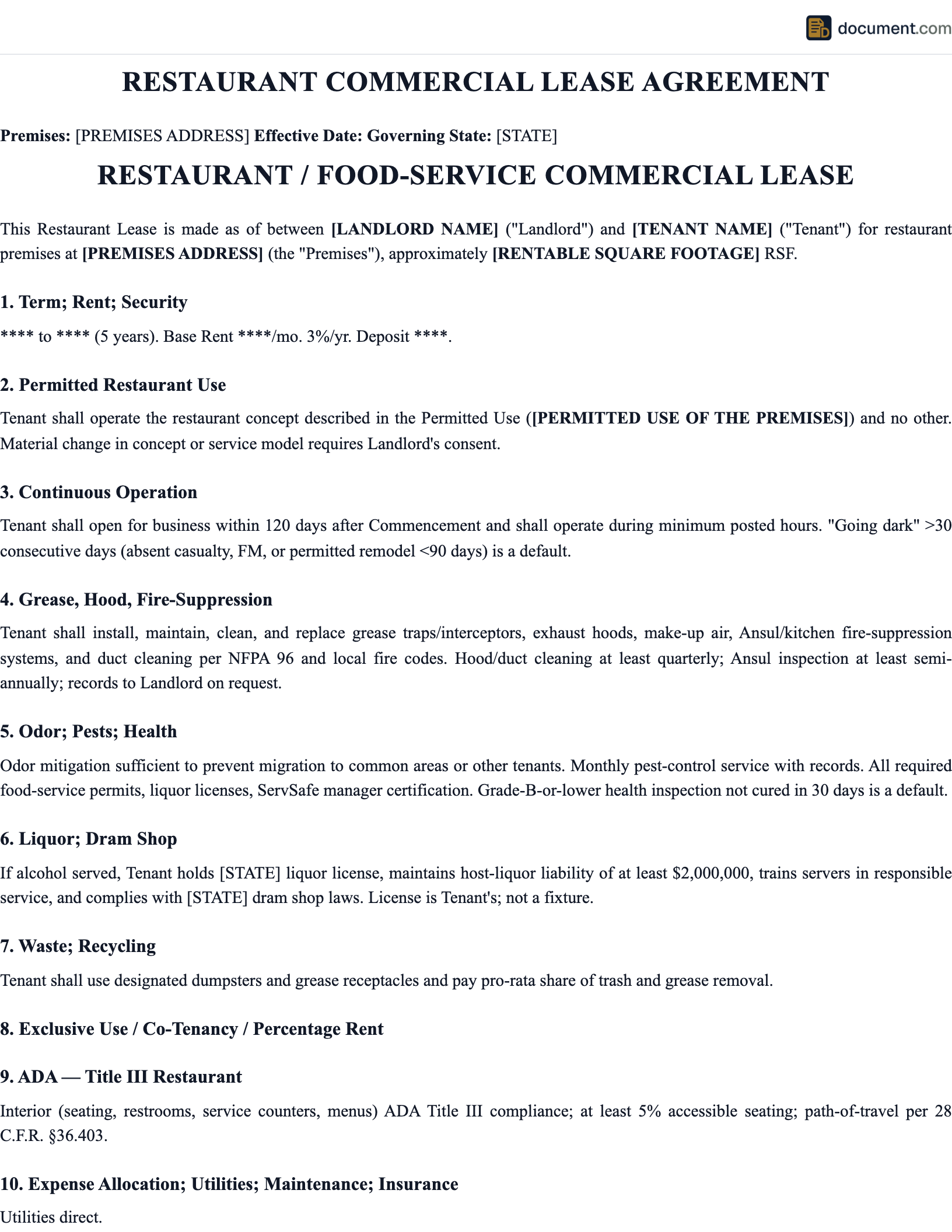
Sample New Jersey Restaurant Lease Agreement
Below is a preview of our New Jersey-specific template. Your customized document will include all fields and provisions required for filing in any New Jersey county.
RESTAURANT LEASE AGREEMENT
STATE OF NEW JERSEY
Legal Document Template
LANDLORD
Name: [Full Legal Name / Entity]
Property: [Building/Center Name]
Address: [Property Address]
TENANT / OPERATOR
Name: [Restaurant Entity Name]
Concept: [Restaurant Name/Concept]
Experience: [Years in Food Service]
Tax ID: [EIN]
PREMISES
Suite: [Number]
Total SF: [Square Feet]
Kitchen SF: [Square Feet]
Dining SF: [Square Feet]
Patio: [Yes/No - SF]
FINANCIAL TERMS
Base Rent: $[Amount]/month
Percentage Rate: [%] above $[Breakpoint]
TI Allowance: $[Amount]
Deposit: $[Amount]
CAM: $[Amount]/month
New Jersey Restaurant Lease Agreement FAQ
Answers to common questions about filing a restaurant lease agreement in New Jersey, including requirements, fees, and procedures.
Official New Jersey Resources
Use these official state resources to verify requirements, find your local filing office, and access government forms for New Jersey.
Related New Jersey Documents
Depending on your situation, you may need additional documents alongside your New Jersey restaurant lease agreement.
Create your New Jersey Commercial Restaurant Lease Agreement in under 5 minutes.
Answer a few questions and download a New Jersey-compliant document, ready for the state agency.