



Pennsylvania Restaurant Lease Agreement Overview
Pennsylvania presents a restaurant leasing environment shaped by forces you will not encounter anywhere else: a PLCB quota system that makes full liquor licenses scarce and expensive in Philadelphia and Pittsburgh, a robust BYOB culture that emerged partly in response to that scarcity, and city-specific health department programs in Philadelphia and Allegheny County that operate separately from the state Department of Agriculture. Getting clear on the liquor licensing situation before you negotiate the lease is not optional. Secondary market PLCB licenses in Philadelphia routinely trade at prices that fundamentally alter the financial model.
The Philadelphia restaurant market is among the most active in the country, with neighborhoods like Fishtown, East Passyunk, and Rittenhouse commanding rents that reflect genuine demand. The Strip District and Lawrenceville have become Pittsburgh's highest-velocity restaurant neighborhoods. In both cities, historic building conversions create ADA compliance challenges and grease infrastructure gaps that show up in pre-opening inspections. Pennsylvania sales tax on prepared food is 6% statewide, with Philadelphia stacking an additional 3% on top. These rates matter directly for how percentage rent provisions in the lease should be structured.
$188.50
Filing fee
Required
Notarization
0
Witnesses required
Recorder
Filing office
Pennsylvania Requirements
Pennsylvania restaurant leases need to address the PLCB quota situation or BYOB use authorization, the applicable city or state health department with inspection jurisdiction, historic building ADA compliance costs, Philadelphia Water Department grease control obligations, and percentage rent gross sales definitions that account for Pennsylvania's layered sales tax structure.
PLCB Quota Scarcity Warning for Philadelphia and Allegheny County
PLCB restaurant liquor licenses in Philadelphia and Allegheny County are not available through the standard new license process. Secondary market acquisition is the only path, and prices in Philadelphia run six figures in most neighborhoods. Investigate license availability and cost before negotiating lease terms. The lease should include a PLCB contingency allowing termination or rent renegotiation if a license cannot be secured within a defined period. BYOB concepts need explicit authorization in the use clause.
Key Provisions for Pennsylvania Restaurant Leases
- Health Authority Jurisdiction: Identify whether Philadelphia Department of Public Health, Allegheny County Health Department, or the state Department of Agriculture has inspection authority over the specific premises
- PLCB Contingency or BYOB Use Clause: Include a PLCB license contingency for full-service concepts specifying the timeline and tenant remedies, or explicit BYOB use authorization for concepts relying on customer-brought alcohol
- Historic Preservation and ADA Costs: In Philadelphia historic districts and older Pittsburgh neighborhoods, allocate who bears Philadelphia Historical Commission review costs and ADA remediation expenses during buildout
- Philadelphia Water Department Grease Control: For Philadelphia locations, assign who maintains the grease interceptor, who retains cleaning records, and who covers the cost of upgrades if PWD requires a larger interceptor
- Percentage Rent Gross Sales Definition: Define whether gross sales include or exclude state and local sales tax collections, given Philadelphia's 9% combined rate makes the difference material over a full lease term
How to Execute a Pennsylvania Restaurant Lease
Pennsylvania restaurant lease execution involves more pre-signing due diligence than most states, primarily because the PLCB licensing situation requires real investigation before you commit to rent. Work through these steps before any letter of intent is signed.
Research PLCB License Availability and Secondary Market Cost
Before touring any lease space in Philadelphia or Allegheny County, determine whether a PLCB restaurant license is available through the standard process or only through secondary market acquisition. Get current secondary market pricing from a Pennsylvania liquor license broker before you commit to any rent number, since the license cost affects the entire financial model of the deal.
Identify the Applicable Health Authority and Request Inspection History
Determine whether the Philadelphia Department of Public Health, Allegheny County Health Department, or the state Department of Agriculture has jurisdiction over the premises. Request the prior inspection history from the landlord. Prior violations in the kitchen or food storage areas predict what your pre-opening inspection will find and inform your TI allowance negotiation.
Negotiate Lease with PLCB and Permitting Protections
Have a Pennsylvania commercial attorney draft the lease to include a PLCB license contingency or explicit BYOB use authorization, health permit commencement trigger, TI allowance coverage for Philadelphia Water Department grease control requirements and ADA work, and historic preservation cost allocation for Philadelphia historic district properties.
Complete Buildout and Obtain Health Permit
After lease execution, complete construction and schedule the pre-opening inspection with the applicable health authority. Philadelphia's inspection process can involve multiple departments for historic conversions. Confirm the permit approval date in writing for rent commencement purposes if the lease uses a health permit trigger.
Complete PLCB Licensing or Establish BYOB Operations
If pursuing a PLCB license, submit the application and allow several months for the PLCB premises inspection and approval process. Plan lease commencement timing around this timeline. For BYOB concepts, post a clear customer-facing BYOB policy that complies with local municipal ordinances, and confirm what local rules apply to the specific municipality where the restaurant is located.
Pennsylvania Restaurant Lease Fees and Costs
Pennsylvania restaurant operators face a cost structure shaped by PLCB secondary market license acquisition, city or state health department permitting, and layered sales tax obligations that differ significantly between Philadelphia and the rest of the state.
| Fee / Cost | Typical Range |
|---|---|
| PLCB Restaurant Liquor License Annual Fee | $700 - $1,600 per year for the annual PLCB license renewal after acquisition |
| PLCB License Secondary Market Acquisition (Philadelphia) | $100,000 - $300,000+ depending on neighborhood and recent comparable transactions in Philadelphia County |
| Health Department Food Facility License (Annual) | $100 - $600 depending on city or county authority, facility size, and risk category |
| Pennsylvania Sales Tax on Prepared Food | 6% statewide; 9% total in Philadelphia (6% state plus 2% city plus 1% School District tax) |
| Grease Interceptor Maintenance (Philadelphia) | $400 - $1,200 per cleaning cycle per Philadelphia Water Department grease control program requirements |
| Pennsylvania Commercial Attorney Lease Review | $1,500 - $4,000 for full review and negotiation support on a Philadelphia or Pittsburgh restaurant lease |
Sample Pennsylvania Restaurant Lease Agreement
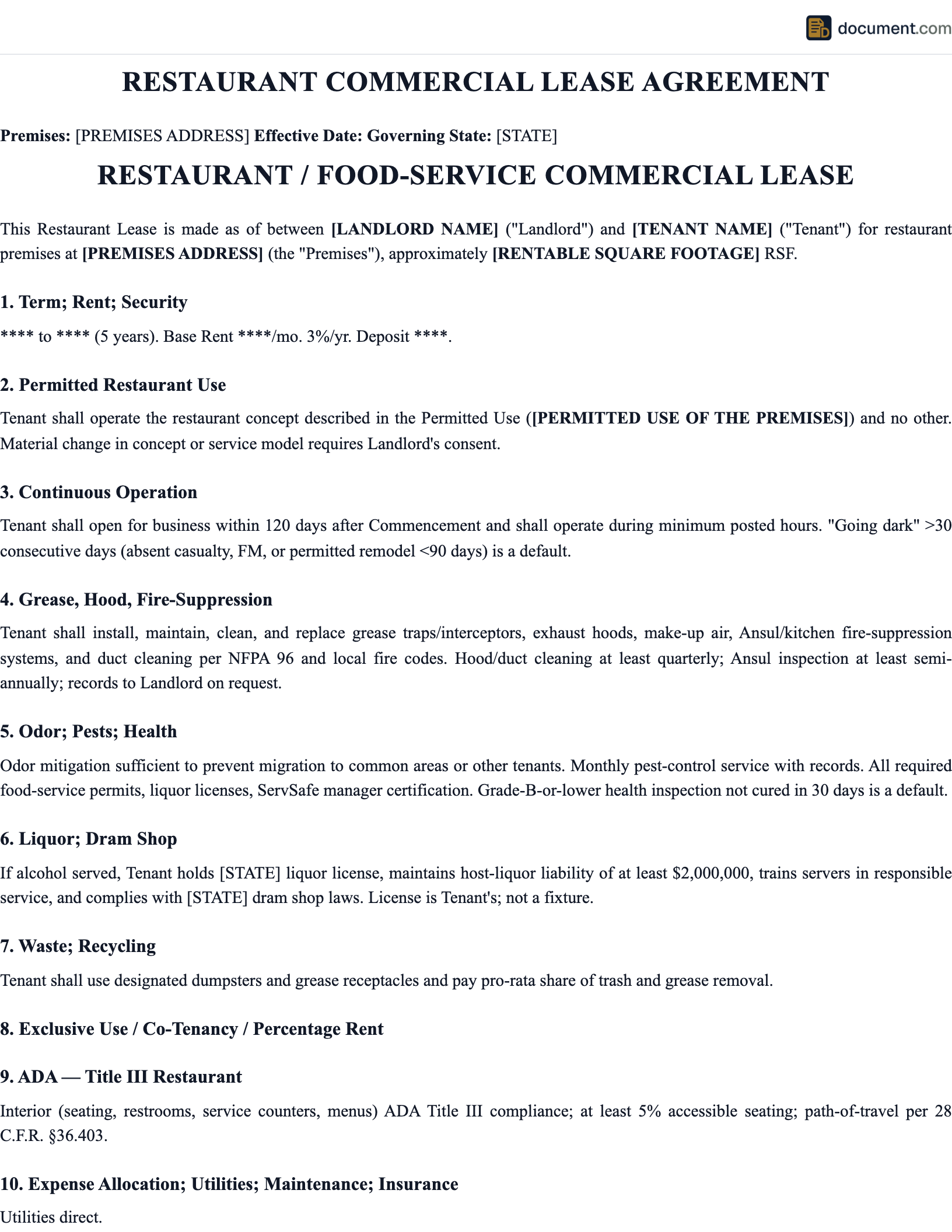
Below is a preview of our Pennsylvania-specific template. Your customized document will include all fields and provisions required for filing in any Pennsylvania county.
RESTAURANT LEASE AGREEMENT
STATE OF PENNSYLVANIA
Legal Document Template
LANDLORD
Name: [Full Legal Name / Entity]
Property: [Building/Center Name]
Address: [Property Address]
TENANT / OPERATOR
Name: [Restaurant Entity Name]
Concept: [Restaurant Name/Concept]
Experience: [Years in Food Service]
Tax ID: [EIN]
PREMISES
Suite: [Number]
Total SF: [Square Feet]
Kitchen SF: [Square Feet]
Dining SF: [Square Feet]
Patio: [Yes/No - SF]
FINANCIAL TERMS
Base Rent: $[Amount]/month
Percentage Rate: [%] above $[Breakpoint]
TI Allowance: $[Amount]
Deposit: $[Amount]
CAM: $[Amount]/month
Pennsylvania Restaurant Lease Agreement FAQ
Answers to common questions about filing a restaurant lease agreement in Pennsylvania, including requirements, fees, and procedures.
Official Pennsylvania Resources
Use these official state resources to verify requirements, find your local filing office, and access government forms for Pennsylvania.
Related Pennsylvania Documents
Depending on your situation, you may need additional documents alongside your Pennsylvania restaurant lease agreement.
Create your Pennsylvania Commercial Restaurant Lease Agreement in under 5 minutes.
Answer a few questions and download a Pennsylvania-compliant document, ready for the state agency.