



Louisiana Restaurant Lease Agreement Overview
Louisiana has the most complex and storied restaurant culture of any state in the country, and New Orleans in particular is unlike any other food city in America. The French Quarter and the broader New Orleans market support a density of fine dining, neighborhood bistros, po-boy shops, and late-night dining operations that has shaped American cuisine for over two centuries. Baton Rouge and Shreveport support substantial restaurant markets of their own, and the Cajun country corridor from Lafayette through Lake Charles represents a regional food culture with its own distinct identity. A restaurant lease in Louisiana needs to account for all of this context, as well as the state's unique legal framework.
Louisiana is the only state in the country that operates under civil law rather than common law, and this distinction matters significantly for commercial leases. The Louisiana Civil Code governs lease relationships differently than common law principles used in every other state, and lease terms that are standard in common law jurisdictions may not carry the same legal meaning or enforceability in Louisiana. Beyond the civil law framework, Louisiana restaurant operators must navigate LDH food service permitting, ATC liquor licensing, the two-witness and notarization requirements for valid lease execution, and in New Orleans, a layer of city-specific regulations that apply on top of state requirements.
$55
Filing fee
Required
Notarization
2
Witnesses required
Clerk
Filing office
Louisiana Restaurant Lease Requirements
Louisiana restaurant leases face a set of requirements that is categorically different from leases in common law states. The civil law framework, two-witness execution requirement, and the complexity of New Orleans-specific regulations mean that a standard commercial lease template from another state is not appropriate for a Louisiana restaurant.
Two Witnesses Required for Valid Louisiana Lease Execution
Louisiana is the only U.S. state that requires two witnesses in addition to notarization for a commercial lease to be properly executed and recordable. Both witnesses must be present at signing and must be disinterested parties. A Louisiana restaurant lease that lacks the two required witnesses may not be enforceable under the Louisiana Civil Code. Do not use an out-of-state lease template that does not account for this requirement.
Key Lease Provisions for Louisiana Restaurants
- Civil Code Compliance: The lease must be drafted under Louisiana Civil Code lease principles, not common law; terms like lessor, lessee, and lease term carry specific civil code meanings in Louisiana
- LDH Food Service Permit Contingency: Tie rent commencement to the Louisiana Department of Health issuing a food service permit, with a right of termination if the permit is denied after a good-faith application
- ATC License Contingency: Confirm the premises qualify for the required ATC retail dealer license tier and include a contingency provision if the license cannot be obtained
- Grease Trap and DEQ Compliance: Assign grease interceptor installation, sizing per DEQ and local sewerage requirements, maintenance, and pumping manifests to a named party
- NFPA 96 Hood System: Specify whether the landlord delivers a code-compliant hood or whether the tenant installs one, and allocate fire suppression inspection and cleaning costs
- New Orleans VCC Compliance: For French Quarter locations, address Vieux Carré Commission approval requirements for any exterior modifications and confirm how VCC restrictions affect the permitted buildout scope
- Mardi Gras and Jazz Fest Provisions: Address parade route access restrictions, percentage rent treatment during peak periods, and force majeure provisions for city-imposed event restrictions
How to Execute a Louisiana Restaurant Lease
Executing a Louisiana restaurant lease correctly requires following civil code formalities, coordinating regulatory approvals, and in New Orleans, navigating city-specific permit processes that run parallel to state requirements. Follow these steps.
Conduct Pre-Lease Site and Regulatory Verification
Verify the location qualifies for the required ATC retail dealer license, confirm zoning permits a food service establishment, and inspect the kitchen infrastructure for LDH plan review compatibility. In New Orleans, also confirm whether the location is subject to Vieux Carré Commission oversight and identify any historic preservation covenants that affect the buildout.
Draft the Lease Under Louisiana Civil Code
Engage a Louisiana attorney to draft or review the lease. The lease must use Louisiana Civil Code-compliant language and structure, include LDH and ATC contingency provisions, address the two-witness execution requirement, assign grease trap and hood responsibilities, and for New Orleans locations, address VCC compliance and event season provisions.
Execute the Lease with Two Witnesses and a Louisiana Notary
Both parties must sign the lease before a Louisiana notary public, with two disinterested witnesses present at the signing. Each witness must sign and provide their printed name and address. Louisiana notaries often play a more active role in the execution process than notaries in common law states. Do not sign before fewer than two witnesses; an improperly witnessed lease may not be enforceable or recordable.
Submit LDH Plan Review and ATC License Application
After lease execution, submit the LDH food service permit application with floor plans showing kitchen layout, equipment, and handwashing stations. Simultaneously apply for the ATC retail dealer license with the signed lease as proof of the premises. In Orleans Parish, also submit the city of New Orleans alcohol permit application. ATC and city permitting processes run concurrently and each has its own timeline.
Record the Lease with the Clerk of Court and Open
File the executed lease with the Clerk of Court in the parish where the property is located. Recording fees start at $55 for the first page. Once LDH issues the food service permit and ATC issues the retail dealer license, the restaurant is ready to operate. Post all required permits in a visible location inside the restaurant as required by Louisiana law.
Louisiana Fees & Costs
Below is a breakdown of the typical costs associated with filing this document in Louisiana. Actual fees may vary by county.
| Fee / Cost | Amount |
|---|---|
| Filing Fee | $55 first page |
| Notarization | $5 - $25 per signature |
| Certified Copy | $1 - $10 per page |
| Attorney Review (optional) | $150 - $500 |
Sample Louisiana Restaurant Lease Agreement
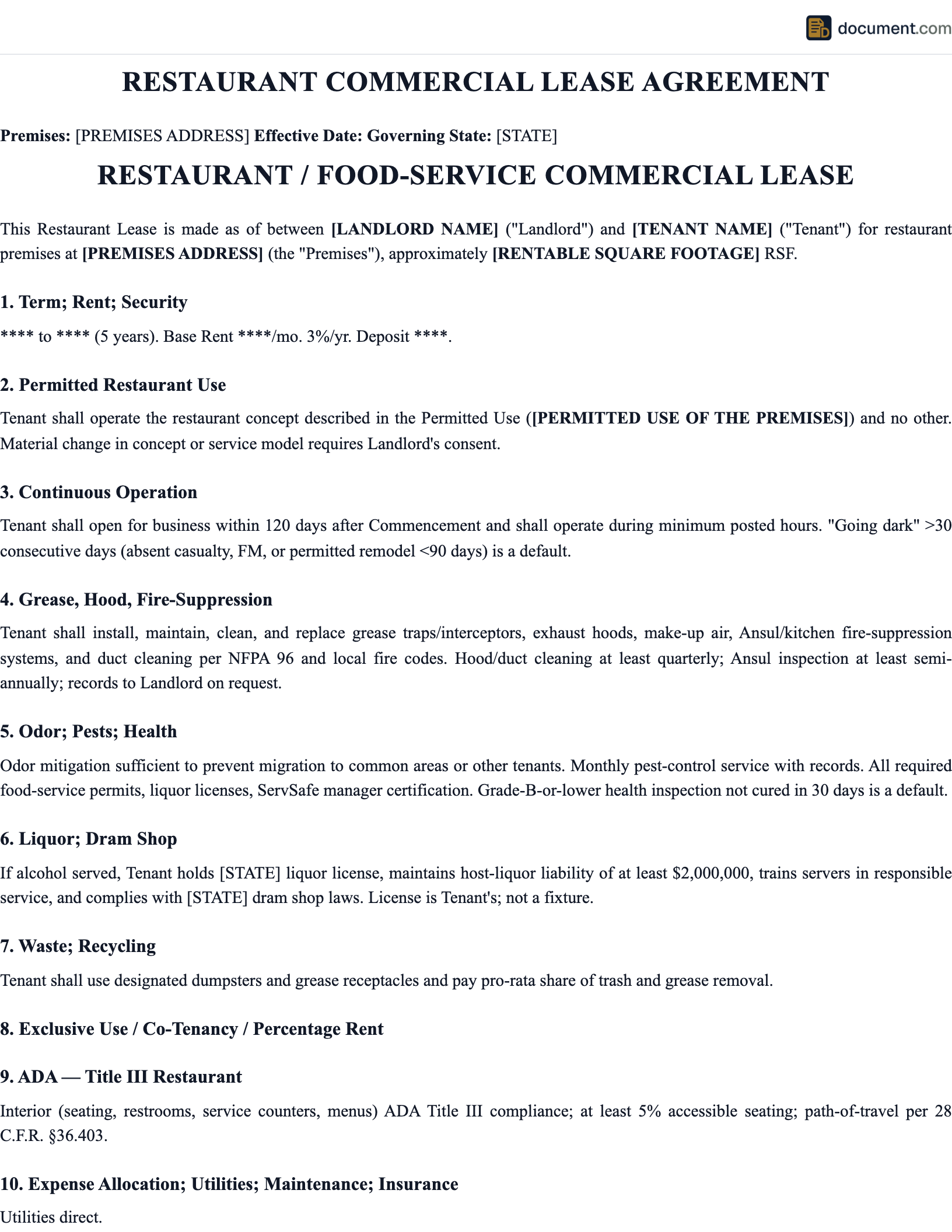
Below is a preview of our Louisiana-specific template. Your customized document will include all fields and provisions required for filing in any Louisiana county.
RESTAURANT LEASE AGREEMENT
STATE OF LOUISIANA
Legal Document Template
LANDLORD
Name: [Full Legal Name / Entity]
Property: [Building/Center Name]
Address: [Property Address]
TENANT / OPERATOR
Name: [Restaurant Entity Name]
Concept: [Restaurant Name/Concept]
Experience: [Years in Food Service]
Tax ID: [EIN]
PREMISES
Suite: [Number]
Total SF: [Square Feet]
Kitchen SF: [Square Feet]
Dining SF: [Square Feet]
Patio: [Yes/No - SF]
FINANCIAL TERMS
Base Rent: $[Amount]/month
Percentage Rate: [%] above $[Breakpoint]
TI Allowance: $[Amount]
Deposit: $[Amount]
CAM: $[Amount]/month
Louisiana Restaurant Lease Agreement FAQ
Answers to common questions about filing a restaurant lease agreement in Louisiana, including requirements, fees, and procedures.
Official Louisiana Resources
Use these official state resources to verify requirements, find your local filing office, and access government forms for Louisiana.
Related Louisiana Documents
Depending on your situation, you may need additional documents alongside your Louisiana restaurant lease agreement.
Create your Louisiana Commercial Restaurant Lease Agreement in under 5 minutes.
Answer a few questions and download a Louisiana-compliant document, ready for the state agency.