



Michigan Restaurant Lease Agreement Overview
Michigan's restaurant market is shaped by the contrasting dynamics of Detroit, Grand Rapids, and the suburban and rural markets in between. Detroit's Eastern Market district and revitalized neighborhoods like Corktown and Midtown have created strong demand for restaurant space in buildings with complex historic infrastructure. Grand Rapids has developed a vibrant food scene near the Medical Mile and along Division Avenue. Across the state, the Michigan Liquor Control Commission is the central licensing authority for alcohol service, and its requirements shape how restaurant leases need to be structured.
Michigan restaurant leases should address MLCC licensing compatibility, Michigan Department of Agriculture and Rural Development food service licensing requirements, hood ventilation and grease trap provisions, and ADA compliance allocation between landlord and tenant. Michigan's craft beer culture also means many restaurant tenants want to feature tap systems or brewing operations, which creates additional licensing and lease provision considerations that a standard commercial lease template does not cover.
$15
Filing fee
Required
Notarization
0
Witnesses required
Register
Filing office
Michigan Requirements
Michigan restaurant leases must address liquor licensing compatibility, food service licensing under the Michigan Food Law, and the physical infrastructure requirements that drive the buildout conversation. Getting these issues resolved in the lease before construction begins avoids the most common sources of costly disputes.
Michigan MLCC Licensing Notice
The Michigan Liquor Control Commission licenses alcohol service and has authority over the physical premises. A restaurant lease must confirm the space is eligible for the license type needed. MLCC inspectors review the premises, and physical layout requirements like bar placement and service area dimensions can affect license approval. Build MLCC cooperation provisions into the lease before signing.
Key Lease Requirements
- MLCC Eligibility: Verify the premises qualifies for the specific MLCC license category you need, whether a Class C restaurant license or another type, and that the landlord will cooperate with MLCC inspections
- MDARD Food Service License: Michigan food service establishments must be licensed through the Michigan Department of Agriculture and Rural Development. The lease should require the landlord to maintain building conditions that support MDARD compliance
- Hood and Ventilation: Address hood system ownership, shaft access rights, suppression system inspection obligations, and grease duct cleaning responsibilities before buildout begins
- Grease Trap Compliance: Michigan municipalities, including Detroit Water and Sewerage Department, have grease interceptor requirements. Allocate maintenance responsibility clearly in the lease
- ADA Compliance: Allocate responsibility for ADA-required modifications between landlord and tenant, distinguishing base building access from interior restaurant layout
How to Execute a Michigan Restaurant Lease
Executing a Michigan restaurant lease requires confirming MLCC licensing eligibility and food service licensing requirements before committing to a space, since these regulatory hurdles can affect whether and when a restaurant can open.
Confirm MLCC Eligibility and Zoning
Before signing, confirm the premises is zoned for restaurant use and is in a location eligible for the MLCC license type you need. Some Michigan municipalities have local restrictions on liquor license density that affect eligibility regardless of state licensing.
Negotiate Buildout and Infrastructure Terms
Address tenant improvement allowances, hood shaft access and roof penetration rights, grease trap sizing and who pays for upgrades if the current interceptor is inadequate, and electrical capacity for commercial kitchen equipment. In Detroit's older building stock, these negotiations matter significantly.
Execute the Lease
Both parties sign the Michigan restaurant lease. Michigan commercial leases do not require notarization to be enforceable between the parties, but notarization is required if a memorandum of lease is to be recorded at the Register of Deeds.
Apply for MLCC License and MDARD Food Service License
Begin the MLCC licensing process promptly after lease execution. MLCC applications require a signed lease and can take several months. File the MDARD food service license application as buildout progresses and before the health inspection is scheduled.
Retain Lease and Permit Records
Keep copies of the executed lease, all MLCC correspondence and approvals, MDARD license and inspection reports, and any buildout permits. These records are essential for license renewals and any future lease disputes.
Michigan Fees & Costs
Below is a breakdown of the typical costs associated with filing this document in Michigan. Actual fees may vary by county.
| Fee / Cost | Amount |
|---|---|
| Filing Fee | $15 first page |
| Notarization | $5 - $25 per signature |
| Certified Copy | $1 - $10 per page |
| Attorney Review (optional) | $150 - $500 |
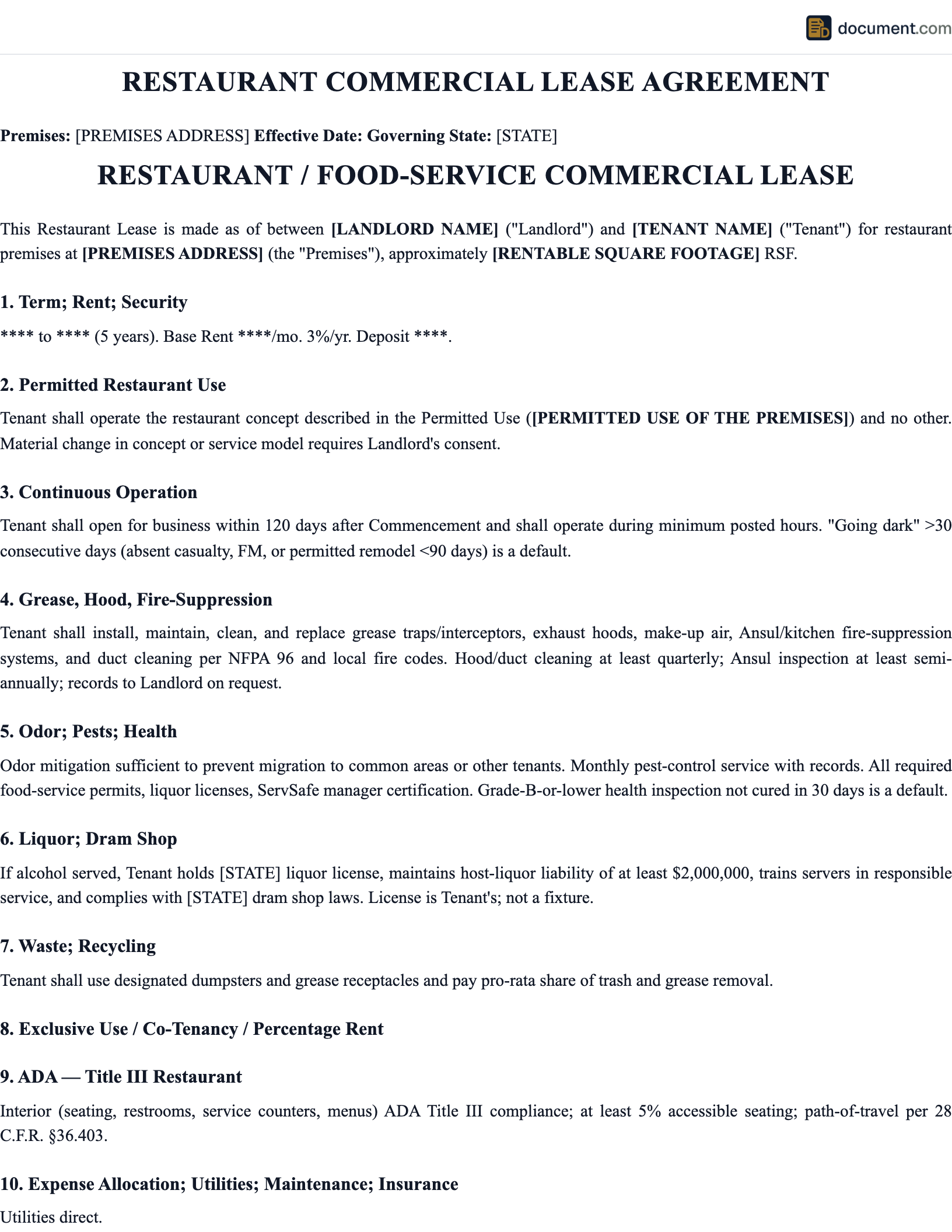
Sample Michigan Restaurant Lease Agreement
Below is a preview of our Michigan-specific template. Your customized document will include all fields and provisions required for filing in any Michigan county.
RESTAURANT LEASE AGREEMENT
STATE OF MICHIGAN
Legal Document Template
LANDLORD
Name: [Full Legal Name / Entity]
Property: [Building/Center Name]
Address: [Property Address]
TENANT / OPERATOR
Name: [Restaurant Entity Name]
Concept: [Restaurant Name/Concept]
Experience: [Years in Food Service]
Tax ID: [EIN]
PREMISES
Suite: [Number]
Total SF: [Square Feet]
Kitchen SF: [Square Feet]
Dining SF: [Square Feet]
Patio: [Yes/No - SF]
FINANCIAL TERMS
Base Rent: $[Amount]/month
Percentage Rate: [%] above $[Breakpoint]
TI Allowance: $[Amount]
Deposit: $[Amount]
CAM: $[Amount]/month
Michigan Restaurant Lease Agreement FAQ
Answers to common questions about filing a restaurant lease agreement in Michigan, including requirements, fees, and procedures.
Official Michigan Resources
Use these official state resources to verify requirements, find your local filing office, and access government forms for Michigan.
Related Michigan Documents
Depending on your situation, you may need additional documents alongside your Michigan restaurant lease agreement.
Create your Michigan Commercial Restaurant Lease Agreement in under 5 minutes.
Answer a few questions and download a Michigan-compliant document, ready for the state agency.