



Maryland Restaurant Lease Agreement Overview
Maryland's restaurant market spans multiple distinct ecosystems. Baltimore City anchors the state's urban dining scene with neighborhood concentrations in Federal Hill, Fells Point, Harbor East, Hampden, and Station North. The DC suburbs of Montgomery County and Prince George's County support a dense, competitive restaurant market driven by federal government employment, high household incomes, and a diverse population that sustains cuisine from across the globe. Secondary markets in Annapolis, Frederick, and the Eastern Shore cater to a mix of local regulars and seasonal tourism traffic.
Leasing restaurant space in Maryland requires navigating a decentralized regulatory structure that differs significantly from state to state. Food service facility licensing runs through the Maryland Department of Health (MDH) but is administered by county health departments, and the local health department's plan review and inspection process determines when you can open. Liquor licensing is the most complex piece: Maryland operates 24 separate liquor licensing jurisdictions, one for each county and Baltimore City, each with its own board, license categories, quotas, proximity restrictions, and fees. There is no uniform statewide liquor licensing framework. Maryland does not impose a statewide sales tax on commercial lease payments, which simplifies your cost structure compared to states that tax rent directly.
$20
Filing fee
Required
Notarization
0
Witnesses required
Circuit
Filing office
Maryland Requirements
Maryland has specific requirements for this type of legal document. Meeting these requirements ensures your document is accepted by the circuit court clerk and is legally enforceable.
Maryland Has 24 Separate Liquor Licensing Jurisdictions
Maryland's liquor licensing is administered by 24 separate local boards, one for each county and Baltimore City. License categories, fees, quotas, and proximity restrictions vary materially from one jurisdiction to the next. Before committing to a restaurant lease, verify with the specific local liquor board that the premises qualifies for the license type your concept requires. A lease contingency tied to liquor license approval is standard for full-service restaurant operations.
Document Requirements
- MDH Food Service License Contingency: Make your lease contingent on successfully obtaining a Maryland Department of Health food service facility license; include a reasonable timeline for health department plan review and inspection
- Local Liquor Board License Contingency: Identify the correct local liquor board for your jurisdiction, verify the premises is eligible for your license type, and make the lease contingent on obtaining that license
- NFPA 96 Hood and Ventilation: Confirm the space has an adequate Type I hood with fire suppression for grease-laden cooking, or negotiate landlord responsibility for installation as part of the deal
- Grease Interceptor: Confirm a properly sized grease interceptor is installed and meets local sewer authority requirements; address maintenance responsibility and pumping costs in the lease
- Permitted Use Clause: The lease must specifically authorize food service, dining, and alcohol service (if applicable); a vague commercial use clause is insufficient and can create regulatory disputes
- ADA Compliance and Path-of-Travel: In older Baltimore City or Annapolis buildings, negotiate a cap on ADA path-of-travel upgrade costs triggered by your tenancy
- TI Allowance Structure: Negotiate tenant improvement contributions tied to clearly defined deliverables and a realistic construction and permitting timeline before opening
How to Execute a Maryland Restaurant Lease
Executing a restaurant lease in Maryland requires careful coordination between the lease signing and the parallel processes of health department plan review and local liquor board application. These steps outline the process from initial site review to opening day.
Pre-Lease Site Inspection and Liquor Board Review
Before negotiating, conduct a pre-lease inspection of the kitchen systems, hood, grease trap, and utility capacity. Then contact your local liquor board to confirm the premises is eligible for the license category your concept requires and verify whether any quota limitations or proximity restrictions apply. Discovering a liquor license obstacle after signing is a costly situation to unwind.
Negotiate Maryland-Specific Lease Provisions
Include contingencies for the MDH food service facility license and the local liquor board license. Negotiate TI allowances covering the hood system and grease trap if not already present, define the permitted use clause to specifically authorize food service and alcohol service, and address ADA upgrade cost caps for older buildings. Establish a rent abatement period tied to actual opening if health department plan review delays your timeline.
Execute the Lease and Begin TI Construction
Both parties sign the lease agreement. Submit construction plans to the county building department and begin TI work. Concurrently, submit your kitchen layout plans to the county health department for MDH plan review approval; the health department will not schedule a pre-opening inspection until plan review is complete and approved.
Apply for Local Liquor Board License
File your liquor license application with the appropriate local board as early as possible. Hearing schedules for local liquor boards vary; some boards meet monthly, others less frequently, so a delayed filing can push your opening by a month or more. Prepare all required documentation including your lease, floor plan, and background check materials before the application deadline for the next hearing cycle.
Pass MDH Pre-Opening Inspection and Open
Schedule the county health department pre-opening inspection after construction is complete. Once the MDH food service facility license is issued and your liquor license is approved, register with the Maryland Comptroller for sales tax and obtain your local business license. You are then cleared to begin operations.
Maryland Fees & Costs
Below is a breakdown of the typical costs associated with filing this document in Maryland. Actual fees may vary by county.
| Fee / Cost | Amount |
|---|---|
| Filing Fee | $20 first page |
| Notarization | $5 - $25 per signature |
| Certified Copy | $1 - $10 per page |
| Attorney Review (optional) | $150 - $500 |
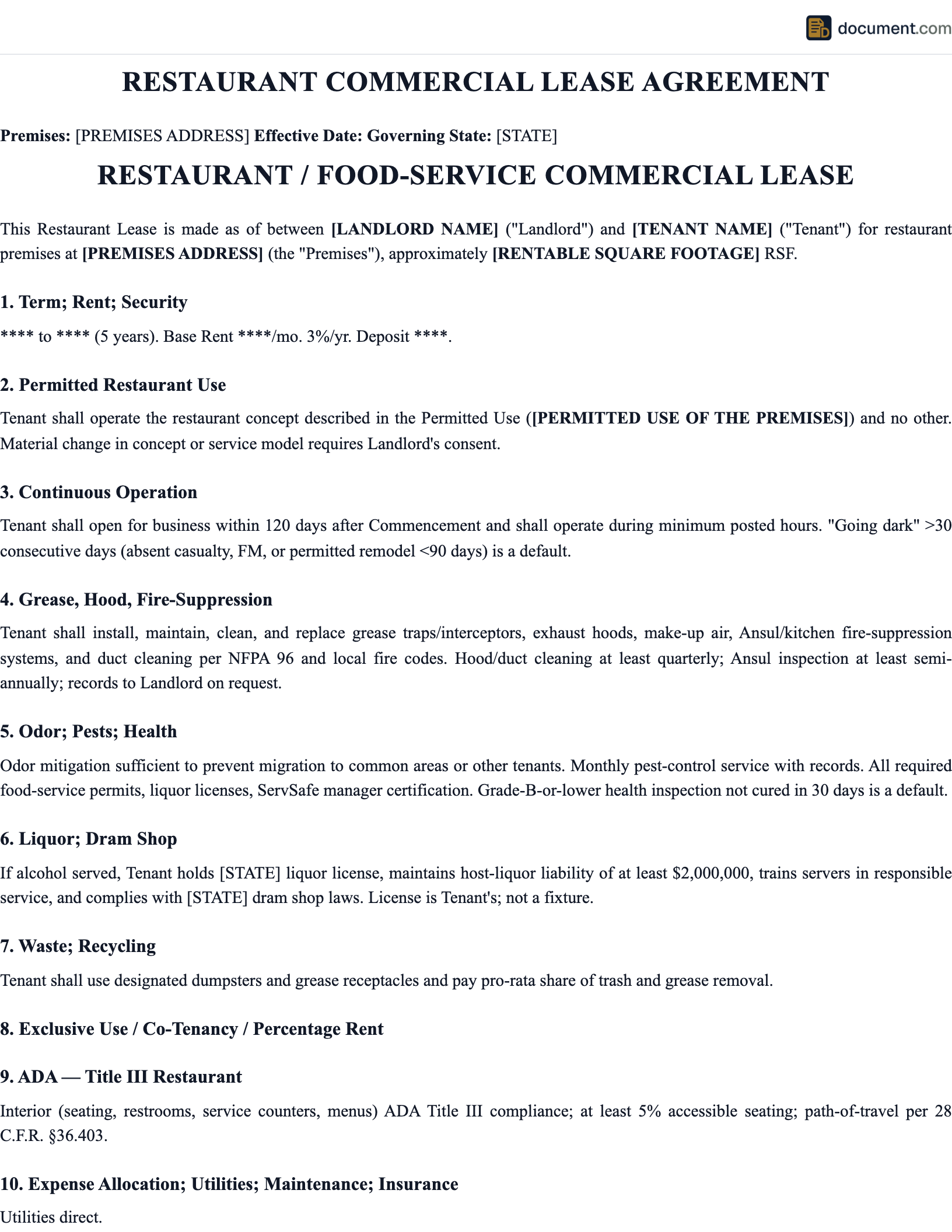
Sample Maryland Restaurant Lease Agreement
Below is a preview of our Maryland-specific template. Your customized document will include all fields and provisions required for filing in any Maryland county.
RESTAURANT LEASE AGREEMENT
STATE OF MARYLAND
Legal Document Template
LANDLORD
Name: [Full Legal Name / Entity]
Property: [Building/Center Name]
Address: [Property Address]
TENANT / OPERATOR
Name: [Restaurant Entity Name]
Concept: [Restaurant Name/Concept]
Experience: [Years in Food Service]
Tax ID: [EIN]
PREMISES
Suite: [Number]
Total SF: [Square Feet]
Kitchen SF: [Square Feet]
Dining SF: [Square Feet]
Patio: [Yes/No - SF]
FINANCIAL TERMS
Base Rent: $[Amount]/month
Percentage Rate: [%] above $[Breakpoint]
TI Allowance: $[Amount]
Deposit: $[Amount]
CAM: $[Amount]/month
Maryland Restaurant Lease Agreement FAQ
Answers to common questions about filing a restaurant lease agreement in Maryland, including requirements, fees, and procedures.
Official Maryland Resources
Use these official state resources to verify requirements, find your local filing office, and access government forms for Maryland.
Related Maryland Documents
Depending on your situation, you may need additional documents alongside your Maryland restaurant lease agreement.
Create your Maryland Commercial Restaurant Lease Agreement in under 5 minutes.
Answer a few questions and download a Maryland-compliant document, ready for the state agency.