



West Virginia Restaurant Lease Agreement Overview
West Virginia is one of the more accessible states for restaurant operators from a regulatory and cost standpoint, but that accessibility comes with market size constraints that require honest financial planning before signing a lease. The WVDHHR food establishment permitting process runs through county health departments and is generally less bureaucratically intensive than in larger states. WVABCA on-premise licensing is similarly straightforward, and the state's 6% sales tax on prepared food without a statewide meals tax creates a clean, predictable tax structure. Lease rates across most West Virginia markets are moderate by national standards.
The state's two main restaurant markets have almost nothing in common. Charleston, the state capital, runs on government worker lunch traffic, lobbyist dinner business during the legislative session, and the stable professional workforce anchored by the healthcare industry at CAMC and Thomas Memorial. Morgantown lives and dies by West Virginia University. The academic calendar drives consistent volume from August through April, but summer sees real slowdowns. WVU football Saturdays are outlier revenue events that Morgantown operators plan their entire fall around. A lease in Morgantown needs provisions that let operators fully capitalize on game days without landlord-imposed hour restrictions. In either market, West Virginia's lean regulatory environment means a prepared operator can typically move from lease execution to opening faster than in most states on the East Coast.
$30
Filing fee
Required
Notarization
0
Witnesses required
County
Filing office
West Virginia Requirements
A West Virginia restaurant lease needs to cover county health department permitting under WVDHHR authority, WVABCA on-premise licensing with a wet jurisdiction confirmation, hood and grease system assignments, and market-specific provisions for either Morgantown's event-driven economy or Charleston's government-professional market.
Confirm Wet Jurisdiction Status Before Signing
West Virginia has dry counties and municipalities where on-premise alcohol sales are prohibited. Before including a liquor service component in your business plan, verify that the specific county and municipality where the restaurant will operate permits on-premise alcohol sales under WVABCA. Some jurisdictions have partial wet status that restricts certain license types but not others. Confirming this before signing the lease avoids a situation where rent obligations begin before a critical operating component is even eligible for a license.
Key Lease Provisions
- WVDHHR Food Establishment Permit: Identify the applicable county health department, assign pre-opening inspection costs, and structure rent commencement to begin after county health approval is issued rather than a fixed calendar date
- WVABCA License Contingency: Include a license contingency with a defined resolution timeline and confirm wet jurisdiction status for the specific address before signing; do not assume a jurisdiction is wet based on proximity to other licensed venues
- Morgantown WVU Event Provisions: For Morgantown locations, include operating hour flexibility for WVU home football games and major university events without requiring separate landlord consent for reasonable schedule extensions during game weekends
- Hood and Grease Trap Assignment: Specify the age and condition of existing systems, assign pumping and maintenance responsibilities, and address whether the TI allowance covers upgrades needed to meet current WVDHHR and fire marshal standards
- ADA Compliance for Older Buildings: For pre-1992 commercial spaces in Charleston and Morgantown, commission an accessibility survey before signing and negotiate written TI allowance coverage for required modifications
How to Execute a West Virginia Restaurant Lease
West Virginia's relatively lean regulatory structure means the pre-opening process can move faster than in many other states, but the basics still need proper sequencing. Wet jurisdiction confirmation and WVABCA eligibility should be settled before the lease is signed, not after.
Confirm Wet Jurisdiction Status and Zoning
Before doing anything else, verify that the county and municipality permit on-premise alcohol sales. West Virginia has dry jurisdictions, and finding out after signing that a liquor license is unavailable at the address is a costly mistake. Confirm restaurant zoning eligibility at the same time.
Inspect Kitchen Systems and ADA Status
Walk the kitchen with a contractor and assess hood system age, grease trap condition, and accessibility features. Charleston and Morgantown both have significant older commercial building inventory where these systems may need upgrading. Use the inspection findings to nail down TI allowance amounts and upgrade responsibility assignments before signing.
Execute Lease with WVDHHR and WVABCA Contingencies
Include county health permit and WVABCA license contingencies with defined timelines. Tie rent commencement to county health department pre-opening inspection approval. For Morgantown, write in the WVU game day operating hour flexibility during this negotiation, not as an afterthought request after signing.
Complete Buildout and County Health Pre-Opening Inspection
Finish tenant improvements, schedule the county health department pre-opening inspection under WVDHHR authority, and correct any deficiencies in hood ventilation, grease management, or food storage before submitting the WVABCA license application. County health clearance should come before WVABCA submission to avoid parallel processing delays.
Obtain WVABCA License and Register for Sales Tax
Submit the WVABCA on-premise license application once county health is satisfied. Register with the West Virginia State Tax Department for the 6% sales tax on prepared food before the first service day. West Virginia does not require a separate meals tax registration in most jurisdictions, which simplifies the pre-opening compliance checklist compared to most other states.
West Virginia Restaurant Lease Costs
West Virginia's regulatory environment keeps startup licensing and permitting costs among the lower ranges on the East Coast. The compliance cost picture is straightforward compared to neighboring states, which helps operators allocate more of their pre-opening capital toward buildout rather than regulatory fees.
| Fee / Cost | Typical Range |
|---|---|
| WVDHHR Food Service Establishment Permit | $50 - $300 depending on county health department and establishment size |
| WVABCA On-Premise Restaurant License | $400 - $1,200 annually depending on license category; processing generally faster than in larger states |
| West Virginia Sales Tax (Prepared Food) | 6% flat state rate; no statewide meals tax and most municipalities do not add a local food and beverage tax |
| Hood System Upgrade (if needed) | $8,000 - $25,000 for replacement in older commercial buildings; negotiate into TI allowance before signing |
| Attorney Review | $300 - $700 for lease review with WVABCA contingency, wet jurisdiction confirmation, and Morgantown event hour provisions |
Sample West Virginia Restaurant Lease Agreement
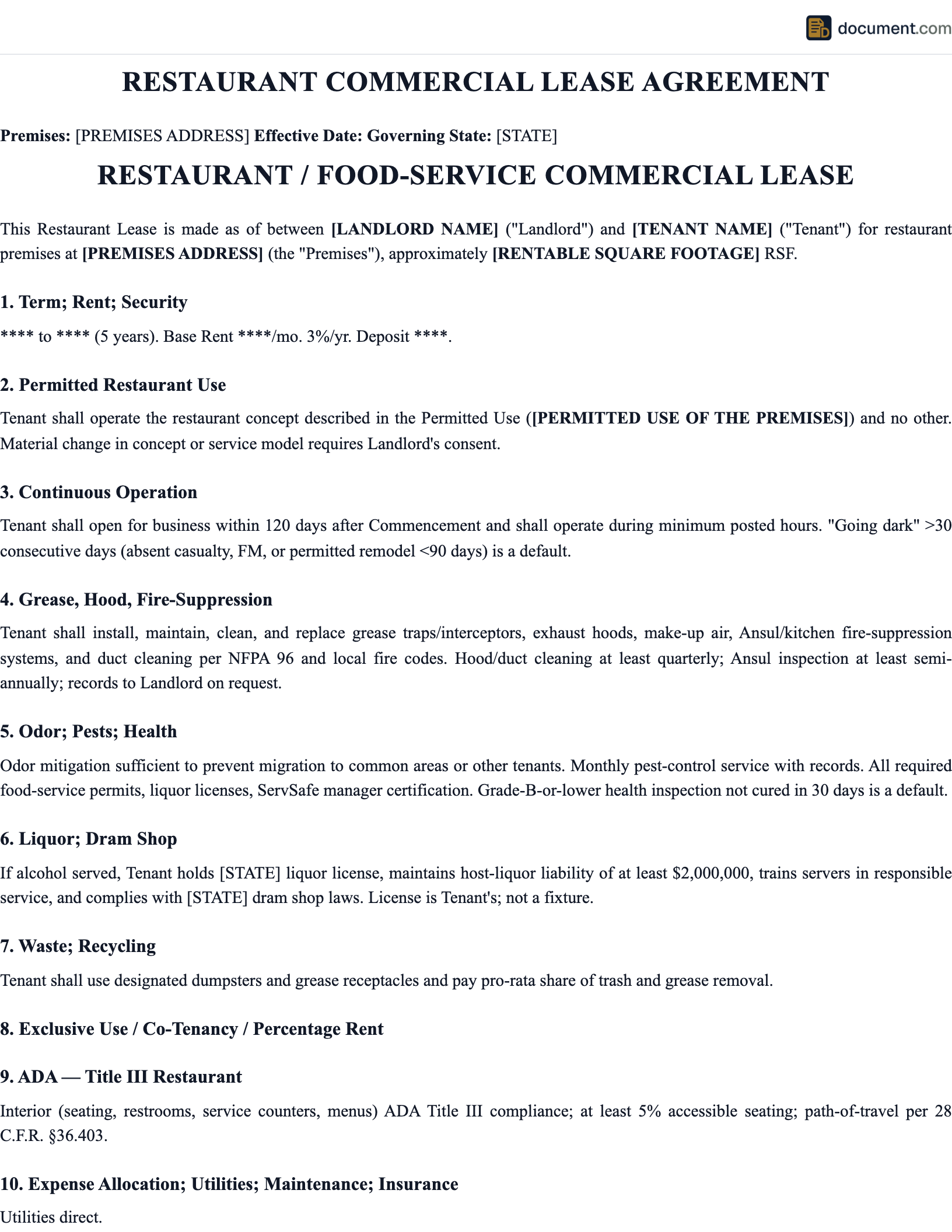
Below is a preview of our West Virginia-specific template. Your customized document will include all fields and provisions required for filing in any West Virginia county.
RESTAURANT LEASE AGREEMENT
STATE OF WEST VIRGINIA
Legal Document Template
LANDLORD
Name: [Full Legal Name / Entity]
Property: [Building/Center Name]
Address: [Property Address]
TENANT / OPERATOR
Name: [Restaurant Entity Name]
Concept: [Restaurant Name/Concept]
Experience: [Years in Food Service]
Tax ID: [EIN]
PREMISES
Suite: [Number]
Total SF: [Square Feet]
Kitchen SF: [Square Feet]
Dining SF: [Square Feet]
Patio: [Yes/No - SF]
FINANCIAL TERMS
Base Rent: $[Amount]/month
Percentage Rate: [%] above $[Breakpoint]
TI Allowance: $[Amount]
Deposit: $[Amount]
CAM: $[Amount]/month
West Virginia Restaurant Lease Agreement FAQ
Answers to common questions about filing a restaurant lease agreement in West Virginia, including requirements, fees, and procedures.
Official West Virginia Resources
Use these official state resources to verify requirements, find your local filing office, and access government forms for West Virginia.
Related West Virginia Documents
Depending on your situation, you may need additional documents alongside your West Virginia restaurant lease agreement.
Create your West Virginia Commercial Restaurant Lease Agreement in under 5 minutes.
Answer a few questions and download a West Virginia-compliant document, ready for the state agency.