



Washington Restaurant Lease Agreement Overview
Washington's restaurant leasing landscape is built around one of the most layered regulatory environments in the Pacific Northwest. The Washington State Liquor and Cannabis Board operates a complex licensing system with multiple endorsements governing what a restaurant can serve and how. Local health jurisdictions handle food establishment permitting independently of the state health department, with King County, Pierce County, and Spokane each running their own processes. Seattle's labor cost environment, driven by a minimum wage well above state and national levels, demands that percentage rent breakpoints be calculated against Seattle-specific economics, not national restaurant industry averages.
Beyond Seattle, Washington has genuine secondary restaurant markets with their own regulatory character. Walla Walla's wine tourism economy supports destination dining concepts with strong seasonal revenue but vulnerability to wildfire smoke events that reduce tourism in late summer. Washington's craft brewing industry, one of the most active in the country, creates co-location and adjacent-premises licensing questions that WSLCB needs to evaluate before a restaurant license is finalized when brewery proximity is involved. The state's Business and Occupation tax on gross revenue is an ongoing operating cost that should be addressed in how percentage rent gross sales are defined. Grease interceptor requirements are set by local utilities and vary by municipality, making local FOG program compliance part of the lease negotiation process for any kitchen with significant cooking volume.
$62.50
Filing fee
Required
Notarization
0
Witnesses required
County
Filing office
Washington Requirements
A Washington restaurant lease needs to address the applicable local health jurisdiction permit process, WSLCB licensing with the correct endorsements for the planned service format, grease interceptor compliance with the local utility FOG program, and financial term definitions that account for Washington's gross-receipts B&O tax and the high combined sales tax rates in the Seattle metro area.
Seattle Labor Cost Warning for Percentage Rent
Seattle's minimum wage significantly exceeds Washington's state floor and national averages. Restaurant operators in Seattle carry a materially higher labor cost burden than industry benchmarks reflect. Before accepting a landlord's proposed percentage rent breakpoint for a Seattle location, calculate your actual break-even sales volume using Seattle-applicable wage rates. A breakpoint calibrated to national averages will almost always be too low for Seattle operations.
Key Lease Provisions
- Local Health Jurisdiction Identification: Name the specific local health jurisdiction for the address (Public Health Seattle-King County, Tacoma-Pierce County Health, Spokane Regional Health District) and tie rent commencement to that jurisdiction's pre-opening inspection approval
- WSLCB License Contingency: Include a WSLCB on-premise spirits, beer, and wine license contingency with a defined resolution timeline; confirm zoning permits on-premise sales and that no brewery or adjacent-premises licensing complications exist for the address
- B&O Tax and Sales Tax Gross Sales Definition: For percentage rent purposes, define whether gross sales are calculated before or after Washington B&O tax and the combined state and local sales tax that reaches 10.25% in Seattle
- Grease Interceptor and FOG Program: Confirm existing interceptor sizing against your cooking equipment load, assign pumping and documentation costs, and address compliance with the applicable local utility FOG program requirements
- Seattle Outdoor Dining Rights: For Seattle locations where sidewalk seating is planned, confirm the lease includes outdoor dining rights and specify who handles SDOT permit renewals and fee obligations each year
How to Execute a Washington Restaurant Lease
Washington's restaurant lease process requires coordinating between a local health jurisdiction and the WSLCB while managing the financial modeling implications of the state's B&O tax and Seattle's wage floor. Identifying the correct health jurisdiction for the specific address early prevents timeline surprises after signing.
Identify Health Jurisdiction, Verify WSLCB Eligibility, and Check Outdoor Dining Rights
Before signing, confirm which local health jurisdiction handles the address. Contact the WSLCB to verify eligibility for the specific license type and endorsements your concept requires. For Seattle locations with planned outdoor seating, check SDOT sidewalk cafe permit availability and any building-specific frontage restrictions before treating outdoor capacity as a given.
Inspect Kitchen and Negotiate TI Allowance
Inspect existing hood systems, grease interceptor sizing, and kitchen equipment condition. Washington health jurisdictions inspect these systems during pre-opening visits, and deficiencies must be corrected before the permit is issued. Use the inspection findings to negotiate TI allowance amounts and written assignment of upgrade responsibility rather than leaving those issues to be resolved mid-buildout.
Execute Lease with Health Jurisdiction and WSLCB Contingencies
Include food establishment permit and WSLCB license contingencies. Structure rent commencement to begin after the local health jurisdiction completes its pre-opening inspection rather than on a fixed date. WSLCB processing for new on-premise licenses typically takes 45 to 90 days and should be reflected in the pre-opening timeline.
Complete Buildout and Pass Health Jurisdiction Pre-Opening Inspection
Complete tenant improvements per approved plans and schedule the pre-opening inspection with the applicable local health jurisdiction. Correct any deficiencies in hood systems, grease management, or food storage before submitting the WSLCB application, since health clearance is typically required before the WSLCB finalizes an on-premise license.
Obtain WSLCB License and Register for B&O and Sales Tax
Once health clearance is confirmed, finalize the WSLCB on-premise license application. Register with the Washington Department of Revenue for B&O tax and sales tax before the first service day. Seattle-area operators should confirm that city sales tax registration is also complete since local additions to the state rate require separate accounting.
Washington Restaurant Lease Costs
Washington restaurant operators face a multi-layer cost picture that includes health jurisdiction permits, WSLCB licensing, Washington's B&O tax on gross revenue, and some of the higher labor costs in the country for Seattle-area operations. Budget all of these before finalizing financial projections for the lease term.
| Fee / Cost | Typical Range |
|---|---|
| Local Health Jurisdiction Food Establishment Permit | $200 - $1,200 depending on jurisdiction, seating capacity, and establishment risk category |
| WSLCB Spirits, Beer, and Wine Restaurant License | $800 - $1,400 annually; new application processing typically 45 to 90 days |
| Washington B&O Tax (Retailing Classification) | 0.471% of gross restaurant receipts on an ongoing basis; no income tax deduction offsets this in Washington |
| Combined Sales Tax (Seattle) | Approximately 10.25% combined state and local rate on restaurant sales in Seattle |
| Seattle SDOT Sidewalk Cafe Permit (if applicable) | Annual fee varies by frontage; contact SDOT for current rate schedule |
| Attorney Review | $500 - $1,100 for lease review with WSLCB contingency, B&O tax definitions, and Seattle labor cost modeling for percentage rent |
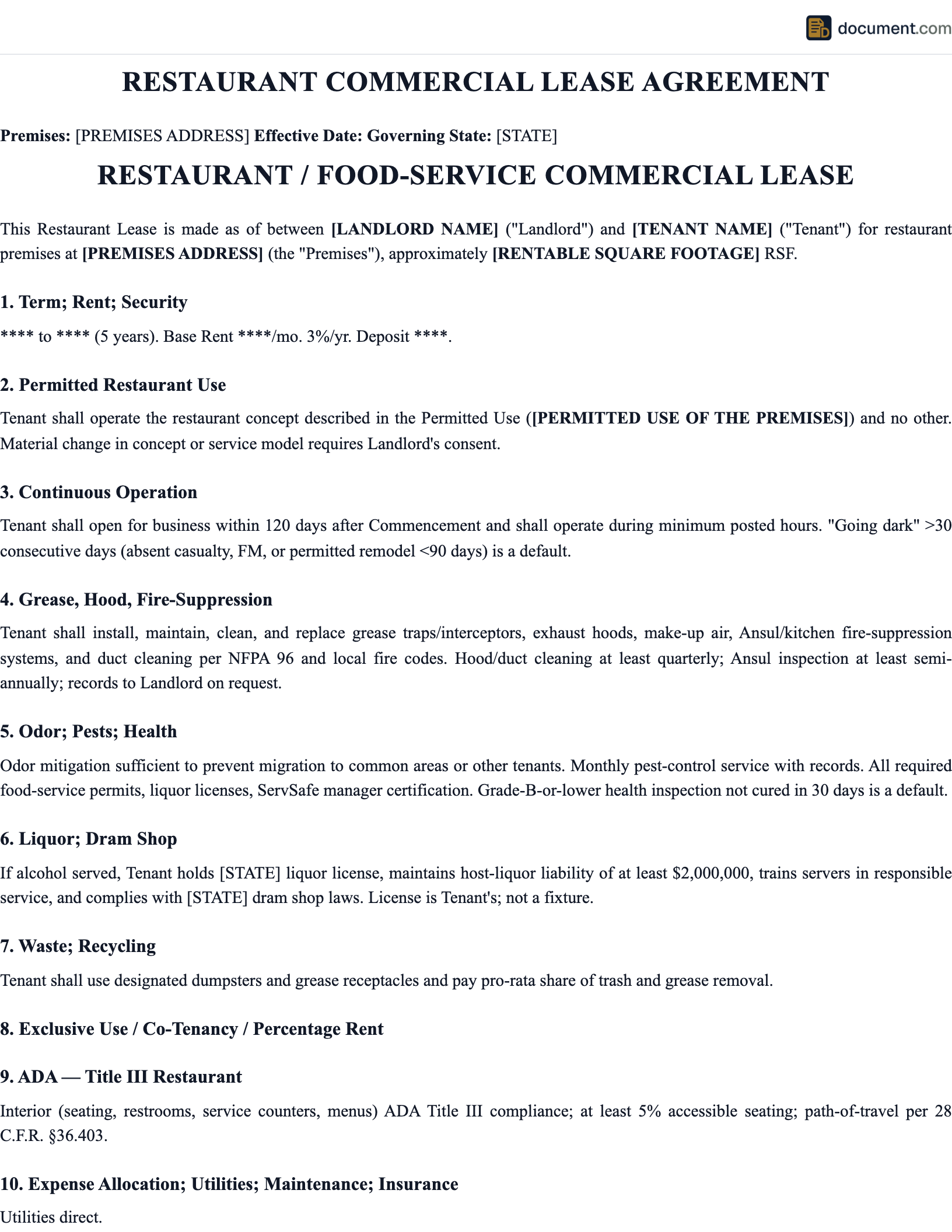
Sample Washington Restaurant Lease Agreement
Below is a preview of our Washington-specific template. Your customized document will include all fields and provisions required for filing in any Washington county.
RESTAURANT LEASE AGREEMENT
STATE OF WASHINGTON
Legal Document Template
LANDLORD
Name: [Full Legal Name / Entity]
Property: [Building/Center Name]
Address: [Property Address]
TENANT / OPERATOR
Name: [Restaurant Entity Name]
Concept: [Restaurant Name/Concept]
Experience: [Years in Food Service]
Tax ID: [EIN]
PREMISES
Suite: [Number]
Total SF: [Square Feet]
Kitchen SF: [Square Feet]
Dining SF: [Square Feet]
Patio: [Yes/No - SF]
FINANCIAL TERMS
Base Rent: $[Amount]/month
Percentage Rate: [%] above $[Breakpoint]
TI Allowance: $[Amount]
Deposit: $[Amount]
CAM: $[Amount]/month
Washington Restaurant Lease Agreement FAQ
Answers to common questions about filing a restaurant lease agreement in Washington, including requirements, fees, and procedures.
Official Washington Resources
Use these official state resources to verify requirements, find your local filing office, and access government forms for Washington.
Related Washington Documents
Depending on your situation, you may need additional documents alongside your Washington restaurant lease agreement.
Create your Washington Commercial Restaurant Lease Agreement in under 5 minutes.
Answer a few questions and download a Washington-compliant document, ready for the state agency.