
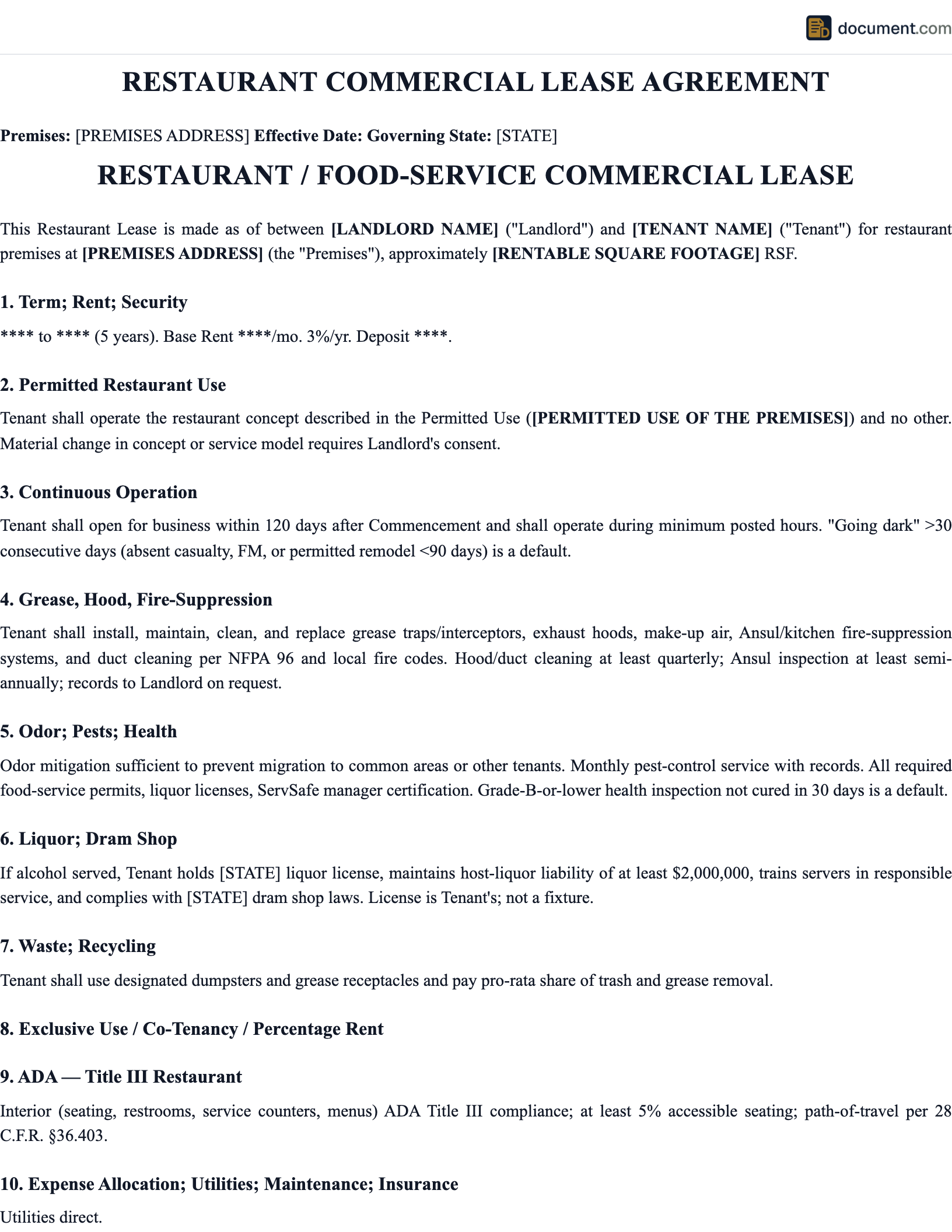



Montana Restaurant Lease Agreement Overview
Montana restaurant leases operate under general commercial contract law since the state has no dedicated food-service tenancy statute. That flexibility is a double-edged situation: parties have wide latitude to negotiate, but nothing fills gaps automatically. In Bozeman and Missoula, where restaurant real estate has tightened considerably over the past decade, landlords often present standard forms that favor ownership. Tenants who review those forms carefully and negotiate buildout, hood systems, permit timelines, and assignment rights come out with meaningfully better deals.
The Montana Department of Public Health and Human Services licenses all retail food establishments under the Montana Food, Drug, and Cosmetic Act (Title 50, Chapter 31, MCA). That license follows the operator, not the property, so a new tenant must apply independently even if the prior operator held a clean license at the same address. Montana also has a state building code and local amendments enforced at the county level, which means fire marshal inspections, Type I hood approvals, and grease interceptor sign-offs can vary noticeably between Gallatin County and Flathead County. Getting clarity on which pre-existing systems meet current code before finalizing lease terms saves significant negotiating leverage.
$12
Filing fee
Required
Notarization
0
Witnesses required
County
Filing office
Montana Requirements
A Montana restaurant lease needs to address several operational and regulatory layers that generic commercial lease templates skip entirely. The biggest categories are food service permitting, fire and health code equipment, liquor license compatibility, and cold-climate buildout considerations. Getting each of these right at the lease stage avoids costly amendments and disputes later.
Montana Specific Note
Montana's DPHHS food service license is operator-specific and does not transfer with the property. Confirm that local zoning allows restaurant and liquor service at the address. In Gallatin and Flathead counties, fire marshal approvals for hood and suppression systems can add weeks to a buildout timeline. Account for these timelines in your lease commencement date.
Document Requirements
- DPHHS Food Permit Contingency: Include a clause tying rent commencement to issuance of the Montana retail food establishment license from the Department of Public Health and Human Services
- Hood and Ventilation Responsibility: Specify who owns, maintains, and is responsible for upgrading Type I hood systems, grease traps, and fire suppression to meet local fire marshal standards
- Liquor License Zoning: Confirm that the zoning designation and distance from sensitive uses permits the liquor license type the tenant intends to hold under the Montana DOJ Liquor Control Division
- Cold-Climate Buildout Period: Mountain and high-elevation Montana markets (Whitefish, Big Sky) face winter construction constraints; build realistic timelines into the free rent and delivery date provisions
- ADA Path of Travel: Allocate responsibility for ADA-required path-of-travel improvements between landlord and tenant, particularly for older strip center or historic downtown buildings common in Helena and Missoula
How to Execute a Montana Restaurant Lease
Executing a restaurant lease in Montana involves more than signing a document. Tenants should complete regulatory groundwork in parallel with lease negotiations so that permit timelines do not push back opening dates.
Confirm Zoning and License Eligibility
Verify the property's zoning classification permits restaurant use and on-premises liquor service before signing. Contact the local planning department and the Montana DOJ Liquor Control Division to confirm license availability for the county.
Inspect Kitchen Equipment and Hood Systems
Have a qualified contractor inspect all existing hood, ventilation, suppression, and grease interceptor systems. Document deficiencies in writing before lease execution so upgrade costs can be negotiated into the tenant improvement allowance.
Negotiate Permit Contingency and Free Rent Period
Structure the lease so that rent does not begin until the DPHHS retail food establishment license is issued and the fire marshal approves the kitchen equipment. Montana permitting timelines vary by county; Gallatin County has experienced higher inspection volumes in recent years.
Execute the Lease and Begin Permitting
Both parties sign the lease. Submit your DPHHS food service license application and building permit application simultaneously. For Bozeman or Whitefish locations, submit early given current workloads at local permitting offices.
Retain Originals and Keep a Permit File
Keep signed originals of the lease and all permits in a secure place. Montana health inspectors and fire marshals can request documentation at any routine inspection, and having the full permit history on-site speeds up those visits.
Montana Fees & Costs
Below is a breakdown of the typical costs associated with filing this document in Montana. Actual fees may vary by county.
| Fee / Cost | Amount |
|---|---|
| Filing Fee | $12 per page |
| Notarization | $5 - $25 per signature |
| Certified Copy | $1 - $10 per page |
| Attorney Review (optional) | $150 - $500 |
Montana Tax Implications for Restaurant Leases
Montana has no general sales tax, which affects restaurant operations in ways that differ from neighboring states. Food and beverage sales are not subject to a statewide sales tax, which simplifies recordkeeping but also means revenue reporting to landlords under percentage rent clauses needs clear definitions of gross sales. Taxable sales for liquor under Montana law include all on-premises consumption, and licensees pay an excise tax through the Liquor Control Division separately from income tax obligations.
Tenant improvement costs funded by a landlord allowance may be treated as taxable income to the tenant under federal rules depending on how the allowance is structured. Montana follows federal income tax treatment for business expenses, so lease payments, depreciation on tenant-owned equipment, and buildout costs that qualify as leasehold improvements are generally deductible under normal business expense rules.
Property taxes on the commercial building are typically a landlord cost in gross leases, but triple-net and modified gross leases in Montana often pass through a pro-rata share of real property taxes to tenants. Confirm exactly which taxes the tenant bears and whether property tax increases during the lease term are capped or passed through without limit.
Important Considerations for Montana Restaurant Tenants
Montana's restaurant markets are geographically diverse. Bozeman and Missoula operate at a pace and rent level comparable to mid-sized western cities, while Whitefish and Big Sky have seasonal dynamics driven heavily by tourism and ski traffic. A lease that works well in one market may create serious cash flow problems in another if seasonality, buildout timing, or permit contingencies are not properly addressed.
Brewery culture is strong in Montana, and many restaurant concepts include a tap room component or co-locate with a craft brewer. This creates licensing complexity since the Montana DOJ Liquor Control Division treats brewpub licenses differently from all-beverages licenses. If the restaurant concept includes any brewing or taproom element, confirm that the lease premises are properly zoned and that the license type the tenant intends to hold is compatible with the landlord's building and neighbors.
Ranch and farm event venue crossover is increasingly common in rural Montana. If the restaurant location has any outdoor event or private dining component, review local county regulations on temporary food service permits and whether those events require separate permitting beyond the base DPHHS retail food license.
Attorney Review Recommended
Montana commercial real estate attorneys familiar with food service licensing can often identify permit conflicts or equipment liability issues that save tenants significantly more than their fee. Given the complexity of liquor license availability and DPHHS requirements, a one-time lease review is a sound investment for any Montana restaurant tenant.
Sample Montana Restaurant Lease Agreement
Below is a preview of our Montana-specific template. Your customized document will include all fields and provisions required for filing in any Montana county.
RESTAURANT LEASE AGREEMENT
STATE OF MONTANA
Legal Document Template
LANDLORD
Name: [Full Legal Name / Entity]
Property: [Building/Center Name]
Address: [Property Address]
TENANT / OPERATOR
Name: [Restaurant Entity Name]
Concept: [Restaurant Name/Concept]
Experience: [Years in Food Service]
Tax ID: [EIN]
PREMISES
Suite: [Number]
Total SF: [Square Feet]
Kitchen SF: [Square Feet]
Dining SF: [Square Feet]
Patio: [Yes/No - SF]
FINANCIAL TERMS
Base Rent: $[Amount]/month
Percentage Rate: [%] above $[Breakpoint]
TI Allowance: $[Amount]
Deposit: $[Amount]
CAM: $[Amount]/month
Montana Restaurant Lease Agreement FAQ
Answers to common questions about filing a restaurant lease agreement in Montana, including requirements, fees, and procedures.
Official Montana Resources
Use these official state resources to verify requirements, find your local filing office, and access government forms for Montana.
Related Montana Documents
Depending on your situation, you may need additional documents alongside your Montana restaurant lease agreement.
Create your Montana Commercial Restaurant Lease Agreement in under 5 minutes.
Answer a few questions and download a Montana-compliant document, ready for the state agency.