
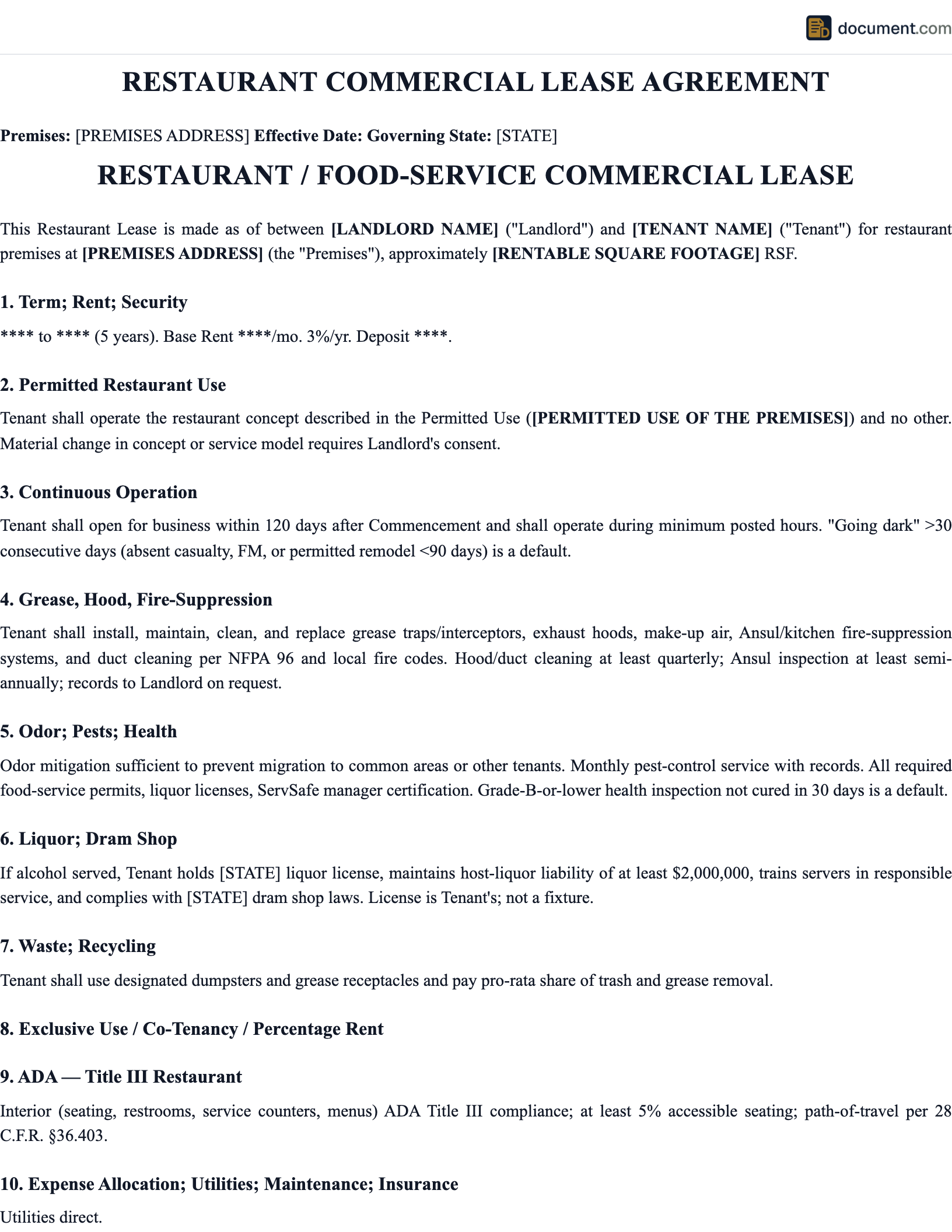



North Carolina Restaurant Lease Agreement Overview
North Carolina's restaurant leasing landscape is defined by three very different markets. Charlotte is the state's financial capital with a fast-growing, nationally recognized dining scene and lease rates that reflect its status as a major metro. Raleigh and the Research Triangle draw restaurant operators targeting the educated, well-compensated workforce at technology and research institutions. Asheville stands apart entirely as a nationally acclaimed food destination whose independent restaurant culture and tourist economy create a unique leasing environment. Each market has distinct rent levels, landlord expectations, and regulatory considerations that a restaurant lease must address specifically.
North Carolina's patchwork of wet and dry counties adds a layer of complexity that does not exist in most other states. A restaurant concept built around a full bar program cannot succeed in a dry county, and the NC ABC Commission licensing process involves county-level approval that must be factored into any timeline before signing. Health permitting flows through county environmental health departments rather than a single statewide agency, meaning the inspection process and standards the landlord's kitchen must meet can vary meaningfully depending on location. A North Carolina restaurant lease should address all of these elements before the first dollar of rent is committed.
$26
Filing fee
Required
Notarization
0
Witnesses required
Register
Filing office
North Carolina Requirements
North Carolina restaurant leases must address health permitting, county-level ABC licensing, and physical infrastructure requirements. The wet/dry status of the location is a threshold issue that must be confirmed before any other lease term is negotiated.
North Carolina Specific Note
North Carolina's wet/dry county patchwork is one of the most consequential location-specific factors for any restaurant concept that includes alcohol service. Some counties are fully dry. Some allow beer and wine only. Some have moist territories where individual municipalities vote independently. Confirm the county's ABC status with the NC ABC Commission before negotiating any restaurant lease where alcohol service is part of the business model. The county ABC board approval is separate from state approval and adds time to the licensing process.
Key Lease Provisions for North Carolina Restaurants
- County Health Permit: Assign responsibility for preparing the kitchen for the county environmental health inspection, and specify the delivery condition the landlord must provide before that inspection can proceed
- NC ABC Commission License: Include a contingency clause allowing the tenant to terminate or defer rent commencement if the county ABC board or the NC ABC Commission denies or significantly delays the on-premise liquor license
- Wet/Dry Confirmation: Confirm in writing the wet/dry status of the specific address before signing any lease that depends on alcohol service for viability
- Hood and Ventilation: Address Type I hood installation, fire suppression within the hood, make-up air, and semi-annual cleaning under NC Building Code requirements
- Asheville Seasonality Provisions: For Asheville restaurant leases, consider whether percentage rent, seasonal rent adjustment, or co-tenancy provisions better reflect the tourist-driven revenue pattern of the market
How to Execute a North Carolina Restaurant Lease
Executing a North Carolina restaurant lease requires front-end due diligence on the wet/dry status of the location, the county health department's delivery condition expectations, and the NC ABC Commission's licensing timeline before any lease obligations are assumed.
Confirm Wet/Dry Status and ABC License Eligibility
Before any other negotiation, verify the wet/dry status of the specific county and municipality. Contact the NC ABC Commission to understand what type of on-premise license is available at the location and whether any local ordinances impose additional restrictions beyond state law.
Assess the Kitchen Infrastructure
Inspect the space and assess existing ventilation, grease interceptor capacity, gas line sizing, and electrical service. Contact the county environmental health department to understand what standards the finished kitchen must meet before a Food Service Establishment Permit will be issued. Document any infrastructure gaps and negotiate who addresses them before lease signing.
Negotiate Buildout Terms and ABC Contingency
Document TI allowance amounts, disbursement schedule, delivery condition, rent commencement triggers, and an ABC license contingency clause with a defined processing period and termination right. For Asheville restaurants, consider whether percentage rent provisions make sense given the seasonal nature of the market.
Execute the Lease
Both parties sign the lease. North Carolina commercial leases do not require notarization to be enforceable between the parties, but notarization is required if the lease is to be recorded with the Register of Deeds. Keep fully executed originals for both parties.
Begin Construction and Regulatory Processes
Begin buildout construction and submit your NC ABC Commission license application and county ABC board application as soon as you have a signed lease. Contact the county environmental health department to schedule a pre-opening inspection once construction is nearing completion. Register your business with the NC Department of Revenue for sales tax collection.
North Carolina Fees & Costs
Below is a breakdown of the typical costs associated with filing this document in North Carolina. Actual fees may vary by county.
| Fee / Cost | Amount |
|---|---|
| Filing Fee | $26 first page |
| Notarization | $5 - $25 per signature |
| Certified Copy | $1 - $10 per page |
| Attorney Review (optional) | $150 - $500 |
Sample North Carolina Restaurant Lease Agreement
Below is a preview of our North Carolina-specific template. Your customized document will include all fields and provisions required for filing in any North Carolina county.
RESTAURANT LEASE AGREEMENT
STATE OF NORTH CAROLINA
Legal Document Template
LANDLORD
Name: [Full Legal Name / Entity]
Property: [Building/Center Name]
Address: [Property Address]
TENANT / OPERATOR
Name: [Restaurant Entity Name]
Concept: [Restaurant Name/Concept]
Experience: [Years in Food Service]
Tax ID: [EIN]
PREMISES
Suite: [Number]
Total SF: [Square Feet]
Kitchen SF: [Square Feet]
Dining SF: [Square Feet]
Patio: [Yes/No - SF]
FINANCIAL TERMS
Base Rent: $[Amount]/month
Percentage Rate: [%] above $[Breakpoint]
TI Allowance: $[Amount]
Deposit: $[Amount]
CAM: $[Amount]/month
North Carolina Restaurant Lease Agreement FAQ
Answers to common questions about filing a restaurant lease agreement in North Carolina, including requirements, fees, and procedures.
Tax Implications for North Carolina Restaurant Leases
North Carolina imposes a 4.75% state sales tax on food sold at restaurants, with county and transit taxes adding to the total. The combined rate varies by county but typically ranges from 6.75% to 7.5% on prepared food. Restaurant operators must register with the NC Department of Revenue and collect and remit sales tax on applicable sales. Lease payments are deductible as ordinary business expenses.
North Carolina has a state corporate income tax and imposes a franchise tax on corporations. Restaurant operators organized as LLCs or S corporations generally pay the pass-through income on personal returns. The NC Department of Revenue can provide guidance on the specific tax obligations applicable to the restaurant's business structure.
Tenant improvement allowances received from landlords are potentially taxable income in the year received. Leasehold improvements made by the tenant are depreciable assets. The 15-year federal depreciation life for qualified improvement property applies for most restaurant interior improvements, subject to bonus depreciation rules that change periodically.
Important Considerations for North Carolina Restaurant Tenants
Charlotte's NoDa, South End, and Plaza Midwood neighborhoods have become some of the Southeast's most competitive restaurant leasing markets. Charlotte landlords in these areas have significant leverage and routinely include personal guarantee requirements, exclusivity carve-outs, and assignment restrictions that are heavily landlord-favorable. Restaurant tenants in Charlotte should be prepared to negotiate aggressively or work with a tenant rep broker who knows the market.
Raleigh and Durham's food scene is driven partly by the Research Triangle academic and tech communities, which tend to demand higher quality dining options and support independent restaurant operators more than most mid-size cities. Lease rates in the core downtown areas and walkable neighborhoods like Five Points and Glenwood South have risen significantly over the past decade.
Asheville presents a unique risk-reward profile. It is one of the best restaurant markets in the Southeast in terms of per-capita dining culture and national media attention, but its limited commercial real estate supply, high tourist seasonality, and growing gentrification pressures mean that lease terms there require careful financial modeling. An Asheville restaurant that cannot survive three to four slow winter months on a fixed rent obligation may not be viable even if its summer and fall numbers are excellent.
Dry County Warning
Several North Carolina counties remain fully or partially dry. A restaurant concept that depends on beer, wine, or spirits revenue for financial viability should not be located in a dry jurisdiction. Confirm the wet/dry status of the specific county and municipality with the NC ABC Commission before spending any time or money on lease negotiations for a location where alcohol service is legally prohibited.
Official North Carolina Resources
These official agencies handle restaurant health permits, liquor licensing, and business tax registration for North Carolina operators.
NCDHHS Food and Lodging
Food service establishment permits and health inspection standards
NC ABC Commission
On-premise liquor license applications and wet/dry county information
NC Department of Revenue
Sales tax registration and business tax requirements
NC League of Municipalities
Local zoning and business licensing resources by city
Related North Carolina Documents
Depending on your situation, you may need additional documents alongside your North Carolina restaurant lease agreement.
Create your North Carolina Commercial Restaurant Lease Agreement in under 5 minutes.
Answer a few questions and download a North Carolina-compliant document, ready for the state agency.