
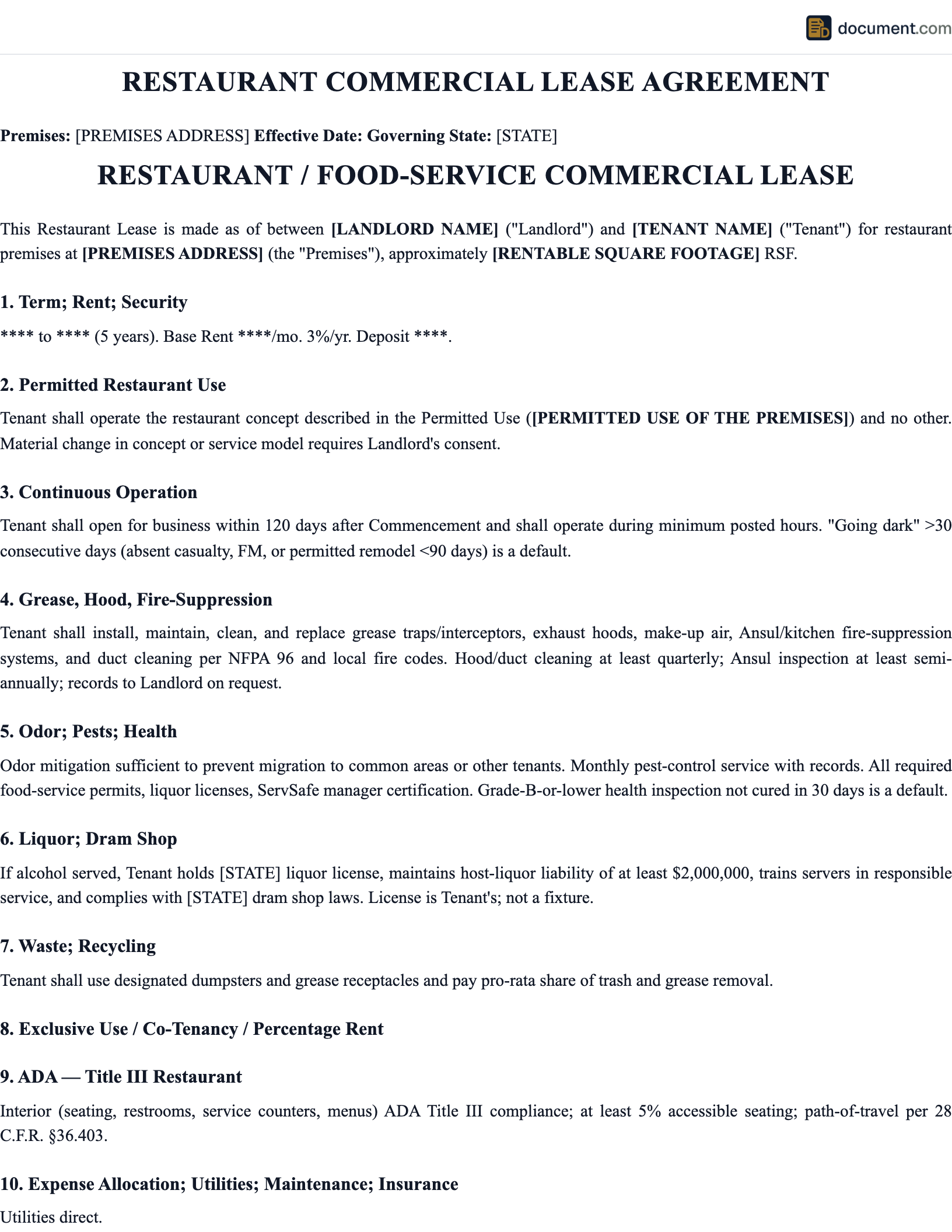



South Carolina Restaurant Lease Agreement Overview
South Carolina's restaurant market has two distinct personalities that shape how leases need to be structured. Charleston is one of the American South's most competitive food cities, with the Upper King Street corridor, the lower peninsula, and neighborhoods like the French Quarter and Cannonborough driving premium rents and sophisticated lease terms. Coastal resort markets like Myrtle Beach operate on a fundamentally different revenue calendar where summer and winter sales can differ by a factor of three or four. These are not the same leasing environment and should not be approached with the same template.
On the regulatory side, South Carolina splits liquor licensing between two agencies: SCDOR handles beer and wine permits, while SC SLED handles liquor by the drink licenses. SCDHEC licenses food establishments, but Charleston County has its own health inspection capacity that operates under SCDHEC oversight. The Historic District Commission in Charleston adds an extra layer to any buildout that involves structural modifications, which matters significantly for ADA compliance work in older peninsula buildings. Getting the permitting timelines, TI allowance scope, and seasonal rent provisions right before signing is what separates a workable deal from one that creates financial strain before the restaurant ever opens.
$15
Filing fee
Required
Notarization
2
Witnesses required
Register
Filing office
South Carolina Requirements
South Carolina restaurant leases need to address SCDHEC permitting, the dual SCDOR and SLED liquor licensing process, Historic District Commission buildout review in Charleston, seasonal percentage rent structure for coastal markets, and grease interceptor maintenance obligations.
Charleston Historic District Commission and ADA Costs
Restaurant tenants in Charleston's Historic District face a dual compliance obligation: federal ADA requirements for accessible entrances, restrooms, and pathways, and Historic District Commission design review for any structural modification needed to achieve that compliance. These are separate processes that can conflict with each other and that together can exceed a standard TI allowance. Address both processes and their costs in the lease before signing.
Key Provisions for South Carolina Restaurant Leases
- SCDHEC Permit Commencement Trigger: Specify who obtains the SCDHEC food establishment permit and tie rent commencement to permit issuance rather than a fixed calendar date to protect against inspection-related delays
- SCDOR Beer and Wine Permit and SLED Liquor by the Drink: Include contingency provisions for both licenses separately, since denial of either affects operations, and specify the timeline and tenant remedy for each
- Seasonal Percentage Rent Structure: For Myrtle Beach, Hilton Head, and Grand Strand locations, use seasonal breakpoints or a monthly percentage rent structure that accounts for the dramatic revenue variation between summer and winter
- Historic District ADA and Commission Costs: In Charleston, define who bears both the ADA remediation cost and the Historic District Commission review cost, and include a realistic timeline for completing approved modifications
- Grease Interceptor Sizing and Maintenance: Specify the current interceptor capacity, who pays for cleaning and pumping, what documentation must be retained for SCDHEC, and who bears upgrade costs if SCDHEC requires a larger unit
- Charleston Noise Ordinance Provisions: For downtown entertainment district locations, address outdoor entertainment hours, sound level compliance, and which party is responsible for any required acoustic mitigation
How to Execute a South Carolina Restaurant Lease
South Carolina restaurant lease execution requires coordinating three separate regulatory timelines before the restaurant can open. Work through these steps in order to avoid paying rent on a space you cannot yet legally operate.
Confirm Zoning, Historic District Status, and License Requirements
Verify local zoning permits restaurant use with your intended hours and outdoor dining configuration. For Charleston, determine whether the space is in the Historic District and contact the Historic District Commission to understand what modifications will require their approval. Research SCDOR beer and wine permit and SLED liquor by the drink requirements for your concept type before signing anything.
Commission Kitchen and Grease Infrastructure Assessment
Have a licensed contractor evaluate the hood system, grease interceptor sizing, gas lines, and electrical capacity before lease terms are finalized. Charleston County health inspectors take grease management seriously during pre-opening inspections. The contractor's findings should drive your TI allowance negotiation and landlord infrastructure representations in the lease.
Negotiate Lease with South Carolina-Specific Provisions
Have a South Carolina commercial attorney draft the lease to include separate contingencies for SCDOR and SLED licenses, a SCDHEC permit commencement trigger, TI allowance coverage for SCDHEC and ADA work, Historic District Commission cost allocation for Charleston properties, and seasonal percentage rent breakpoints for coastal resort locations.
Complete Buildout and Schedule SCDHEC Pre-Opening Inspection
After lease execution, complete construction to approved plans. For Charleston Historic District properties, obtain Historic District Commission approval for structural modifications before beginning work. Schedule the SCDHEC pre-opening inspection after construction is complete and submit the SCDOR and SLED applications concurrently so licensing timelines overlap with the final construction phase.
Obtain All Licenses and Establish Compliance Calendar
After SCDHEC permit, SCDOR beer and wine permit, and SLED liquor by the drink license are all issued, you can open. Store all licenses and the executed lease together. Set up a recurring calendar for SCDHEC annual renewal, SCDOR and SLED annual renewals, grease interceptor cleaning documentation, and hood system inspections.
South Carolina Restaurant Lease Fees and Costs
South Carolina restaurant operators need to budget for SCDHEC permitting, dual liquor licensing through SCDOR and SLED, sales tax obligations, and the grease and ADA infrastructure costs that routinely surface in Charleston's older building stock.
| Fee / Cost | Typical Range |
|---|---|
| SCDHEC Food Establishment Permit (Annual) | $100 - $400 depending on facility size, seating capacity, and food risk category |
| SCDOR Beer and Wine Permit (Annual) | Confirm current rates with SCDOR; separate from the SLED liquor by the drink license |
| SC SLED Liquor by the Drink License (Annual) | Confirm current rates with SLED; required for serving distilled spirits in addition to beer and wine |
| SC Sales Tax on Prepared Food | 5% state base rate plus local additions; Charleston County combined rate is approximately 9% |
| Grease Interceptor Maintenance | $400 - $1,200 per cleaning; older Charleston peninsula buildings may require more frequent service |
| South Carolina Commercial Attorney Lease Review | $1,000 - $3,500 for Charleston or Columbia restaurant lease review and negotiation support |
Sample South Carolina Restaurant Lease Agreement
Below is a preview of our South Carolina-specific template. Your customized document will include all fields and provisions required for filing in any South Carolina county.
RESTAURANT LEASE AGREEMENT
STATE OF SOUTH CAROLINA
Legal Document Template
LANDLORD
Name: [Full Legal Name / Entity]
Property: [Building/Center Name]
Address: [Property Address]
TENANT / OPERATOR
Name: [Restaurant Entity Name]
Concept: [Restaurant Name/Concept]
Experience: [Years in Food Service]
Tax ID: [EIN]
PREMISES
Suite: [Number]
Total SF: [Square Feet]
Kitchen SF: [Square Feet]
Dining SF: [Square Feet]
Patio: [Yes/No - SF]
FINANCIAL TERMS
Base Rent: $[Amount]/month
Percentage Rate: [%] above $[Breakpoint]
TI Allowance: $[Amount]
Deposit: $[Amount]
CAM: $[Amount]/month
South Carolina Restaurant Lease Agreement FAQ
Answers to common questions about filing a restaurant lease agreement in South Carolina, including requirements, fees, and procedures.
Official South Carolina Resources
Use these official state resources to verify requirements, find your local filing office, and access government forms for South Carolina.
Related South Carolina Documents
Depending on your situation, you may need additional documents alongside your South Carolina restaurant lease agreement.
Create your South Carolina Commercial Restaurant Lease Agreement in under 5 minutes.
Answer a few questions and download a South Carolina-compliant document, ready for the state agency.