



Minnesota Restaurant Lease Agreement Overview
Minnesota's restaurant market is shaped by the Twin Cities metropolitan area, where Minneapolis and St. Paul have distinct dining cultures and different licensing environments. The Minnesota Alcohol and Gambling Enforcement Division administers liquor licensing in coordination with city licensing authorities. In Minneapolis and St. Paul, the city licensing office is the operational point of contact, and license availability in some neighborhoods is limited. Minnesota's cold climate creates unique lease provisions around outdoor dining, heating infrastructure, and seasonal operations that other states rarely need to address.
A well-drafted Minnesota restaurant lease addresses AGED licensing compatibility, Minnesota Department of Health or city health department food service licensing requirements, hood ventilation and grease trap provisions, outdoor dining rights with appropriate winter provisions, and ADA compliance allocation between landlord and tenant. The Twin Cities market also has strong neighborhood association involvement in commercial development, and leases for restaurant spaces in residential-adjacent commercial corridors should account for potential community engagement in the permitting process.
$46
Filing fee
Required
Notarization
0
Witnesses required
County
Filing office
Minnesota Requirements
Minnesota restaurant leases require attention to liquor licensing eligibility, health department food service licensing, cold-weather operational provisions, and grease trap compliance with metropolitan utility requirements. Addressing these issues before signing avoids the most common disputes.
Minnesota AGED Licensing and MDH Permit Notice
Minnesota liquor licensing runs through AGED and city licensing offices in Minneapolis and St. Paul. License availability is capped in some neighborhoods. Minnesota Department of Health or city health department food service permits are tied to the physical premises and require pre-opening inspection. Get licensing eligibility confirmed before signing, and build AGED and health department cooperation obligations into the lease.
Key Lease Requirements
- AGED and City Licensing Eligibility: Confirm the premises is in a zone eligible for the liquor license category needed and that neighborhood license caps do not prevent approval
- MDH or City Health Permit: Confirm the lease requires landlord cooperation with health department inspections and maintenance of building systems necessary for permit compliance
- Outdoor Dining Provisions: Address seasonal enclosure rights, winter snowfall and ice removal obligations, and whether reduced outdoor access affects rent obligations
- Grease Trap Compliance: Address interceptor sizing for the Metro Council Environmental Services pretreatment requirements and who pays for upgrades if a larger interceptor is required
- Hood and Ventilation: Confirm shaft access rights and roof penetration rights for commercial kitchen exhaust, particularly in older Twin Cities commercial buildings
How to Execute a Minnesota Restaurant Lease
Executing a Minnesota restaurant lease requires confirming liquor licensing eligibility and health permit requirements before committing to a space, since these regulatory steps affect whether and when the restaurant can open.
Verify Liquor Licensing Eligibility and Zoning
Before signing, confirm the premises is in a zone eligible for your AGED or city liquor license category and that neighborhood license caps do not apply. In Minneapolis and St. Paul, contact the city licensing office to verify eligibility for specific neighborhood corridors.
Negotiate Buildout and Seasonal Provisions
Work out tenant improvement allowances, hood shaft access and roof penetration rights, outdoor dining rights with winter provisions, grease trap sizing and maintenance obligations, and electrical capacity for commercial kitchen equipment. Minnesota cold climate makes the outdoor dining and patio enclosure terms particularly important.
Execute the Lease
Both parties sign the Minnesota restaurant lease. Minnesota commercial leases do not require notarization to be enforceable between the parties, but notarization is required if a memorandum of lease is to be recorded at the County Recorder's office.
Apply for Liquor License and Health Permit
Begin the AGED or city liquor license application promptly, as the process requires a signed lease and local city council approval in Minneapolis and St. Paul. File the Minnesota Department of Health or city health department food service license application as buildout progresses and before the pre-opening inspection is scheduled.
Retain All Records
Keep copies of the executed lease, all AGED and city licensing correspondence, MDH or city health department inspection reports, and grease trap maintenance records. These documents are essential for license renewals and any lease disputes that arise during the tenancy.
Minnesota Fees & Costs
Below is a breakdown of the typical costs associated with filing this document in Minnesota. Actual fees may vary by county.
| Fee / Cost | Amount |
|---|---|
| Filing Fee | $46 per document |
| Notarization | $5 - $25 per signature |
| Certified Copy | $1 - $10 per page |
| Attorney Review (optional) | $150 - $500 |
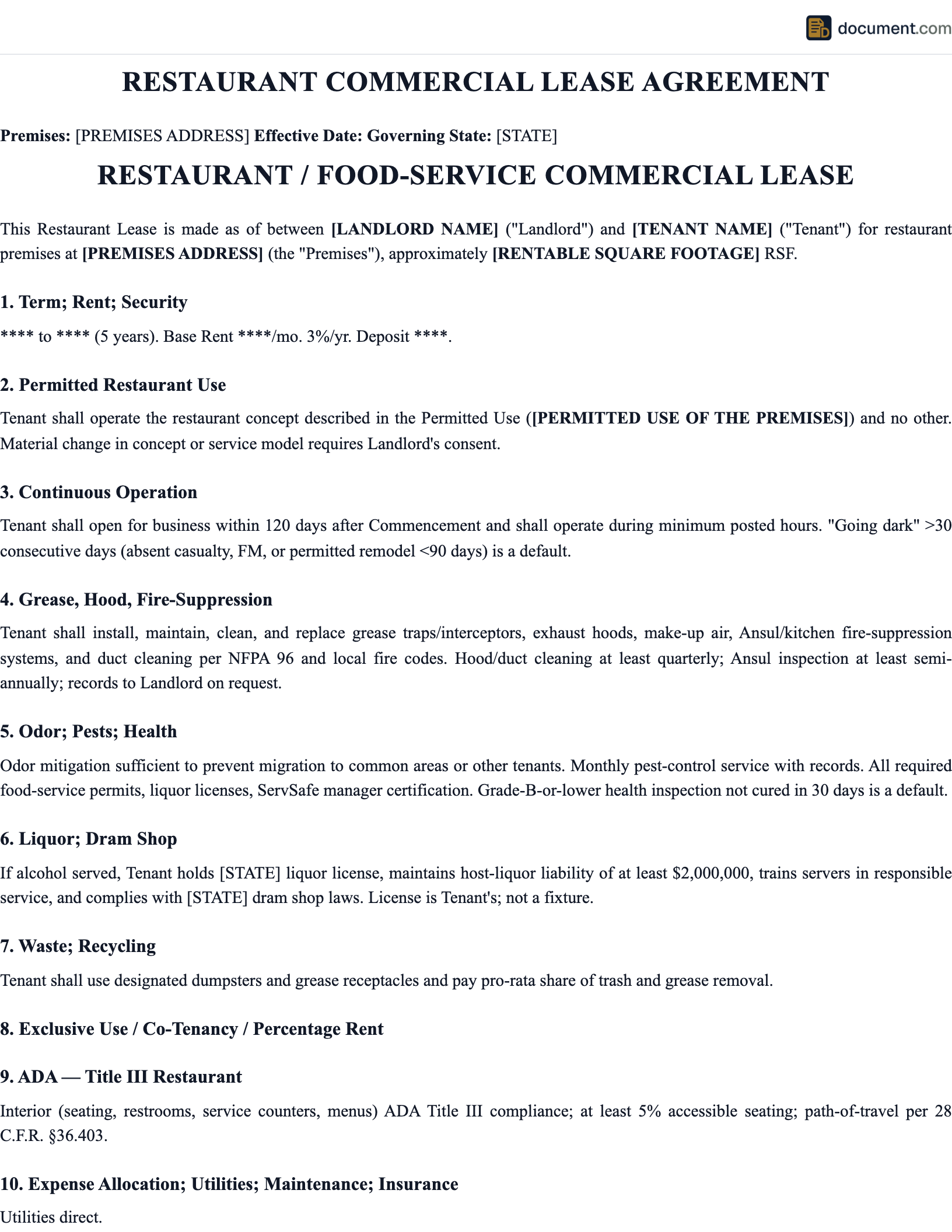
Sample Minnesota Restaurant Lease Agreement
Below is a preview of our Minnesota-specific template. Your customized document will include all fields and provisions required for filing in any Minnesota county.
RESTAURANT LEASE AGREEMENT
STATE OF MINNESOTA
Legal Document Template
LANDLORD
Name: [Full Legal Name / Entity]
Property: [Building/Center Name]
Address: [Property Address]
TENANT / OPERATOR
Name: [Restaurant Entity Name]
Concept: [Restaurant Name/Concept]
Experience: [Years in Food Service]
Tax ID: [EIN]
PREMISES
Suite: [Number]
Total SF: [Square Feet]
Kitchen SF: [Square Feet]
Dining SF: [Square Feet]
Patio: [Yes/No - SF]
FINANCIAL TERMS
Base Rent: $[Amount]/month
Percentage Rate: [%] above $[Breakpoint]
TI Allowance: $[Amount]
Deposit: $[Amount]
CAM: $[Amount]/month
Minnesota Restaurant Lease Agreement FAQ
Answers to common questions about filing a restaurant lease agreement in Minnesota, including requirements, fees, and procedures.
Official Minnesota Resources
Use these official state resources to verify requirements, find your local filing office, and access government forms for Minnesota.
Related Minnesota Documents
Depending on your situation, you may need additional documents alongside your Minnesota restaurant lease agreement.
Create your Minnesota Commercial Restaurant Lease Agreement in under 5 minutes.
Answer a few questions and download a Minnesota-compliant document, ready for the state agency.