



North Dakota Restaurant Lease Agreement Overview
North Dakota's restaurant market is defined by three distinct economies. Bismarck and Fargo anchor the state's two largest commercial centers, each with different demand drivers. Bismarck's stable government-based economy provides consistent year-round dining demand, while Fargo is the state's most dynamic restaurant market, driven by North Dakota State University, a growing healthcare sector, and expanding technology employment. Grand Forks, home to the University of North Dakota, is a smaller but active restaurant market with a high concentration of students and university-related traffic. In western North Dakota, the Bakken oil patch around Williston creates a boom-bust market that rewards flexibility in lease terms above almost all other considerations.
Restaurant tenants in North Dakota deal with the NDDOH for their food establishment license at the state level, which provides more consistency than county-by-county permitting systems. The ND AGED handles alcohol licensing through the Attorney General's office, and the state's licensing framework is generally less restrictive than states with capped license numbers. However, the state's harsh winter climate creates unique lease considerations around HVAC obligations, utility costs, and operational continuity during extreme weather events that require specific attention in any North Dakota restaurant lease.
NDDOH
Food licensing
AGED
Alcohol licensing
3+
Major markets
Cold
HVAC provisions key
North Dakota Restaurant Lease Requirements
A North Dakota restaurant lease must address the specific regulatory, climate, and market conditions that affect food service operations in the state. Standard commercial lease templates designed for other uses often miss critical restaurant-specific provisions.
Bakken Market Caution
Restaurant operators considering locations in western North Dakota's oil patch communities should be extremely cautious about long-term fixed-rent leases. Revenue in Williston, Dickinson, and other Bakken communities tracks oil production activity closely, and multi-year rent obligations entered during boom periods can become unsustainable during downturns. Negotiate for shorter initial terms, early termination rights tied to revenue thresholds, or percentage rent structures that align costs with revenue performance.
Key Lease Requirements
- NDDOH License Contingency: Include a contingency allowing the tenant to exit the lease if a NDDOH food establishment license cannot be obtained for the specific location and intended use
- AGED License Contingency: If alcohol service is planned, include a contingency allowing lease termination if the ND AGED liquor license cannot be obtained within a specified timeframe
- HVAC and Heating Obligations: Specify the landlord's obligation to maintain adequate heating during North Dakota winters, including minimum temperature standards and emergency repair timelines for HVAC failures during extreme cold
- Ventilation and Hood Systems: Address who is responsible for commercial kitchen exhaust hood installation, maintenance, and cleaning, and ensure these systems comply with NDDOH and local fire code requirements
- Rent Commencement Tied to Delivery: Tie rent commencement to the date the landlord delivers the premises in a condition ready for the tenant's buildout, not to lease execution
- Utility Load Warranty: Require the landlord to warrant that the premises can support the electrical, gas, and water loads required for commercial kitchen operations
How to Execute a North Dakota Restaurant Lease
Executing a North Dakota restaurant lease requires working through regulatory and infrastructure due diligence before signing. Given the state's climate and the regulatory environment, preparation is critical.
Confirm Zoning and AGED Eligibility
Contact the city planning or zoning department to confirm the space is properly zoned for restaurant use. If you plan to serve alcohol, review the AGED requirements and confirm there are no proximity restrictions or local ordinances that would prevent you from obtaining a license at the specific location. In Fargo, Bismarck, Grand Forks, and Minot, this is straightforward, but smaller communities may have restrictions.
Assess Kitchen Infrastructure and HVAC
Have a mechanical engineer or experienced kitchen contractor walk the space before signing. Confirm the electrical panel has capacity for commercial cooking equipment, that gas supply is adequate, that the HVAC system can handle both commercial kitchen heat loads and North Dakota winter temperatures, and that plumbing supports a grease interceptor. Any deficiencies identified at this stage should be addressed in the lease rather than discovered after you are committed.
Negotiate Contingencies and Buildout Terms
Include a NDDOH license contingency and an AGED license contingency if alcohol service is planned. Negotiate a tenant improvement allowance sufficient for the kitchen buildout. Tie rent commencement to actual delivery of the premises, not to lease signing. Oil patch operators should negotiate a shorter initial term or revenue-based early termination right given the volatility of the Bakken market.
Execute the Lease
Both parties should sign a comprehensive written lease that addresses all regulatory contingencies, HVAC obligations, buildout responsibilities, and utility warrants. Have an attorney review the lease before signing. Retain fully executed originals.
Begin NDDOH Licensing and Construction
Apply for the NDDOH food establishment license and, if applicable, begin the AGED liquor license application. NDDOH will conduct a pre-opening inspection before issuing the license, so allow time for the inspection process in your opening timeline. Begin construction once you have the executed lease and necessary permits in hand, and document all improvements for insurance and lease-end purposes.
Tax Implications for North Dakota Restaurant Tenants
North Dakota restaurant tenants face several tax considerations at the state and federal level that are worth understanding before signing a lease.
| Tax Issue | North Dakota Treatment |
|---|---|
| ND Sales Tax on Food | North Dakota imposes a 5% state sales tax on prepared food sold for immediate consumption. Restaurant operators must collect and remit this tax on all food and beverage sales. The state also allows cities and counties to impose additional local sales taxes, so the total rate in Fargo or Bismarck may be higher than the state rate alone. |
| Lease Rent Deductibility | Restaurant lease rent is deductible as an ordinary business expense for both federal income tax and North Dakota state income tax purposes, provided the space is used exclusively for business operations. Keep records of all rent payments and lease modifications. |
| TI Allowance Tax Treatment | Tenant improvement allowances received from landlords may be includable in gross income for federal tax purposes unless specific IRS safe harbors apply. Consult a tax advisor about how TI allowances received for North Dakota restaurant buildouts should be reported and whether any exemptions apply to your specific lease structure. |
| Oil Patch Revenue Volatility | Bakken region restaurant operators who experience extreme revenue swings should work with a tax professional familiar with ND to understand the implications of percentage rent clauses, revenue-based early termination provisions, and the timing of income recognition in a volatile revenue environment. |
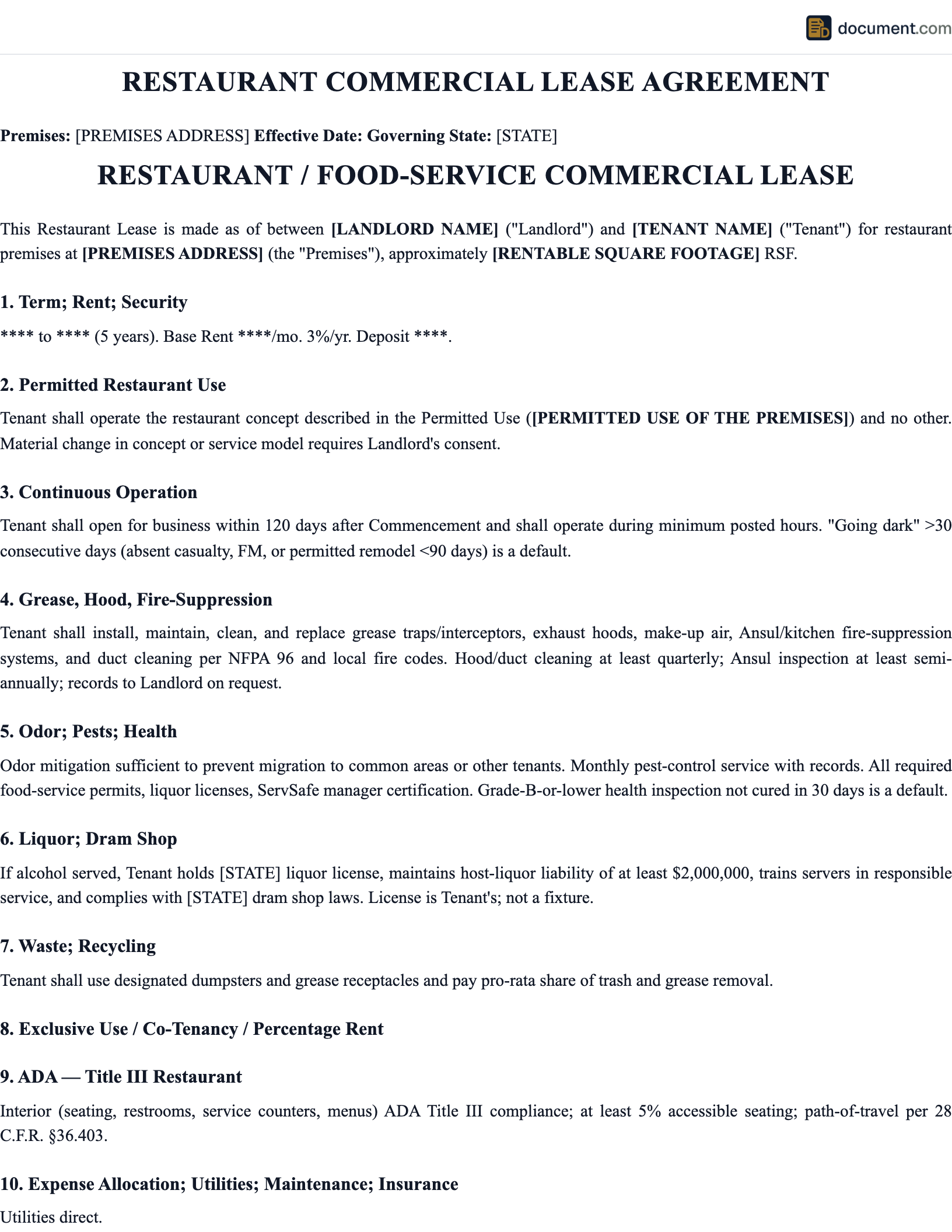
Sample North Dakota Restaurant Lease Agreement
Below is a preview of our North Dakota-specific template. Your customized document will include all fields and provisions required for filing in any North Dakota county.
RESTAURANT LEASE AGREEMENT
STATE OF NORTH DAKOTA
Legal Document Template
LANDLORD
Name: [Full Legal Name / Entity]
Property: [Building/Center Name]
Address: [Property Address]
TENANT / OPERATOR
Name: [Restaurant Entity Name]
Concept: [Restaurant Name/Concept]
Experience: [Years in Food Service]
Tax ID: [EIN]
PREMISES
Suite: [Number]
Total SF: [Square Feet]
Kitchen SF: [Square Feet]
Dining SF: [Square Feet]
Patio: [Yes/No - SF]
FINANCIAL TERMS
Base Rent: $[Amount]/month
Percentage Rate: [%] above $[Breakpoint]
TI Allowance: $[Amount]
Deposit: $[Amount]
CAM: $[Amount]/month
North Dakota Restaurant Lease Agreement FAQ
Answers to common questions about filing a restaurant lease agreement in North Dakota, including requirements, fees, and procedures.
Important Considerations for ND Restaurant Tenants
North Dakota's winter climate is an operational reality that restaurant tenants need to plan for in their lease terms. HVAC failures during a North Dakota winter are not just uncomfortable, they can be operationally catastrophic. Pipes can freeze, food safety can be compromised, and the physical premises can be damaged within hours of a heating failure in January or February. A restaurant lease in North Dakota should include specific provisions requiring the landlord to respond to HVAC emergencies within a defined time window and granting the tenant the right to make emergency repairs at the landlord's expense if the landlord fails to respond quickly.
The North Dakota restaurant labor market has been persistently tight, particularly in the Bakken region and in Fargo where multiple industries compete for workers. Labor shortages can affect operating hours, which in turn affects the revenue projections underlying a lease commitment. Tenants should be cautious about leasing large spaces that require many employees if the local labor market makes adequate staffing uncertain.
Fargo is the most competitive and sophisticated restaurant market in the state, and new operators should assess the competitive landscape carefully before signing. The Research Triangle analogy applies loosely: Fargo draws from a well-educated, food-culture-aware consumer base that supports sophisticated concepts, but also means the competitive field is strong and undifferentiated concepts struggle to survive.
Get a Lease Review Before You Sign
North Dakota restaurant leases are long-term commitments in a state where climate, market volatility, and regulatory complexity create real risk. An attorney with commercial real estate or food service experience can identify lease terms that expose you to outsized risk and negotiate protections that preserve your ability to operate and exit if circumstances change. The Bakken region, in particular, is a market where long-term fixed-rent restaurant leases have ended careers, and professional review is strongly recommended.
Official North Dakota Resources
Use these official state resources to verify licensing requirements and regulatory guidance for North Dakota restaurant operators.
NDDOH Food Safety Program
Food establishment licensing and inspection requirements
ND AGED - Alcoholic Beverage Control
Liquor license applications and requirements
ND Office of State Tax Commissioner
Sales tax rates on prepared food and beverage sales
ND Attorney General - Landlord/Tenant
Commercial lease rights and remedies guidance
Related North Dakota Documents
Depending on your situation, you may need additional documents alongside your North Dakota restaurant lease agreement.
Create your North Dakota Commercial Restaurant Lease Agreement in under 5 minutes.
Answer a few questions and download a North Dakota-compliant document, ready for the state agency.