
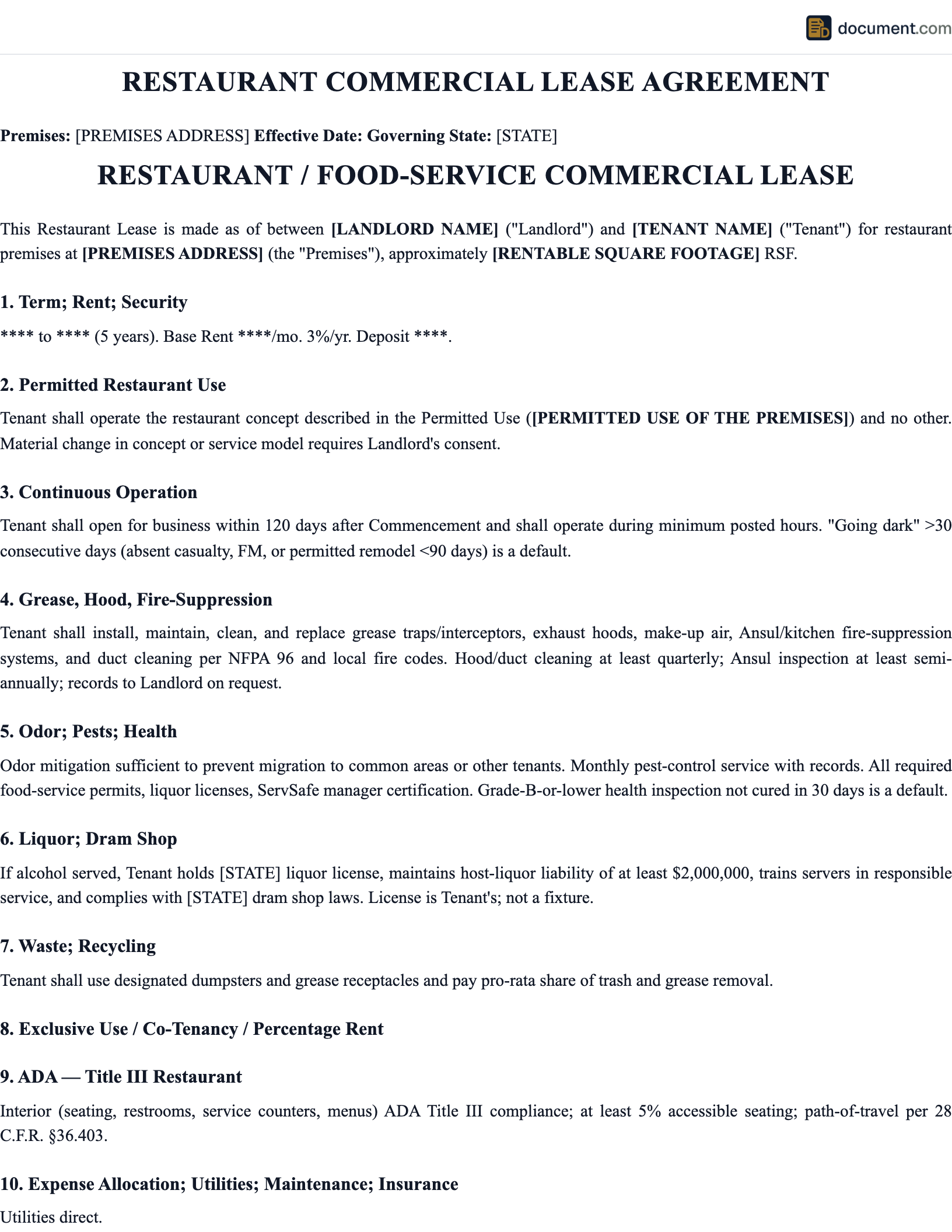



Missouri Restaurant Lease Agreement Overview
Missouri's restaurant market is anchored by two distinct metropolitan food cultures. Kansas City's barbecue tradition drives demand for space with heavy cooking infrastructure, smoker capacity, and high-output ventilation, and the city's restaurant scene has expanded well beyond the classic barbecue joints to a diverse set of dining concepts concentrated in neighborhoods like the Crossroads Arts District, Waldo, and the River Market. St. Louis operates across a unique jurisdictional split between the city and the county, with active restaurant markets in the Central West End, the Delmar Loop, Soulard, and suburban Clayton and Chesterfield. Liquor licensing in Missouri is administered at the state level by the Division of Alcohol and Tobacco Control, but cities and counties layer their own requirements on top of the state framework, making the licensing path vary by specific address.
Missouri's restaurant licensing environment requires tenants to coordinate across multiple agencies. The Missouri Department of Health and Senior Services or a local county health department handles food establishment licensing, depending on the restaurant's location. The Division of Alcohol and Tobacco Control issues the state liquor license, and the applicable city or county may require an additional municipal liquor license. Kansas City's Health Department and St. Louis City's Health Division each have their own pre-opening inspection processes, separate from state oversight. A Missouri restaurant lease should establish responsibility for meeting all applicable licensing conditions and address what happens to the lease if required licenses are denied or delayed.
$24
Filing fee
Required
Notarization
0
Witnesses required
Recorder
Filing office
Missouri Requirements
Missouri restaurant leases must account for the layered licensing structure of state and municipal alcohol control, food establishment permitting at the state or local level, NFPA 96 hood and fire suppression compliance, grease trap requirements from local sewer authorities, and ADA compliance obligations. These are not boilerplate concerns; they determine whether your restaurant can legally operate in the specific space.
Missouri ATC Licensing and Municipal Overlay Notice
Missouri's Division of Alcohol and Tobacco Control issues state liquor licenses, but Kansas City, St. Louis City, St. Louis County, and other municipalities impose additional local licensing requirements on top of the state license. The licensing path for a restaurant at a specific address depends on which city or county jurisdiction it falls within. Confirm both the state ATC eligibility requirements and any applicable municipal licensing requirements before signing a Missouri restaurant lease.
Document Requirements
- ATC and Municipal Liquor License Eligibility: Verify state ATC eligibility and any applicable city or county licensing requirements; for Kansas City restaurants, contact the Kansas City Finance Department liquor licensing division; for St. Louis City, contact the St. Louis City Excise Commissioner's office; for St. Louis County municipalities, confirm with the relevant county or municipal licensing body
- Food Establishment License: Confirm whether the restaurant will be licensed by the Missouri Department of Health and Senior Services or by the applicable local health department; the lease should be contingent on successful food establishment licensing and address what happens if the license is delayed or denied
- Hood and Ventilation Compliance: Request documentation of the existing hood suppression system and confirm NFPA 96 inspection is current; if the concept requires commercial smoker installation, negotiate landlord approval for smoker equipment and confirm the existing hood is rated for wood smoke output
- Grease Trap Requirements: Confirm grease interceptor sizing requirements with the applicable local sewer authority, whether Kansas City Water Services, Metropolitan St. Louis Sewer District, or a local utility; the lease should specify who is responsible for grease trap installation, sizing, and ongoing maintenance
- ADA Compliance and Parking: Confirm the lease assigns base building accessibility compliance to the landlord; verify that parking available to the restaurant meets local zoning requirements for the planned seating capacity and confirm any dedicated parking rights in the lease
How to File in Missouri
Executing a Missouri restaurant lease requires mapping the full licensing path for your specific address, negotiating buildout provisions appropriate for your cooking concept, and ensuring the lease structure protects your investment through the licensing and permit approval period.
Verify ATC and Municipal Liquor License Eligibility
Contact the Missouri Division of Alcohol and Tobacco Control to confirm the proposed premises is eligible for the type of liquor license your concept requires. For Kansas City locations, also contact the Kansas City Finance Department liquor licensing office. For St. Louis City, contact the Excise Commissioner. For St. Louis County municipalities, confirm with the applicable municipal body. Zoning affects liquor license availability, and the distance from schools, churches, or other licensed premises can affect eligibility in some Missouri cities.
Negotiate Buildout Provisions for Your Concept
Missouri restaurant buildouts vary significantly by concept. Barbecue and heavy cooking operations require smoker installation approval, high-capacity hood and exhaust systems, NFPA 96-compliant fire suppression, and grease trap sizing adequate for high-fat output. Negotiate landlord contribution to buildout costs and confirm any approval requirements for smoker or equipment installation that might require structural modifications. Address grease interceptor requirements from the applicable sewer utility, whether Kansas City Water Services, the Metropolitan St. Louis Sewer District (MSD), or another local authority.
Execute the Lease with License Contingency Protections
Missouri commercial leases do not require notarization for enforceability between the parties, though notarization is required to record the lease with the Recorder of Deeds for constructive notice purposes. Execute the lease and include a contingency that allows termination without penalty if the required state ATC or municipal liquor license cannot be obtained, or if the health department licensing inspection fails. If the liquor license is being transferred from a prior operator, confirm the ATC transfer procedures and timelines before setting your opening date.
Apply for State and Municipal Licenses
Submit the ATC state liquor license application and any required municipal liquor license applications concurrently after lease execution. Submit the food establishment license application to either the Missouri Department of Health and Senior Services or the applicable local health department. Coordinate the pre-opening inspection timeline with your buildout schedule to avoid delays between completion of construction and the ability to open. Kansas City and St. Louis City health departments typically require pre-opening inspections and may require multiple visits for new establishments.
Retain All Regulatory and Lease Records
Maintain copies of your state ATC license, any applicable municipal liquor license, your food establishment license, hood suppression inspection records, grease trap maintenance logs, health department inspection reports, and all lease documents and correspondence. Missouri's ATC requires license holders to maintain certain records on premises, and local health departments may request inspection and maintenance records during routine inspections. A complete lease file also protects you if a landlord dispute arises over permitted use, equipment modifications, or assignment rights in connection with a future business sale.
Missouri Fees & Costs
Below is a breakdown of the typical costs associated with filing this document in Missouri. Actual fees may vary by county.
| Fee / Cost | Amount |
|---|---|
| Filing Fee | $24 first page |
| Notarization | $5 - $25 per signature |
| Certified Copy | $1 - $10 per page |
| Attorney Review (optional) | $150 - $500 |
Sample Missouri Restaurant Lease Agreement
Below is a preview of our Missouri-specific template. Your customized document will include all fields and provisions required for filing in any Missouri county.
RESTAURANT LEASE AGREEMENT
STATE OF MISSOURI
Legal Document Template
LANDLORD
Name: [Full Legal Name / Entity]
Property: [Building/Center Name]
Address: [Property Address]
TENANT / OPERATOR
Name: [Restaurant Entity Name]
Concept: [Restaurant Name/Concept]
Experience: [Years in Food Service]
Tax ID: [EIN]
PREMISES
Suite: [Number]
Total SF: [Square Feet]
Kitchen SF: [Square Feet]
Dining SF: [Square Feet]
Patio: [Yes/No - SF]
FINANCIAL TERMS
Base Rent: $[Amount]/month
Percentage Rate: [%] above $[Breakpoint]
TI Allowance: $[Amount]
Deposit: $[Amount]
CAM: $[Amount]/month
Missouri Restaurant Lease Agreement FAQ
Answers to common questions about filing a restaurant lease agreement in Missouri, including requirements, fees, and procedures.
Official Missouri Resources
Use these official state resources to verify requirements, find your local filing office, and access government forms for Missouri.
Related Missouri Documents
Depending on your situation, you may need additional documents alongside your Missouri restaurant lease agreement.
Create your Missouri Commercial Restaurant Lease Agreement in under 5 minutes.
Answer a few questions and download a Missouri-compliant document, ready for the state agency.