



Rhode Island Restaurant Lease Agreement Overview
Rhode Island punches above its weight in the national restaurant conversation, with Providence carrying a James Beard Award track record that reflects a genuinely competitive food scene for a city of its size. That translates into real commercial real estate demand, particularly in Federal Hill, the East Side, and the emerging Jewelry District neighborhoods. RIDOH Center for Food Protection issues food establishment licenses, while liquor licenses flow through a two-step process involving local city and town boards and then DBR oversight. The Providence local board has its own hearing calendar and can take several months to process applications, which affects how lease commencement dates should be structured.
Rhode Island's small geography creates lease negotiating dynamics you will not encounter in larger states. A non-compete radius clause of five miles in Providence can cover a significant fraction of the entire restaurant market in the state. The 8% state sales tax on restaurant food and beverages is one of the higher rates in New England and directly affects how percentage rent provisions should define gross sales. Older Providence building stock in Federal Hill and College Hill frequently has grease interceptor and hood system gaps that surface during pre-opening inspections. Getting the TI allowance language right, and the inspection-based commencement trigger right, is where most of the negotiating work happens on Rhode Island restaurant deals.
$40
Filing fee
Required
Notarization
0
Witnesses required
City
Filing office
Rhode Island Requirements
Rhode Island restaurant leases need to address RIDOH food establishment licensing, the two-step DBR liquor license process through local boards, ADA compliance in historic building stock, grease trap and hood maintenance, and the particular danger of broad non-compete radius clauses in a geographically small state.
Providence Local Licensing Board Timing
Liquor license applications in Providence go to the local licensing board before DBR, and the board has its own hearing schedule. Applications can take several months from filing to approval. Do not structure rent commencement on a fixed calendar date if the liquor license is material to your business model. Include a commencement trigger tied to license issuance and a termination right if the application is denied.
Key Provisions for Rhode Island Restaurant Leases
- RIDOH License and Providence Fire Inspection Trigger: Tie rent commencement to successful RIDOH and Providence Fire Department hood inspection, specifying who covers the cost of any required modifications found during either inspection
- Local Board and DBR Liquor License Contingency: Include a termination right or commencement delay provision tied to local board denial of a liquor license application, since local board approval precedes the DBR license
- ADA Buildout in Historic Buildings: Specifically address who funds ADA remediation in older Federal Hill and College Hill buildings, and whether the TI allowance explicitly covers accessible entrance, restroom, and pathway work
- Grease Interceptor and Hood Maintenance: Specify who maintains and pays for cleaning the grease interceptor and hood system, including frequency standards and documentation obligations consistent with RIDOH requirements
- Non-Compete Radius Limitations: Resist broad mile-radius non-compete provisions in a state this small; negotiate for restrictions limited to specific corridors or named competing properties rather than geographic radius
- Percentage Rent Gross Sales Definition: Define gross sales explicitly as pre-tax revenue to exclude Rhode Island's 8% sales tax from the percentage rent calculation base
How to Execute a Rhode Island Restaurant Lease
Rhode Island restaurant lease execution involves coordinating RIDOH permitting, Providence Fire Department hood inspection, and the multi-step liquor license process before rent obligations should begin. Work through the steps below before executing any lease.
Research Zoning and Local Liquor Board Timeline
Confirm the address is properly zoned for food service and that the applicable city or town licensing board is accepting applications for the license category your concept requires. Contact the Providence licensing board or the applicable town clerk to understand the current hearing schedule before you commit to a lease commencement date.
Assess Kitchen and Grease Infrastructure
Commission a contractor inspection of the hood system, grease interceptor, gas capacity, and electrical service before lease terms are finalized. Federal Hill and College Hill buildings in Providence frequently have older grease infrastructure that will draw comments from both RIDOH and the Providence Fire Department. Knowing the condition before negotiating TI protects you from absorbing remediation costs afterward.
Negotiate Lease with Rhode Island-Specific Provisions
Have a Rhode Island commercial attorney draft the lease to include a RIDOH permit commencement trigger, a local board liquor license contingency, TI allowance coverage for ADA work and grease remediation, a carefully scoped non-compete provision, and a percentage rent gross sales definition that treats sales tax correctly given the state's 8% rate.
Complete Buildout and Schedule RIDOH and Fire Inspections
After lease execution and construction, schedule the RIDOH pre-opening inspection through the Center for Food Protection and separately coordinate the hood inspection with the Providence Fire Department. Both must be completed before operations can begin. Submit the liquor license application to the local board concurrently so the timelines run in parallel.
Obtain DBR License and Open
After local board approval, DBR issues the state liquor license. Keep copies of all licenses with the executed lease and set up a renewal calendar for RIDOH annual license renewal, DBR license renewal, hood cleaning, and grease interceptor maintenance documentation required by RIDOH.
Rhode Island Restaurant Lease Fees and Costs
Rhode Island restaurant costs include RIDOH permitting, DBR liquor licensing, and an 8% state sales tax on food and beverages that is among the highest in New England. Budget these costs realistically against projected revenue before finalizing lease rent obligations.
| Fee / Cost | Typical Range |
|---|---|
| RIDOH Food Establishment License (Annual) | $100 - $500 depending on facility type, size, and food risk category |
| DBR Restaurant Liquor License (Annual) | Varies by license category and city or town; confirm current fee schedule directly with DBR |
| Rhode Island Sales Tax on Prepared Food | 8% statewide on restaurant food and beverage sales; one of the highest rates in New England |
| Hood Cleaning and Fire Suppression Inspection | $300 - $700 per cleaning; Providence Fire Department requires compliant hood inspection before occupancy |
| Grease Interceptor Maintenance | $300 - $900 per cleaning cycle; frequency depends on cooking volume and RIDOH requirements |
| Rhode Island Commercial Attorney Lease Review | $800 - $2,500 for review and negotiation support on a Providence area restaurant lease |
Sample Rhode Island Restaurant Lease Agreement
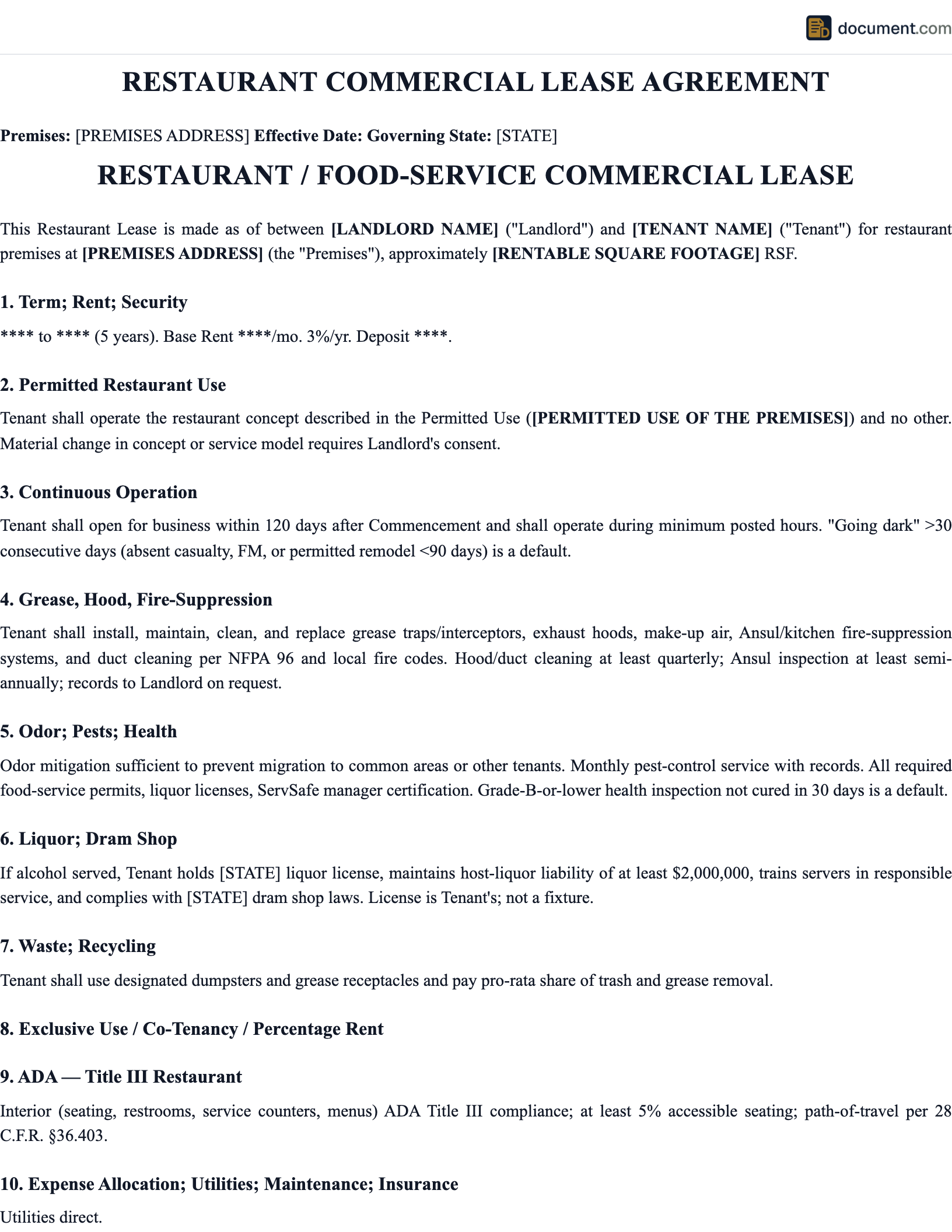
Below is a preview of our Rhode Island-specific template. Your customized document will include all fields and provisions required for filing in any Rhode Island county.
RESTAURANT LEASE AGREEMENT
STATE OF RHODE ISLAND
Legal Document Template
LANDLORD
Name: [Full Legal Name / Entity]
Property: [Building/Center Name]
Address: [Property Address]
TENANT / OPERATOR
Name: [Restaurant Entity Name]
Concept: [Restaurant Name/Concept]
Experience: [Years in Food Service]
Tax ID: [EIN]
PREMISES
Suite: [Number]
Total SF: [Square Feet]
Kitchen SF: [Square Feet]
Dining SF: [Square Feet]
Patio: [Yes/No - SF]
FINANCIAL TERMS
Base Rent: $[Amount]/month
Percentage Rate: [%] above $[Breakpoint]
TI Allowance: $[Amount]
Deposit: $[Amount]
CAM: $[Amount]/month
Rhode Island Restaurant Lease Agreement FAQ
Answers to common questions about filing a restaurant lease agreement in Rhode Island, including requirements, fees, and procedures.
Official Rhode Island Resources
Use these official state resources to verify requirements, find your local filing office, and access government forms for Rhode Island.
Related Rhode Island Documents
Depending on your situation, you may need additional documents alongside your Rhode Island restaurant lease agreement.
Create your Rhode Island Commercial Restaurant Lease Agreement in under 5 minutes.
Answer a few questions and download a Rhode Island-compliant document, ready for the state agency.