
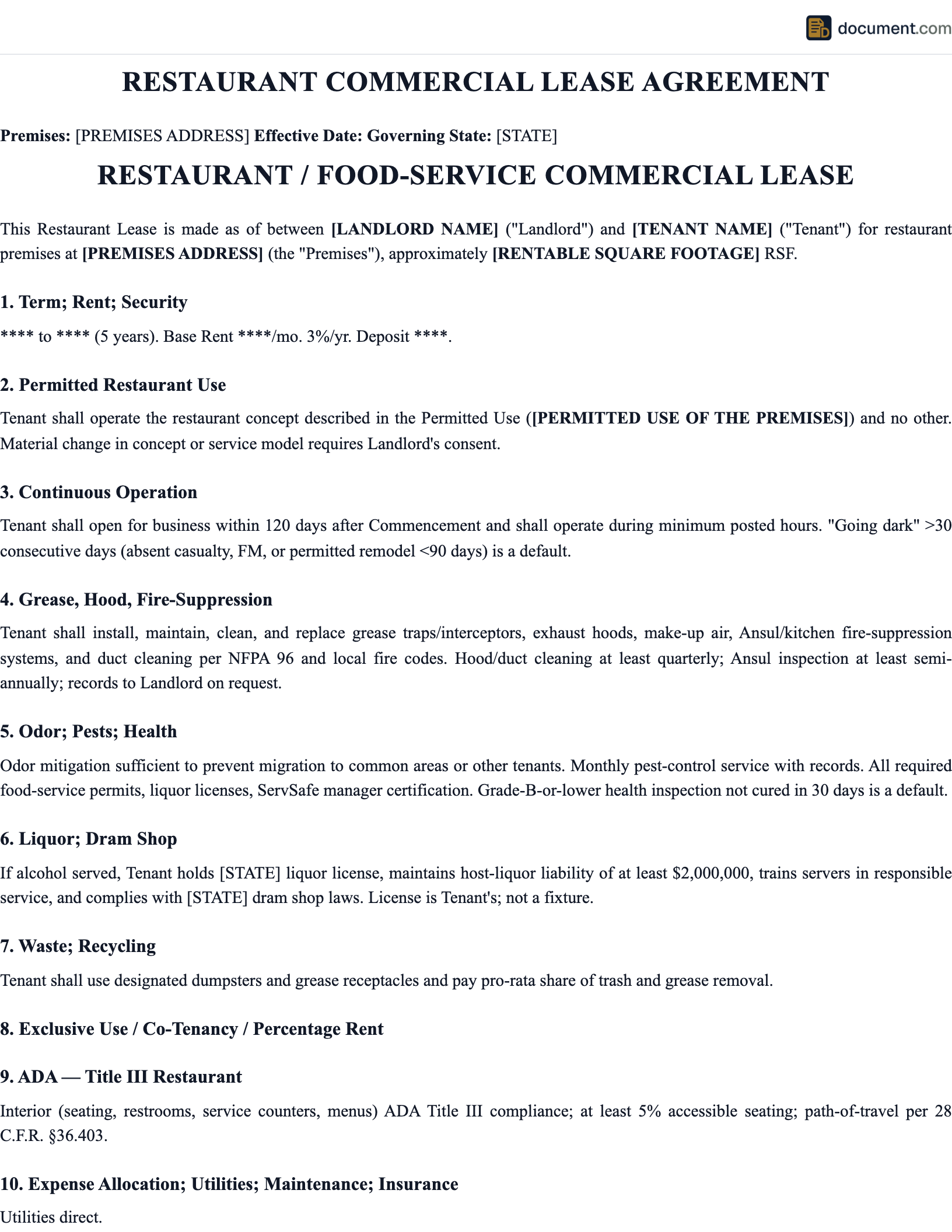



Nevada Restaurant Lease Agreement Overview
Nevada restaurant leasing is divided into two distinct worlds. Las Vegas and the broader Clark County market is among the most competitive and complex restaurant leasing environments in the country, shaped by casino economics, tourist-driven revenue cycles, and a regulatory structure involving the Southern Nevada Health District, Clark County, and various city governments. Reno and Washoe County are a simpler market with more conventional restaurant lease dynamics. A lease template that works for Reno would miss critical provisions needed for a Las Vegas Strip or Resort Corridor location.
Nevada has no dedicated restaurant tenancy statute; commercial leases are governed by general contract law and the Nevada Revised Statutes covering commercial landlord-tenant relationships. Food service licensing is administered at the county health district level: the Southern Nevada Health District for Clark County restaurants, and Washoe County District Health for Reno and Sparks. Liquor licensing is city or county specific depending on whether the restaurant is in an incorporated municipality or unincorporated area. For Las Vegas Strip or casino-adjacent restaurants, Nevada Gaming Control Board rules may also apply. All of these regulatory layers need to be addressed in the lease.
$25
Filing fee
Required
Notarization
0
Witnesses required
County
Filing office
Nevada Requirements
Nevada has specific requirements for this type of legal document. Meeting these requirements ensures your document is accepted by the county recorder and is legally enforceable.
Nevada Specific Note
Nevada restaurant leases in Clark County require attention to Southern Nevada Health District food establishment permit requirements, city and county-level liquor licensing, and for casino-adjacent locations, potential Nevada Gaming Control Board considerations. Execute your lease before submitting liquor license applications since Nevada licensing authorities require documentation of your right to occupy the premises. SNHD pre-opening inspections can be scheduled in advance; do not wait until buildout is complete to initiate the inspection process.
Document Requirements
- Health Permit Contingency: Include a clause tying rent commencement to issuance of the food establishment permit from SNHD (Clark County) or Washoe County District Health
- Hood and Suppression System Responsibility: Specify ownership, maintenance, certification, and upgrade obligations for Type I hood systems and fire suppression per NFPA 96 and local fire code
- Liquor License Zoning: Confirm that the specific address and zoning classification permit the liquor license type you intend to hold under the applicable city or county licensing authority
- Casino-Adjacent Provisions: For Las Vegas Strip or Resort Corridor locations, negotiate co-tenancy clauses, signage rights, and comp program participation terms that protect the tenant's standalone viability
- ADA Compliance: Clarify which party is responsible for ADA path-of-travel improvements in shared building corridors, particularly in complex Las Vegas commercial properties
How to Execute a Nevada Restaurant Lease
Executing a Nevada restaurant lease, particularly in Las Vegas, involves more regulatory coordination than most states. Plan for health permit, liquor license, and building permit applications to run in parallel with lease negotiation and buildout.
Confirm Zoning and License Eligibility
Verify the property is zoned for restaurant use and that the applicable liquor licensing authority will approve the license type you need at that address. In Las Vegas, contact the City of Las Vegas, Clark County, or Henderson depending on whether the address is in an incorporated city or unincorporated county land.
Inspect Kitchen and HVAC Systems
Have a qualified contractor evaluate all existing hood, ventilation, grease interceptor, and fire suppression systems. Document any deficiencies and negotiate upgrades into the tenant improvement allowance before signing. SNHD inspectors will evaluate these systems during the pre-opening inspection.
Execute the Lease and Apply for Permits
Sign the lease so you have occupancy documentation, then simultaneously submit building permit applications and your SNHD or Washoe County food establishment permit application. Submit your liquor license application to the appropriate local authority with a copy of the executed lease.
Schedule SNHD Pre-Opening Inspection
Contact SNHD or Washoe County District Health to schedule a pre-opening inspection before buildout is finalized. Early scheduling avoids delays since inspectors have limited availability and any required corrections take additional time to resolve and re-inspect.
Post Permits and Retain All Originals
Display the food establishment permit in a visible location as required by Nevada law. Keep signed lease originals, all permits, and insurance documents in a secure location accessible at the restaurant. Health inspectors and liquor enforcement agents will request documentation during routine compliance checks.
Nevada Tax Implications for Restaurant Leases
Nevada has no state income tax, which is a significant financial benefit for restaurant operators. Business income is not subject to state income tax in Nevada, making it materially more attractive than neighboring California from a tax standpoint. However, Nevada does impose a Commerce Tax on businesses with Nevada gross revenue above $4 million annually, which applies to restaurant chains and larger operators.
Nevada imposes a statewide sales tax (currently 6.85% state rate with local additions that bring Clark County's combined rate to 8.375%) on prepared food and restaurant meals. This is a significant cost that restaurant operators must incorporate into their pricing models. Percentage rent computations should explicitly exclude sales tax collected from gross sales, since sales tax revenue belongs to the state and is not the tenant's income.
Nevada also imposes a Modified Business Tax on payroll above a quarterly exemption threshold. This is an additional cost of doing business that restaurant operators with significant staff should factor into lease-period financial projections. Property taxes in Clark County are capped at a 3% annual increase per the Nevada cap, which provides predictability for landlords passing through property tax costs in triple-net leases.
Important Considerations for Nevada Restaurant Tenants
The Las Vegas restaurant market has fundamentally different economics from almost any other US market. Casino comp culture means that a large share of dining decisions in the Las Vegas metro involve casino loyalty programs that route guests to casino-controlled food and beverage. An independent restaurant in or adjacent to a casino property competes with subsidized in-house concepts and faces the reality that many tourists budget their dining as an extension of their gaming experience. Underestimating this competitive reality in lease-period revenue projections is a common mistake.
Las Vegas has unique resort fee and minimum spend dynamics in hotel-adjacent retail space. Some hotel-adjacent restaurant lease terms include minimum revenue performance requirements or co-tenancy clauses tied to hotel occupancy. These provisions need careful analysis since hotel occupancy and restaurant traffic are correlated but not identical.
Reno is a simpler and more stable restaurant market without the casino complexity of Las Vegas. Reno leases in established districts like Midtown or the Riverwalk area follow more conventional western US commercial lease patterns. The regulatory environment through Washoe County District Health is less complex than SNHD, and liquor licensing through the City of Reno or Washoe County is more straightforward.
Nevada Counsel Strongly Recommended for Las Vegas
Las Vegas restaurant leases in casino-adjacent or Resort Corridor locations involve enough unique provisions that Nevada hospitality attorneys with local market experience are genuinely valuable. Casino landlord terms, SNHD compliance requirements, and gaming regulatory intersections require local knowledge that generic commercial real estate attorneys may not have.
Nevada Fees & Costs
Below is a breakdown of the typical costs associated with filing this document in Nevada. Actual fees may vary by county.
| Fee / Cost | Amount |
|---|---|
| Filing Fee | $25 first page |
| Notarization | $5 - $25 per signature |
| Certified Copy | $1 - $10 per page |
| Attorney Review (optional) | $150 - $500 |
Sample Nevada Restaurant Lease Agreement
Below is a preview of our Nevada-specific template. Your customized document will include all fields and provisions required for filing in any Nevada county.
RESTAURANT LEASE AGREEMENT
STATE OF NEVADA
Legal Document Template
LANDLORD
Name: [Full Legal Name / Entity]
Property: [Building/Center Name]
Address: [Property Address]
TENANT / OPERATOR
Name: [Restaurant Entity Name]
Concept: [Restaurant Name/Concept]
Experience: [Years in Food Service]
Tax ID: [EIN]
PREMISES
Suite: [Number]
Total SF: [Square Feet]
Kitchen SF: [Square Feet]
Dining SF: [Square Feet]
Patio: [Yes/No - SF]
FINANCIAL TERMS
Base Rent: $[Amount]/month
Percentage Rate: [%] above $[Breakpoint]
TI Allowance: $[Amount]
Deposit: $[Amount]
CAM: $[Amount]/month
Nevada Restaurant Lease Agreement FAQ
Answers to common questions about filing a restaurant lease agreement in Nevada, including requirements, fees, and procedures.
Official Nevada Resources
Use these official state resources to verify requirements, find your local filing office, and access government forms for Nevada.
Related Nevada Documents
Depending on your situation, you may need additional documents alongside your Nevada restaurant lease agreement.
Create your Nevada Commercial Restaurant Lease Agreement in under 5 minutes.
Answer a few questions and download a Nevada-compliant document, ready for the state agency.