



Nebraska Restaurant Lease Agreement Overview
Nebraska restaurant leases are governed by general commercial contract law under the Nebraska Uniform Commercial Code and common law contract principles. The state has no dedicated restaurant tenancy statute, which means the lease document itself carries significant weight in defining rights and obligations. Omaha and Lincoln are the primary restaurant markets, with the Omaha metro accounting for a large share of the state's food service industry. Both cities have active redevelopment activity in neighborhoods like Omaha's Blackstone District, Benson, and Midtown Crossing, and Lincoln's Haymarket, where restaurant demand has been strong.
The Nebraska Department of Health and Human Services licenses all retail food establishments under the Nebraska Pure Food Act. Restaurants must apply for and maintain an NDHHS food establishment license at the operating address. The Nebraska Liquor Control Commission separately licenses on-premises alcohol sales, and both licenses are site-specific and operator-specific. Because license applications require proof of the applicant's right to occupy the premises, the sequence of lease execution and license application needs to be planned carefully so that permit delays do not push back the opening date unnecessarily.
$10
Filing fee
Required
Notarization
0
Witnesses required
Register
Filing office
Nebraska Requirements
A Nebraska restaurant lease needs to address food service licensing, fire code equipment standards, liquor license zoning, and buildout terms. Generic commercial lease templates miss the operational provisions that matter most for restaurant tenants.
Nebraska Specific Note
Nebraska Liquor Control Commission license applications require documentation of the applicant's right to occupy the premises. Execute your lease or letter of intent before submitting the liquor license application, since the Commission will not process applications without it. Omaha and Lincoln have active enforcement of this requirement.
Document Requirements
- NDHHS Permit Contingency: Include a clause tying rent commencement to the issuance of the NDHHS retail food establishment license at the address
- Hood and Grease System Responsibility: Specify who owns, maintains, and certifies Type I hood systems and grease interceptors per Nebraska State Fire Marshal requirements
- Liquor License Zoning Confirmation: Confirm that the address's zoning classification permits on-premises liquor sales under Nebraska Liquor Control Commission rules
- Tenant Improvement Allowance Terms: Detail the amount, permitted uses, completion timeline, and ownership of improvements funded by any landlord allowance
- ADA Compliance Allocation: Assign responsibility for ADA path-of-travel improvements between landlord and tenant, particularly for older Omaha and Lincoln commercial buildings
How to Execute a Nebraska Restaurant Lease
Executing a Nebraska restaurant lease properly requires coordinating the legal agreement with NDHHS and Nebraska Liquor Control Commission application timelines. Plan these in parallel to avoid unnecessary delays.
Confirm Zoning and License Eligibility
Verify the property's zoning classification permits restaurant use and on-premises liquor service. Contact the local planning department and the Nebraska Liquor Control Commission to confirm that the specific address qualifies for the license type you intend to hold.
Inspect Existing Kitchen Systems
Have a qualified contractor evaluate all existing hood, ventilation, grease trap, and suppression systems before signing. Document deficiencies and negotiate upgrades into the tenant improvement allowance before lease execution.
Execute the Lease and Begin License Applications
Sign the lease so you have documentation of your right to occupy the premises. Submit your NDHHS food establishment license application and your Nebraska Liquor Control Commission application simultaneously, as both require the executed lease or letter of intent.
Complete Buildout Under Permit Contingency
Use the free rent or permit-contingency period to complete buildout. Nebraska State Fire Marshal approval of hood and suppression systems is required before the health department will issue a food establishment license for a new installation.
Retain All Originals and Licenses On-Site
Keep the signed lease, NDHHS food establishment license, and Nebraska Liquor Control Commission license posted or accessible at the restaurant. Nebraska health inspectors and liquor enforcement agents can request documentation at any inspection.
Nebraska Tax Implications for Restaurant Leases
Nebraska imposes a 5.5% state sales tax on prepared food and beverage sales, which applies to restaurant meals. Unlike some states that exempt food from sales tax, Nebraska treats restaurant food as taxable. This affects the gross sales definitions used in percentage rent calculations since Nebraska sales tax collected is not the tenant's revenue and should be explicitly excluded from any percentage rent computation.
Tenant improvement costs paid by a landlord allowance may be treated as taxable income to the tenant under federal rules depending on the allowance structure. Nebraska follows federal income tax treatment for most business purposes, so lease payments and leasehold improvements depreciate under the same rules. Nebraska does not have a separate corporate income tax rate that materially differs from federal treatment for most restaurant operators.
Property taxes on the commercial building are typically a landlord cost in gross leases but often pass through to tenants under triple-net and modified gross leases. Nebraska commercial property is assessed at a percentage of actual value by county assessors. Tenants in triple-net leases should request the current assessed value and tax bill for the property to project their share of the annual tax obligation.
Important Considerations for Nebraska Restaurant Tenants
Omaha's restaurant market has grown substantially, with strong concentration in neighborhoods like Benson, Dundee, Midtown Crossing, and Blackstone. These areas have seen significant rent appreciation, and landlords in high-demand corridors often present aggressive lease terms. Tenants who negotiate HVAC replacement reserves, cap CAM escalations, and secure personal guarantee carve-outs for experienced operators will be in a materially better position over the lease term.
Agricultural and commodity culture in Nebraska creates real demand for farm-to-table and regional cuisine concepts. If the restaurant's brand depends on specific agricultural sourcing relationships or seasonal menus, the lease should not contain use restrictions that conflict with those concepts. Some Nebraska landlords insert use clauses that are narrower than the tenant realizes at signing.
Lincoln leases near the University of Nebraska campus involve unique dynamics around Husker football game days. Revenue on game days can dwarf normal weekly sales. If the lease includes any percentage rent component, negotiate the natural breakpoint based on annual revenue projections that include game-day peaks, and confirm that parking-related costs during events are allocated fairly.
Attorney Review Recommended
Nebraska restaurant attorneys familiar with NDHHS licensing and Liquor Control Commission requirements can identify lease gaps that could delay your opening. A review focused on permit contingencies, equipment obligations, and percentage rent calculations is a sound investment before signing.
Nebraska Fees & Costs
Below is a breakdown of the typical costs associated with filing this document in Nebraska. Actual fees may vary by county.
| Fee / Cost | Amount |
|---|---|
| Filing Fee | $10 first page + $6/additional |
| Notarization | $5 - $25 per signature |
| Certified Copy | $1 - $10 per page |
| Attorney Review (optional) | $150 - $500 |
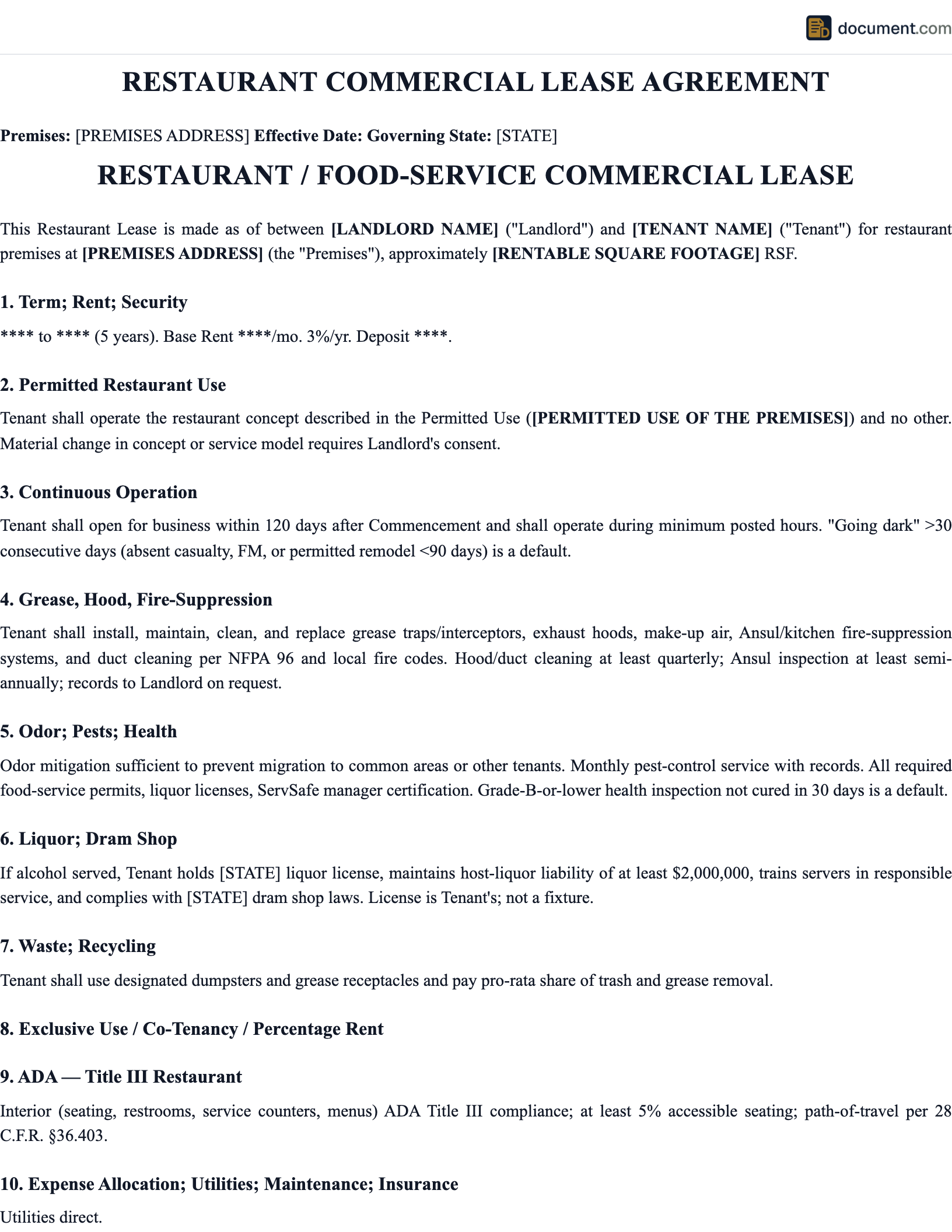
Sample Nebraska Restaurant Lease Agreement
Below is a preview of our Nebraska-specific template. Your customized document will include all fields and provisions required for filing in any Nebraska county.
RESTAURANT LEASE AGREEMENT
STATE OF NEBRASKA
Legal Document Template
LANDLORD
Name: [Full Legal Name / Entity]
Property: [Building/Center Name]
Address: [Property Address]
TENANT / OPERATOR
Name: [Restaurant Entity Name]
Concept: [Restaurant Name/Concept]
Experience: [Years in Food Service]
Tax ID: [EIN]
PREMISES
Suite: [Number]
Total SF: [Square Feet]
Kitchen SF: [Square Feet]
Dining SF: [Square Feet]
Patio: [Yes/No - SF]
FINANCIAL TERMS
Base Rent: $[Amount]/month
Percentage Rate: [%] above $[Breakpoint]
TI Allowance: $[Amount]
Deposit: $[Amount]
CAM: $[Amount]/month
Nebraska Restaurant Lease Agreement FAQ
Answers to common questions about filing a restaurant lease agreement in Nebraska, including requirements, fees, and procedures.
Official Nebraska Resources
Use these official state resources to verify requirements, find your local filing office, and access government forms for Nebraska.
Related Nebraska Documents
Depending on your situation, you may need additional documents alongside your Nebraska restaurant lease agreement.
Create your Nebraska Commercial Restaurant Lease Agreement in under 5 minutes.
Answer a few questions and download a Nebraska-compliant document, ready for the state agency.