
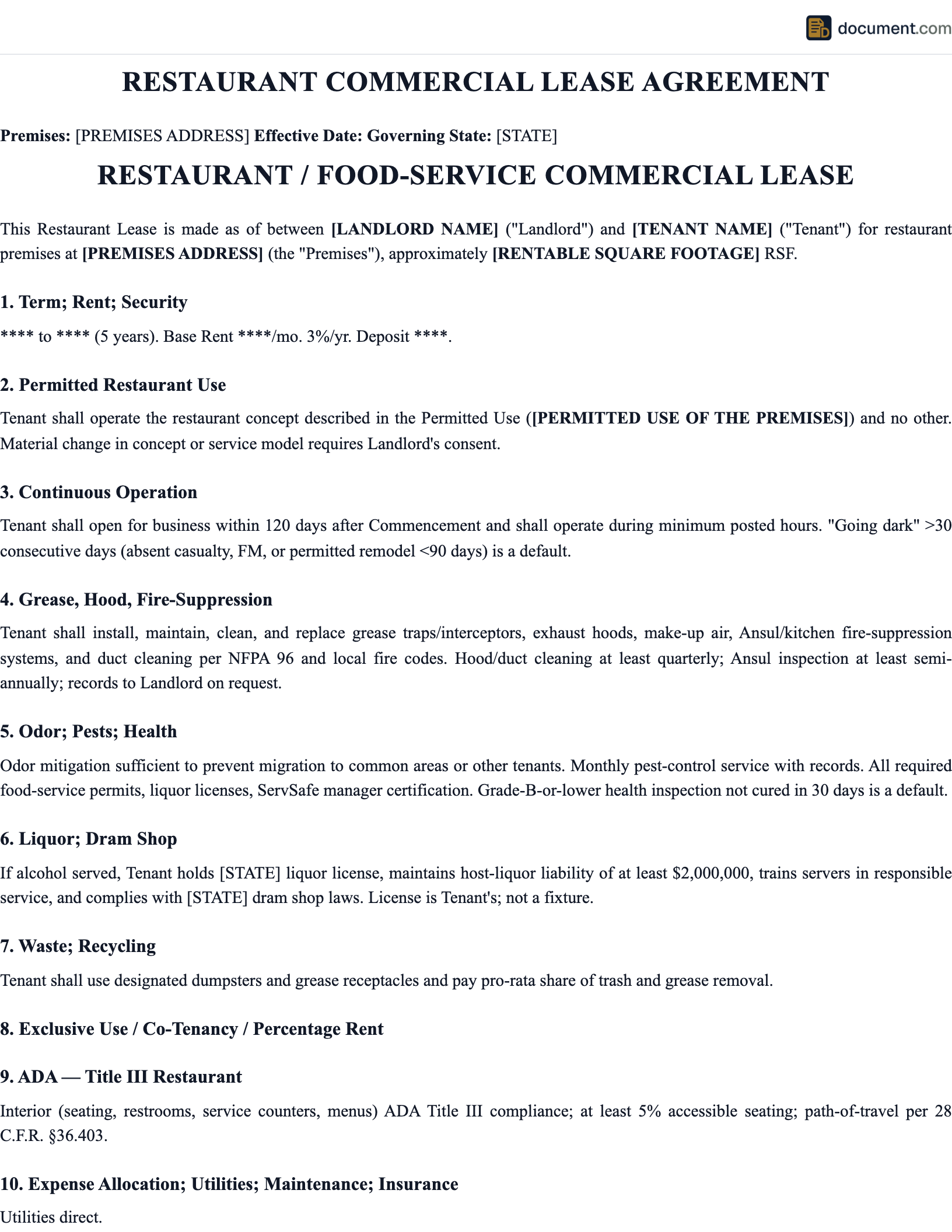



New Mexico Restaurant Lease Agreement Overview
Opening a restaurant in New Mexico means navigating a leasing environment shaped by the state's distinct culinary identity, its relatively small commercial real estate markets, and regulatory requirements that are often more locally administered than in larger states. Albuquerque concentrates most of the state's full-service restaurant activity, while Santa Fe's high tourism volume and nationally recognized dining scene create a premium market with limited quality space. Any restaurant lease in New Mexico must address NMDOH food service permitting, the state's notoriously restricted liquor license system, and kitchen infrastructure requirements that vary depending on whether the tenant is the first food-service operator in the space or taking over from a prior restaurant tenant.
Unlike some states where commercial leasing is heavily standardized, New Mexico restaurant lease negotiations tend to be more bilateral and customized. The state's relatively small population means landlords and tenants often deal with each other directly, without large institutional landlords imposing rigid form documents. This can benefit tenants who are prepared to negotiate ventilation specifications, buildout timelines, and liquor license contingencies in detail. A well-drafted New Mexico restaurant lease addresses the full buildout scope, assigns responsibility for green chile cooking ventilation if relevant, and includes realistic milestones for the NMDOH permit inspection process.
$25
Filing fee
Required
Notarization
0
Witnesses required
County
Filing office
New Mexico Requirements
A New Mexico restaurant lease must address the full stack of regulatory requirements that apply before a food service operation can open. These span health department permitting, fire and building code compliance, zoning, and liquor licensing. Getting these provisions wrong in the lease means negotiating corrections under time pressure after construction has already begun.
New Mexico Specific Note
New Mexico's statewide liquor license cap makes alcohol service a genuine contingency risk for restaurant tenants. The NMDOH Environmental Health Bureau requires a pre-opening inspection of the finished kitchen before a Food Service Establishment Permit is issued. For concepts involving green chile roasting or other high-smoke cooking methods, ventilation specifications must be negotiated before lease signing, not treated as a buildout afterthought.
Key Lease Provisions for New Mexico Restaurants
- NMDOH Permit Compliance: The lease should assign responsibility for preparing the kitchen space for a Food Service Establishment Permit inspection, including equipment installation standards and handwashing station placement
- Liquor License Contingency: If the concept requires alcohol service, include a contingency clause tied to obtaining a New Mexico Regulation and Licensing Department liquor license, with a clear timeline and termination right if the license is denied
- Hood and Ventilation: Specify Type I hood dimensions, fire suppression (Ansul) system responsibility, make-up air provisions, and semi-annual cleaning obligations under the International Mechanical Code as adopted in New Mexico
- Grease Interceptor: Define interceptor size, installation cost allocation, and ongoing maintenance responsibility in compliance with local pretreatment ordinances in Albuquerque or Santa Fe
- ADA Compliance Scope: Clearly delineate which accessible improvements the landlord completes as part of delivery and which fall to the tenant, particularly for older buildings in Santa Fe's historic district
- Green Chile Roasting Rights: If in-house roasting is part of the concept, specify exhaust pathway rights, any building restrictions on open-flame cooking, and fire suppression coverage for the roasting zone
How to Execute a New Mexico Restaurant Lease
Executing a restaurant lease in New Mexico involves more than just signing a document. You need to align the lease timeline with the regulatory calendar and ensure every infrastructure commitment is documented before construction begins.
Confirm Zoning and Liquor License Eligibility
Before signing, verify with the local municipality that the address is zoned for food service and that no proximity restrictions will block a New Mexico liquor license application. Contact the Regulation and Licensing Department to understand license availability in that market.
Negotiate Buildout and Delivery Terms
Document TI allowance amount, disbursement schedule, landlord delivery condition (shell, warm shell, or turnkey), and a rent commencement date that begins only after you have actual access to begin construction. New Mexico restaurant buildouts typically run 90 to 180 days depending on scope.
Specify Ventilation and Kitchen Infrastructure
Attach a kitchen plan or equipment schedule as a lease exhibit. Detail hood type and dimensions, grease interceptor size, fire suppression coverage, gas line capacity, and electrical service requirements. This protects both parties if disputes arise during construction.
Execute the Lease with All Parties
Both landlord and tenant sign. New Mexico commercial leases do not require notarization or witness signatures to be enforceable between the parties, but if the lease will be recorded with the county clerk, notarization is required. Keep fully executed originals for both parties.
Coordinate NMDOH Pre-Opening Inspection
Schedule your Food Service Establishment Permit inspection with the NMDOH Environmental Health Bureau after construction is complete. The inspector will verify that the finished kitchen meets all NM food safety standards before a permit is issued. Plan for this in your opening timeline.
New Mexico Fees & Costs
Below is a breakdown of the typical costs associated with filing this document in New Mexico. Actual fees may vary by county.
| Fee / Cost | Amount |
|---|---|
| Filing Fee | $25 first page |
| Notarization | $5 - $25 per signature |
| Certified Copy | $1 - $10 per page |
| Attorney Review (optional) | $150 - $500 |
Sample New Mexico Restaurant Lease Agreement
Below is a preview of our New Mexico-specific template. Your customized document will include all fields and provisions required for filing in any New Mexico county.
RESTAURANT LEASE AGREEMENT
STATE OF NEW MEXICO
Legal Document Template
LANDLORD
Name: [Full Legal Name / Entity]
Property: [Building/Center Name]
Address: [Property Address]
TENANT / OPERATOR
Name: [Restaurant Entity Name]
Concept: [Restaurant Name/Concept]
Experience: [Years in Food Service]
Tax ID: [EIN]
PREMISES
Suite: [Number]
Total SF: [Square Feet]
Kitchen SF: [Square Feet]
Dining SF: [Square Feet]
Patio: [Yes/No - SF]
FINANCIAL TERMS
Base Rent: $[Amount]/month
Percentage Rate: [%] above $[Breakpoint]
TI Allowance: $[Amount]
Deposit: $[Amount]
CAM: $[Amount]/month
New Mexico Restaurant Lease Agreement FAQ
Answers to common questions about filing a restaurant lease agreement in New Mexico, including requirements, fees, and procedures.
Tax Implications for New Mexico Restaurant Leases
New Mexico imposes a Gross Receipts Tax (GRT) rather than a traditional sales tax. Restaurant operators pay GRT on gross receipts from food and beverage sales, and the rates vary by municipality. Albuquerque's combined state and local GRT rate for restaurants is higher than the base state rate, and Santa Fe has its own local component. Tenant improvement allowances paid by the landlord may be treated as taxable income to the tenant in the year received, so consult a New Mexico CPA before drawing TI funds.
Restaurant lease payments themselves are generally deductible as business expenses for the tenant. Leasehold improvements made by the tenant can typically be depreciated over the lease term or applicable tax life under federal rules. New Mexico follows federal depreciation treatment for most purposes. If a percentage rent clause is included, those additional payments are also deductible.
Liquor license costs are significant in New Mexico due to the statewide cap on licenses. The license itself is a depreciable intangible asset with a potentially long tax life. Annual renewal fees paid to the Regulation and Licensing Department are deductible as ordinary business expenses.
Important Considerations for New Mexico Restaurant Tenants
The Santa Fe restaurant market is driven heavily by tourism, and lease terms there often reflect a landlord's expectation that a concept will survive seasonality. Landlords sometimes push for higher base rents with lower percentage rent thresholds in high-tourist areas. Understand the seasonal revenue pattern of your specific location before agreeing to flat monthly rent structures that do not account for slow months.
Albuquerque has seen significant growth in its food and beverage scene, particularly in neighborhoods like Nob Hill, Downtown, and the Sawmill District. Competition for quality restaurant space in these areas has increased, but market rents remain well below national gateway city rates, giving tenants more leverage than they might expect.
Ghost kitchen operations are an emerging model in Albuquerque, though the market is still relatively small compared to Phoenix or Denver. If your model is delivery-only or shared kitchen, the lease structure differs substantially from a traditional restaurant lease. Commissary certification requirements under NMDOH apply regardless of whether you have a public dining room.
Personal Guarantee Exposure
New Mexico landlords routinely require personal guarantees from individual restaurant owners, particularly for concepts without an established track record. Negotiate the guarantee to be limited in duration (a "burn-off" guarantee) or capped at a fixed dollar amount. A guarantor whose personal assets are exposed to a multi-year restaurant lease obligation faces substantial risk if the concept underperforms.
Official New Mexico Resources
These official state agencies handle food service permitting, liquor licensing, and business regulation for New Mexico restaurants.
NMDOH Food Program
Food Service Establishment Permit applications and inspections
NM Regulation and Licensing Department
Liquor license applications and requirements
NM Taxation and Revenue Department
Gross Receipts Tax rates and business registration
NM Construction Industries Division
Building permits and mechanical code compliance for restaurant buildouts
Related New Mexico Documents
Depending on your situation, you may need additional documents alongside your New Mexico restaurant lease agreement.
Create your New Mexico Commercial Restaurant Lease Agreement in under 5 minutes.
Answer a few questions and download a New Mexico-compliant document, ready for the state agency.