
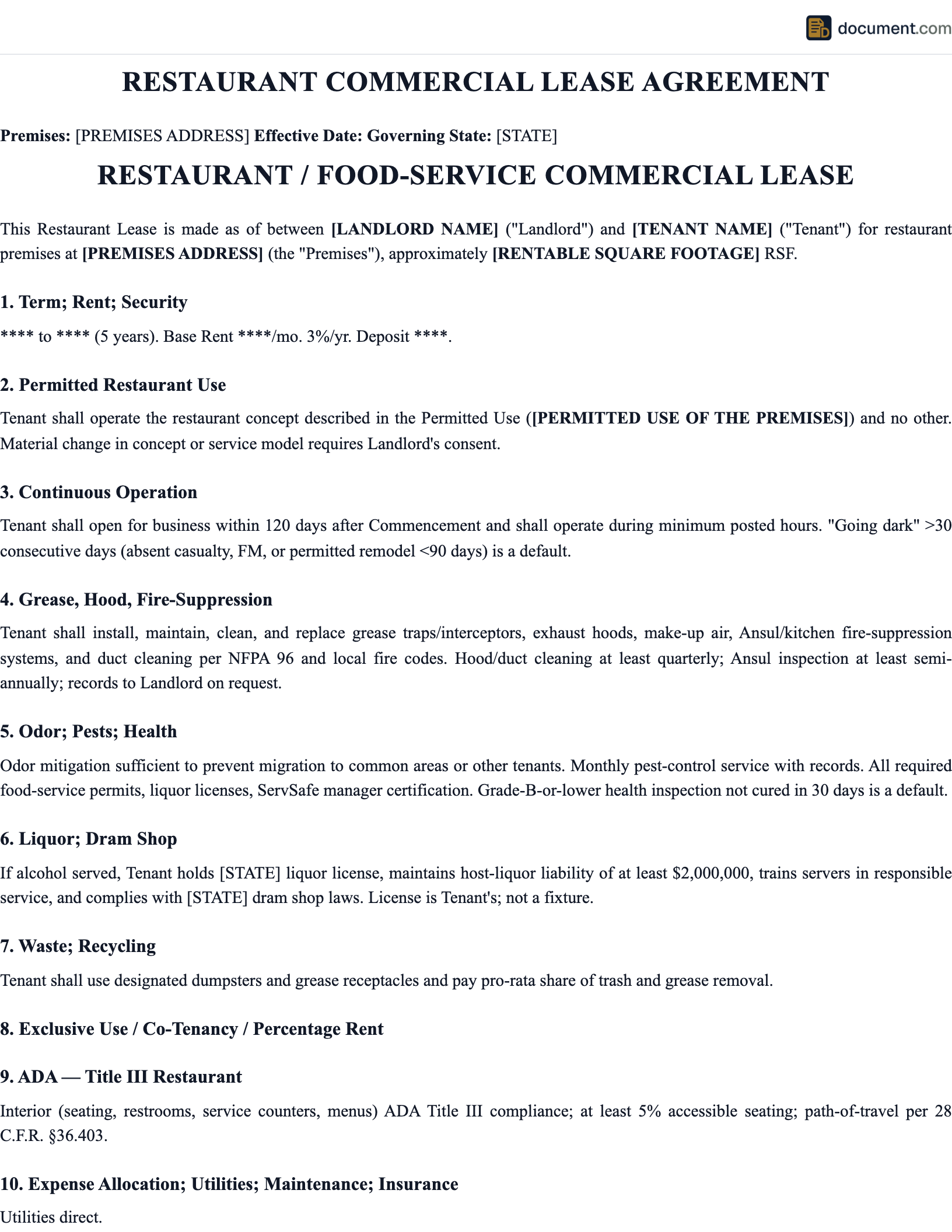



Wisconsin Restaurant Lease Agreement Overview
Wisconsin takes restaurant culture seriously, and the state's commercial real estate market for food service reflects that. Milwaukee has built a legitimate food destination reputation around the Third Ward, Brady Street, Bay View, and the Deer District that goes beyond local demand. Summerfest creates one of the most concentrated restaurant revenue windows in the Midwest. The Milwaukee Brewers, Bucks, and the steady cycle of lakefront festivals and arena events drive consistent year-round demand that smart lease terms should allow operators to fully capture. Madison's market is different but stable, anchored by the University of Wisconsin and a state government workforce that supports consistent weekday demand with manageable seasonality.
The regulatory picture in Wisconsin has a wrinkle that catches operators who come from other states: liquor licensing is primarily a municipal function. Class B licenses allowing beer and liquor by the drink are issued by cities, villages, and towns under Wisconsin statute's per capita cap system. In popular Milwaukee neighborhoods and Madison's commercial corridors, those caps have been reached in many cases. Operators who need a fresh license rather than acquiring an existing one face longer timelines and more uncertainty than the state-controlled systems in other markets. WDATCP food establishment licensing is handled more conventionally through the state or delegated local health departments, and that process is generally straightforward. Wisconsin's supper club submarket adds a third dimension: older dining rooms in rural counties that carry charm but may require substantial infrastructure investment to meet current code before a new operator can legally open.
$30
Filing fee
Required
Notarization
0
Witnesses required
Register
Filing office
Wisconsin Requirements
A Wisconsin restaurant lease needs to address WDATCP or local health department food establishment licensing, municipal Class B liquor license contingencies with realistic timelines, event operating hour flexibility for Milwaukee, and kitchen infrastructure provisions that account for the state's cold winters and older commercial building stock.
Wisconsin Municipal Class B License Cap Warning
Wisconsin municipalities control Class B liquor license counts under a per capita cap system, and in Milwaukee's popular neighborhoods and Madison's active commercial corridors, those caps are often at or near their limits. Operators who need a brand-new Class B license rather than acquiring an existing one should confirm availability before signing the lease. Do not treat a Class B license as a routine formality; in a capped municipality, approval can take months and may require acquiring an existing license at market value.
Key Lease Provisions
- WDATCP Food Establishment License: Identify whether the address falls under WDATCP direct jurisdiction or a delegated local health department, assign pre-opening inspection costs, and tie rent commencement to inspection approval rather than a calendar date
- Municipal Class B License Contingency: Include a contingency with a defined timeline that accounts for cap status in the municipality; for Milwaukee and Madison locations, confirm current license availability before signing rather than after
- Milwaukee Event Operating Provisions: Include lease language allowing extended operating hours during Summerfest, Fiserv Forum events, and Brewers and Bucks games within reasonable parameters without individual landlord consent for each event
- Hood and Winter Grease Management: Address Wisconsin winter-specific maintenance requirements for grease trap insulation and heat systems; assign cleaning frequency, documentation, and upgrade responsibility in the lease
- Supper Club and Historic Building Infrastructure: For older Wisconsin dining properties, negotiate TI allowances that reflect actual modernization costs after inspecting kitchen ventilation, ADA compliance, and WDATCP code gaps before signing
How to Execute a Wisconsin Restaurant Lease
The Wisconsin restaurant lease process runs on two parallel tracks: WDATCP food establishment licensing and municipal Class B liquor license approval. In Milwaukee and Madison, the municipal track is often the more uncertain of the two and should anchor the rent commencement timeline negotiation.
Confirm Zoning and Class B License Cap Status
Before investing time in lease negotiations, contact the city, village, or town licensing authority to determine current Class B license availability. In Milwaukee's desirable neighborhoods and Madison's commercial corridors, cap limits can make new licenses unavailable. Knowing this before negotiating saves significant time and potential disappointment after lease signing.
Inspect Kitchen, Grease Systems, and Building Infrastructure
Inspect hood ventilation, grease trap condition, and winterization of grease management systems. For older supper club or historic Milwaukee and Madison spaces, assess ADA compliance and whether the current HVAC is adequate for the planned menu and staffing level. Use all findings to negotiate a TI allowance that reflects actual modernization costs.
Execute Lease with WDATCP and Class B Contingencies
Include food establishment license and Class B license contingencies with realistic timelines. Negotiate rent commencement to begin after both approvals are in hand. Write Milwaukee event operating hour flexibility directly into the lease at this stage, since it is much harder to add after signing.
Complete Buildout and WDATCP Pre-Opening Inspection
Finish tenant improvements and schedule the WDATCP or local health department pre-opening inspection. Address any deficiencies in ventilation, grease management, or food storage. For Wisconsin winters, verify grease system insulation and heat tape before inspection if the opening falls in the cold months.
Obtain Class B License and Register for Sales Tax
Finalize Class B license approval from the municipality and register with the Wisconsin Department of Revenue for state sales tax and the 0.5% Milwaukee County surcharge if applicable. Time the opening around event season if possible, since Milwaukee's Summerfest and sports calendar provide natural demand that benefits new restaurant openings in the right neighborhoods.
Wisconsin Restaurant Lease Costs
Wisconsin restaurant costs range from the predictable, like WDATCP licensing fees, to the highly variable, like Class B license acquisition costs in capped municipalities. Budget conservatively for the licensing side before finalizing lease financial projections.
| Fee / Cost | Typical Range |
|---|---|
| WDATCP Food Establishment License | $110 - $710 annually depending on establishment risk category and seating capacity |
| Municipal Class B Liquor License | $500 - $2,000+ annually for new licenses; existing license market transfers in capped Milwaukee neighborhoods can carry significant premiums |
| Wisconsin Sales Tax (Prepared Food) | 5% state rate; Milwaukee County adds 0.5% for a combined 5.5% rate in Milwaukee County jurisdictions |
| Supper Club or Older Building Infrastructure Upgrades | Highly variable; kitchen modernization, ADA improvements, and HVAC upgrades in vintage Wisconsin dining properties can run $50,000 to $200,000+ |
| Attorney Review | $400 - $800 for lease review with Class B contingency, event operating provisions, and winter maintenance obligations |
Sample Wisconsin Restaurant Lease Agreement
Below is a preview of our Wisconsin-specific template. Your customized document will include all fields and provisions required for filing in any Wisconsin county.
RESTAURANT LEASE AGREEMENT
STATE OF WISCONSIN
Legal Document Template
LANDLORD
Name: [Full Legal Name / Entity]
Property: [Building/Center Name]
Address: [Property Address]
TENANT / OPERATOR
Name: [Restaurant Entity Name]
Concept: [Restaurant Name/Concept]
Experience: [Years in Food Service]
Tax ID: [EIN]
PREMISES
Suite: [Number]
Total SF: [Square Feet]
Kitchen SF: [Square Feet]
Dining SF: [Square Feet]
Patio: [Yes/No - SF]
FINANCIAL TERMS
Base Rent: $[Amount]/month
Percentage Rate: [%] above $[Breakpoint]
TI Allowance: $[Amount]
Deposit: $[Amount]
CAM: $[Amount]/month
Wisconsin Restaurant Lease Agreement FAQ
Answers to common questions about filing a restaurant lease agreement in Wisconsin, including requirements, fees, and procedures.
Official Wisconsin Resources
Use these official state resources to verify requirements, find your local filing office, and access government forms for Wisconsin.
Related Wisconsin Documents
Depending on your situation, you may need additional documents alongside your Wisconsin restaurant lease agreement.
Create your Wisconsin Commercial Restaurant Lease Agreement in under 5 minutes.
Answer a few questions and download a Wisconsin-compliant document, ready for the state agency.