
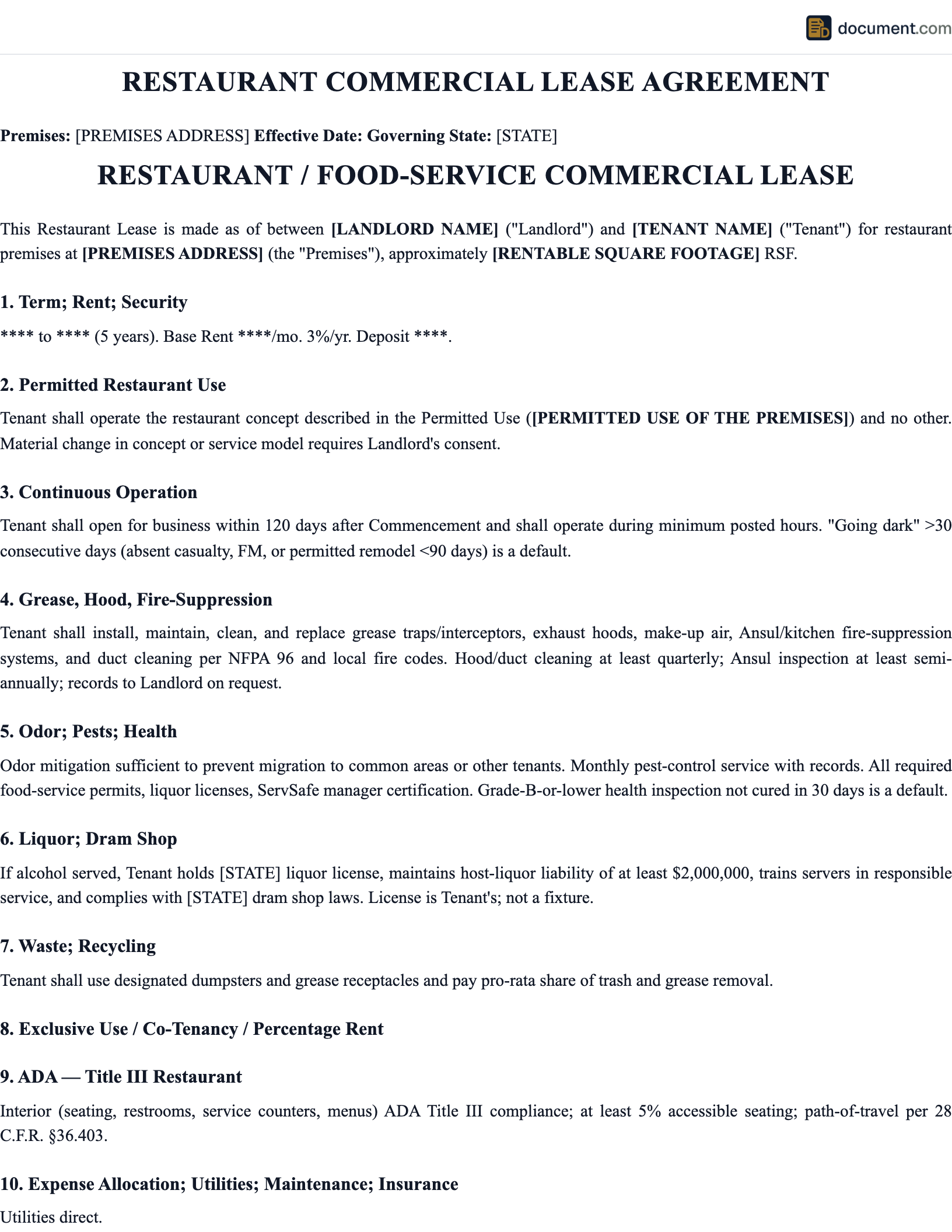



Arkansas Restaurant Lease Agreement Overview
Opening a restaurant in Arkansas involves navigating the Arkansas Department of Health's food establishment permit process, the DFA Alcoholic Beverage Control Division's liquor licensing rules, and a commercial leasing market that varies considerably between Little Rock, northwest Arkansas, and smaller markets. Arkansas has minimal commercial tenant regulation, which means the written lease is essentially the only document protecting your buildout investment and ongoing operations.
The Bentonville and northwest Arkansas market has grown into one of the more interesting restaurant markets in the mid-South, driven by corporate activity around Walmart's headquarters and the Crystal Bridges Museum. Little Rock's Midtown and River Market districts offer established food and beverage corridors. In all markets, the lease needs to address ADH permit timelines, DFA ABC license zoning compatibility, hood and grease trap responsibilities, ADA restroom compliance, and parking minimums before signing.
$15
Filing fee
Required
Notarization
0
Witnesses required
Circuit
Filing office
Arkansas Requirements
An Arkansas restaurant lease needs to address ADH permit timelines, DFA ABC licensing contingencies, kitchen infrastructure responsibility, and local dry county status. Without these provisions in writing, tenant protections are minimal under Arkansas law.
Arkansas Specific Note
Arkansas restaurant leases must address DFA ABC license zoning compatibility (particularly given the state's dry county patchwork), ADH pre-opening inspection timelines, Type I hood and fire suppression system responsibility, grease trap installation and maintenance, and ADA restroom compliance. Because Arkansas has no commercial tenant protection statute, every protection must be explicitly negotiated into the lease.
Key Lease Provisions
- DFA ABC Contingency: Include a lease termination or rent abatement right if the DFA ABC Division denies an alcohol license due to dry zone status or proximity restrictions not disclosed before signing
- ADH Health Permit Timeline: Tie rent commencement to the Arkansas Department of Health pre-opening inspection approval rather than a fixed calendar date, with buildout time that realistically accommodates ADH review
- Type I Hood and Fire Suppression: Specify whether the landlord delivers a code-compliant Type I hood and fire suppression system or whether tenant installs it, and define who pays for required semi-annual inspections by a licensed service company
- Grease Trap Installation and Maintenance: Address whether landlord delivers a grease interceptor sized for your cooking volume and who is responsible for quarterly pumping and documentation required by the local sewer authority
- ADA Restroom Compliance: Confirm ADA compliance status of restrooms and accessible path of travel before signing, and negotiate who bears remediation costs in older Arkansas buildings
- Occupancy Load and Fire Marshal: Confirm the local fire marshal's approved occupancy load for the dining room covers your target seating count, since exceeding that figure requires structural or egress changes that take time and money
How to Execute an Arkansas Restaurant Lease
Signing a restaurant lease in Arkansas is only the starting point. The steps below walk through what needs to happen before and after execution to protect your investment and get the doors open legally.
Verify Zoning, Dry County Status, and ABC Eligibility
Confirm with the local planning office that the address is zoned for food service and that the location is in a wet jurisdiction. Then check the DFA Alcoholic Beverage Control Division's proximity rules for your specific address before signing anything.
Negotiate Arkansas-Specific Lease Terms
Push for an ABC license contingency, a buildout period timed to ADH pre-opening inspections, landlord responsibility for delivering a compliant grease trap and Type I hood, ADA restroom clarity, and a TI allowance that reflects the actual cost of Arkansas restaurant construction.
Draft and Review the Lease
Have an Arkansas commercial real estate attorney review the final draft. Because Arkansas provides minimal statutory protection for commercial tenants, the written lease is your only safety net, and missing a key provision costs far more to fix after signing than to negotiate before.
Execute the Lease and Begin Permit Applications
Sign the lease and immediately submit your ADH food establishment permit application, DFA ABC license application, and any local business license required by Little Rock, Fayetteville, or your specific municipality. These processes run concurrently with buildout and timing matters.
Complete Buildout and Pass Pre-Opening Inspections
Complete construction according to approved plans, schedule the ADH pre-opening inspection once kitchen equipment is installed and operational, and schedule the local fire marshal inspection for the hood and suppression system. Keep documentation of all inspections and approvals as part of your operating record.
Arkansas Restaurant Lease Costs
The costs below represent the major line items Arkansas restaurant tenants should budget for alongside base rent. Actual figures vary by market and lease structure.
| Fee / Cost | Typical Range |
|---|---|
| ADH Food Establishment Permit | $100 - $400 (varies by seat count and risk category) |
| DFA ABC Liquor License | $200 - $1,000+ (varies by license type and county) |
| Grease Trap Installation | $2,500 - $10,000 (if not landlord-provided) |
| Type I Hood and Fire Suppression | $12,000 - $40,000 (if not landlord-provided) |
| Arkansas Sales Tax on Food Service | 6.5% state + local rate on prepared food (Little Rock adds 2%) |
| Attorney Review | $400 - $1,500 |
Arkansas imposes a 6.5% state sales tax on prepared food sales, and most municipalities add a local option tax on top of that. Little Rock currently adds 2% for a combined rate around 8.5%. Budget this as an operating cost when modeling your break-even revenue figures before signing the lease.
Sample Arkansas Restaurant Lease Agreement
Below is a preview of our Arkansas-specific template. Your customized document will include all fields and provisions required for filing in any Arkansas county.
RESTAURANT LEASE AGREEMENT
STATE OF ARKANSAS
Legal Document Template
LANDLORD
Name: [Full Legal Name / Entity]
Property: [Building/Center Name]
Address: [Property Address]
TENANT / OPERATOR
Name: [Restaurant Entity Name]
Concept: [Restaurant Name/Concept]
Experience: [Years in Food Service]
Tax ID: [EIN]
PREMISES
Suite: [Number]
Total SF: [Square Feet]
Kitchen SF: [Square Feet]
Dining SF: [Square Feet]
Patio: [Yes/No - SF]
FINANCIAL TERMS
Base Rent: $[Amount]/month
Percentage Rate: [%] above $[Breakpoint]
TI Allowance: $[Amount]
Deposit: $[Amount]
CAM: $[Amount]/month
Arkansas Restaurant Lease Agreement FAQ
Answers to common questions about filing an restaurant lease agreement in Arkansas, including requirements, fees, and procedures.
Official Arkansas Resources
Use these official state resources to verify requirements, find your local filing office, and access government forms for Arkansas.
Related Arkansas Documents
Depending on your situation, you may need additional documents alongside your Arkansas restaurant lease agreement.
Create your Arkansas Commercial Restaurant Lease Agreement in under 5 minutes.
Answer a few questions and download a Arkansas-compliant document, ready for the state agency.