



What Is an Add/Remove Tenant Amendment?
An add/remove tenant amendment is a written modification to an existing residential lease that adds a new occupant as a named tenant, removes a current tenant from the lease roster, or substitutes one tenant for another. The amendment leaves the rent, term, deposit framework, and house rules of the original lease intact and changes only the identity of the parties bearing the joint-and-several rent obligation. It must be signed by the landlord, every existing tenant, and the incoming or departing tenant whose status is changing. Without all signatures the change is unenforceable, and the original lease continues to control under the four-corners rule.
The amendment matters because the standard residential lease binds every named tenant to the full rent under joint and several liability. Adding a person without amending the lease leaves that person as an unauthorized occupant with no rent obligation, no lease rights, and no eviction process directed against them; the landlord can only proceed against the original tenants. Removing a person without amending the lease leaves that person liable for rent that accrues after they have moved out, which becomes a small-claims action waiting to happen. Both problems are foreclosed by a properly signed amendment dated to the change.
Common triggers include a romantic partner moving in, a roommate moving out, an adult child being added at age 18 to qualify for utilities or insurance in their own name, a divorce that requires removing one spouse from the residential lease, the death of a cotenant (which triggers different mechanics under state successor-tenancy statutes such as New York Real Property Law §236), or a domestic-violence early-termination by one cotenant under California Code of Civil Procedure §1161.3. The amendment is also the appropriate vehicle when a guarantor is added or released, because guarantor liability is independent of tenancy and survives any tenancy-only modification.
Joint and several liability under the standard residential lease
The standard residential lease names every adult occupant as jointly and severally liable for the full rent, the full security-deposit obligation, and the full damages liability at lease end. The landlord may collect 100 percent of any month's rent from any single tenant regardless of internal allocation among roommates. Adding a tenant expands the pool of obligors and gives the landlord another potential collection target. Removing a tenant shrinks the pool but does not change the rent owed; the remaining tenants now bear the full obligation between them. The amendment should restate the joint-and-several covenant explicitly to forestall any argument that the modification altered the original allocation, and should release the departing tenant only as to obligations accruing after the effective date.
FCRA screening of the incoming tenant and security-deposit reallocation
Adding a tenant is a screening event that must be run identically to a new lease application. The Fair Credit Reporting Act, 15 U.S.C. §§1681 et seq., requires written authorization on the application before a consumer report is ordered, requires the landlord to provide a Summary of Consumer Rights, and requires written adverse-action notice with the credit-bureau contact information if the application is denied or approved on adjusted terms. The same income standard (typically 3x rent gross), credit floor (620 to 680 typical), and rental-history check should apply. On the deposit side, the amendment must specify whether the existing deposit is reallocated among the new roster (signed assignment), whether the landlord performs an interim move-out inspection and refunds the departing tenant's share under the state deposit-return statute, or whether a fresh deposit cycle starts with the incoming tenant funding the replacement.
Tenant Changes
Formally add or remove individuals from the lease
Background Checks
Screening requirements for new tenants being added
Updated Liability
Revised rent and damage responsibility allocation
Form Preview
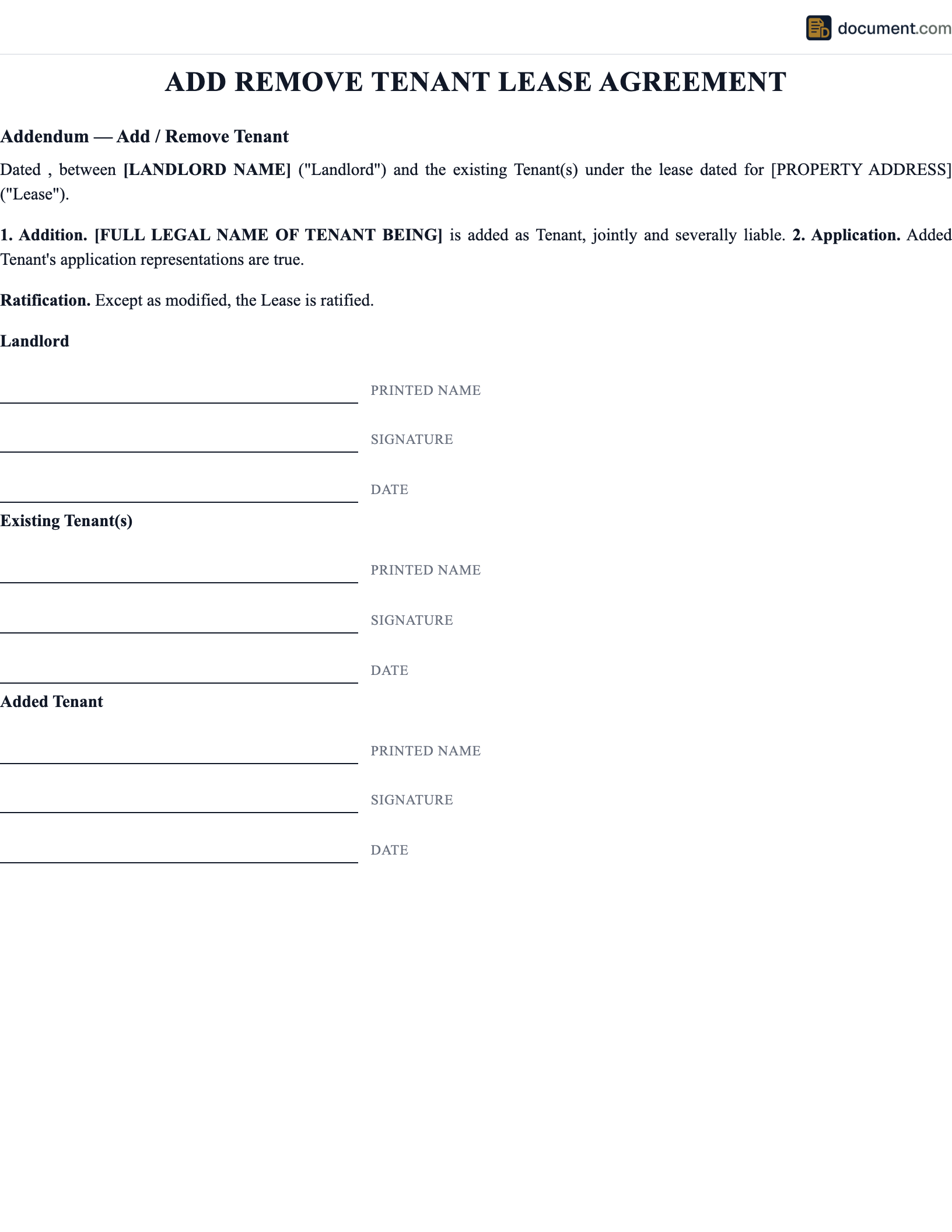
The amendment follows a fixed structure: a recital identifying the master lease, an effective-date paragraph, a roster section listing tenants added and removed, a liability and deposit allocation paragraph, an explicit release for the departing tenant, an assumption clause for the incoming tenant, and signature blocks for the landlord and every tenant whose status the amendment affects.
ADD/REMOVE TENANT AMENDMENT
Lease Roster Modification
This document is entered into on [Date] between the parties identified below:
LANDLORD:
Name: [Landlord Name]
EXISTING TENANT(S):
Name: [Tenant Names]
How to Use This Document
Four steps move the change from a verbal request to a fully executed amendment that the landlord can rely on for collections, that the departing tenant can rely on for release, and that the incoming tenant can rely on as the basis of their tenancy.
Submit a written request with proposed effective date
The current tenants submit a dated written request identifying the person being added or removed, the proposed effective date (typically the first of an upcoming month for clean rent accounting), the reason for the change, and the contact information of the incoming tenant. Email is acceptable; a request through a tenant portal is preferred for the landlord's recordkeeping. The landlord may charge a documented amendment fee covering screening costs (typically $50 to $200) and should respond within 7 to 14 days. The original lease's no-assignment-or-sublet clause governs the landlord's discretion to refuse.
Run the same FCRA-compliant screening as a new applicant
Order a tenant-screening package (TransUnion SmartMove, Experian RentBureau, or Equifax) on signed authorization from the incoming tenant. Apply the property's written income standard (3x rent gross is industry standard), credit floor (620 to 680 typical), rental-history review, and criminal-history policy uniformly. Comply with FCRA adverse-action requirements under 15 U.S.C. §1681m if denying. Honor source-of-income protections in covered jurisdictions (California Government Code §12955(p), New York City Admin. Code §8-107(5), Washington RCW 59.18.255). Retain the screening file for the FCRA two-year statute-of-limitations period.
Draft the amendment with explicit liability and deposit allocation
Identify the original lease by date and address, list all current tenants by name, specify who is being added or removed and the effective date, restate the joint-and-several rent covenant as applied to the new roster, allocate the security deposit (assignment to remaining tenants, partial refund under the state deposit-return statute, or fresh deposit cycle), and confirm that the lease term, rent, and all other provisions remain unchanged. Add an explicit release of the departing tenant for obligations accruing after the effective date, and an explicit assumption by the incoming tenant of all lease obligations going forward.
Execute, distribute, and update the property records
All parties sign: the landlord, every existing tenant (including those not changing), the departing tenant, and the incoming tenant. Missing signatures void the amendment as to the missing party. Distribute fully signed copies to every tenant by email and retain the original in the property file with the master lease. Update tenant records in the property-management system, rekey the unit if a tenant is removed (within 24 hours of the effective date is the industry standard), update the renter's-insurance certificate to reflect the new occupant roster, and notify any HOA or building management of the change.
Key Components
| Component | Description |
|---|---|
| Original Lease Reference | Date, property, and current tenants on the lease |
| Tenant Being Added/Removed | Full identification of the person and effective date |
| Screening Results | Background and credit check results for new tenants |
| Updated Rent Responsibility | How rent obligations change with the roster change |
| Security Deposit Adjustment | Any changes to the deposit amount or responsibility |
| Signatures | All current tenants, new tenant, removed tenant, and landlord |
Frequently Asked Questions
Joint-and-several liability, FCRA screening, deposit reallocation, and survivor-of-violence questions.
Resources
Create your Add Remove Tenant Lease Agreement in under 10 minutes.
Answer a few questions and download a compliant, attorney-drafted document ready for your state.