
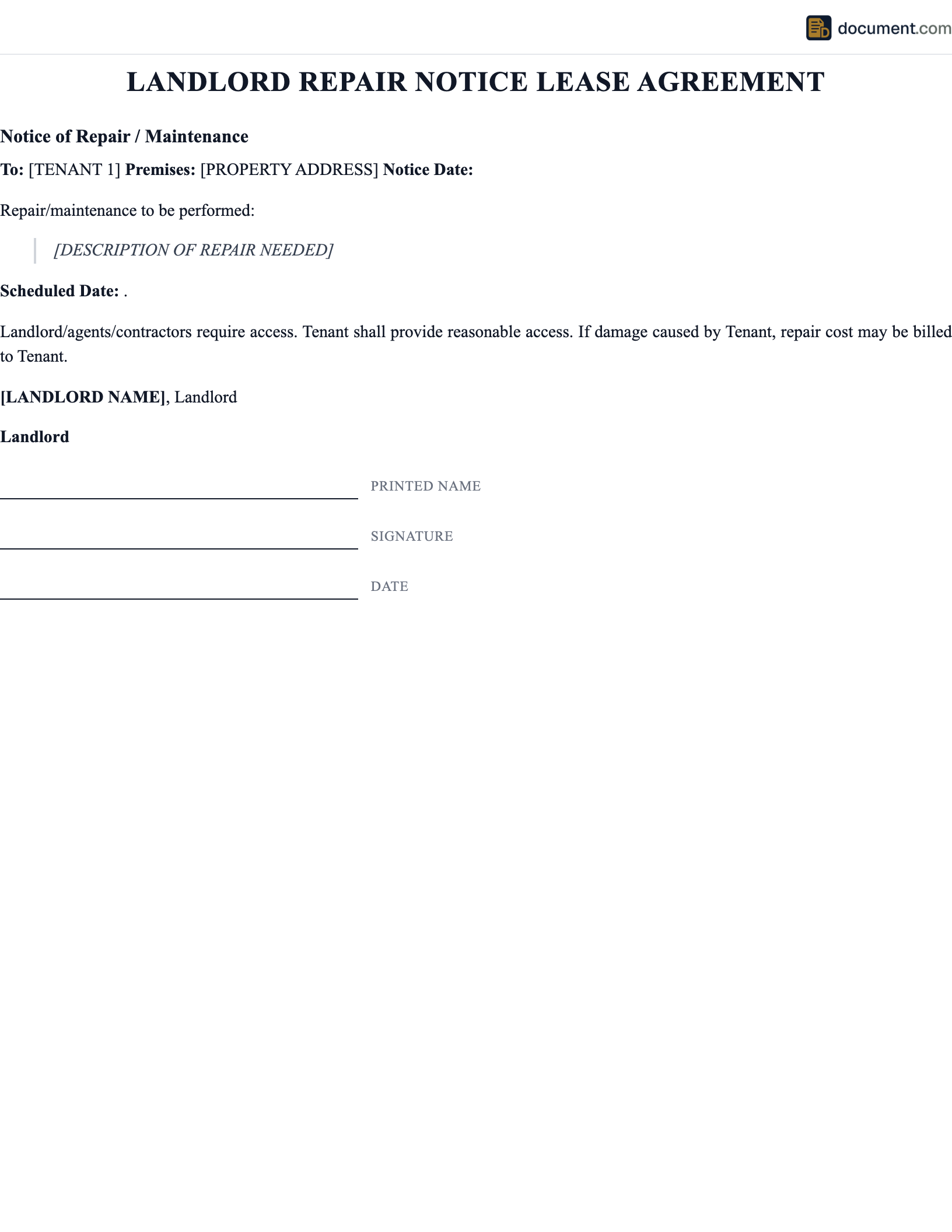



What Is a Landlord Repair Notice?
A landlord repair notice to tenant is a formal written document that communicates repair needs, maintenance responsibilities, or damage concerns from the landlord to the tenant. This notice serves multiple purposes: it documents property conditions requiring attention, establishes timelines for repairs, clarifies which party is responsible for the work, and creates a paper trail that protects both parties in potential disputes.
Repair notices are essential tools in property management. They can address tenant-caused damage that needs repair, notify tenants of scheduled maintenance that will affect their unit, inform tenants of their maintenance responsibilities under the lease, document habitability issues that the landlord is addressing, or request tenant cooperation for repairs to common areas or building systems.
The legal framework for repair notices varies by state. Many states have implied warranty of habitability statutes that require landlords to maintain rental properties in livable condition. When landlords discover issues, providing prompt written notice of planned repairs demonstrates compliance with these obligations. Conversely, when tenants cause damage, a repair notice documents the issue and establishes the tenant's financial responsibility.
A well-drafted repair notice should clearly describe the issue, identify responsible parties, provide a timeline for repairs, specify any tenant obligations (such as providing access or temporarily relocating), and reference relevant lease provisions. Maintaining copies of all repair notices is critical for landlords who may later need to justify security deposit deductions or eviction proceedings.
Landlord Repair Notice to Tenant Form Preview
Our landlord repair notice to tenant form includes all the fields required for a valid document. Below is a preview of the key sections. Your customized document will be tailored to your state's specific requirements.
LANDLORD REPAIR NOTICE TO TENANT
Legal Document Template
LANDLORD / MANAGER
Name: [Full Legal Name]
Property: [Property Address]
Phone: [Contact Number]
TENANT(S)
Name: [Tenant Full Name]
Unit: [Unit Number/Address]
Lease Date: [Start Date]
REPAIR DETAILS
Issue: [Description of Repair Needed]
Location: [Specific Area/Room]
Discovered: [Date]
Severity: [Emergency/Urgent/Routine]
ACTION REQUIRED
Responsible Party: [Landlord/Tenant]
Timeline: [Days to Complete]
Access Needed: [Yes/No]
Estimated Cost: $[Amount]
Key Provisions
A landlord repair notice to tenant requires several important provisions to be legally effective and protect all parties involved. Review each provision carefully.
Issue Description
Provide a detailed description of the repair needed, including location within the property, severity, when the issue was discovered, and any relevant photographs or inspection reports.
Responsibility Assignment
Clearly state whether the repair is the landlord's responsibility (normal wear and tear, building systems) or the tenant's responsibility (tenant-caused damage, lease violations).
Repair Timeline
Establish a reasonable timeline for completing repairs, consistent with state habitability requirements and the urgency of the issue.
Access Requirements
Specify any need for the landlord or contractors to access the tenant's unit, including dates, times, and notice requirements per state law.
Cost Allocation
If the tenant is responsible for repair costs, provide an estimate, payment options, and consequences of non-payment.
Emergency Procedures
Address emergency repair situations including tenant's obligation to report emergencies promptly and landlord's commitment to respond within required timeframes.
When to Use A Landlord Repair Notice to Tenant
Understanding when to use a landlord repair notice to tenant helps ensure you select the right document for your situation. Below are the most common use cases.
Tenant-Caused Damage
Documenting damage caused by the tenant or their guests that goes beyond normal wear and tear, such as holes in walls, broken fixtures, stained carpets, or damaged appliances.
Habitability Repairs
Notifying tenants that the landlord is scheduling repairs to address habitability issues such as plumbing problems, heating system failures, pest infestations, or roof leaks.
Scheduled Maintenance
Informing tenants about planned maintenance activities that may affect their unit, such as painting, HVAC servicing, window replacement, or building system upgrades.
Lease Violation Repairs
Addressing situations where the tenant has made unauthorized modifications, failed to maintain the property as required by the lease, or created conditions requiring remediation.
How to Draft A Landlord Repair Notice to Tenant
Drafting a landlord repair notice to tenant involves several steps to ensure the document is legally sound, complete, and enforceable in your state. Follow these steps for a thorough and professional document.
Gather Required Information
Collect all necessary details including party names, addresses, property or subject matter descriptions, financial terms, and any state-specific requirements for your jurisdiction.
Select Your State
Choose your state to ensure the document includes all required provisions, disclosures, and formatting requirements mandated by your jurisdiction's laws.
Complete All Sections
Fill in every section of the document carefully, including all parties, terms, conditions, and any special provisions relevant to your specific situation.
Review and Sign
Review the completed document for accuracy, have all parties sign, and arrange for notarization or witnesses if required by your state. Keep copies for all parties.
Distribute and Store
Provide signed copies to all parties involved. Store the original in a secure location and file any required copies with the appropriate government offices or recording agencies.
Legal Requirements
Legal requirements for a landlord repair notice to tenant vary by state. Each state has its own statutes governing this type of document, including specific provisions, disclosures, notice periods, and execution requirements. Selecting your state ensures your document meets all local requirements.
Important Legal Notice
This document template is provided for informational purposes and general guidance. While designed to comply with common legal requirements, laws vary by state and locality. For significant transactions or complex situations, consult with a licensed attorney in your jurisdiction to ensure full compliance with applicable laws.
- State Compliance: Each state has specific legal requirements that must be met for this document to be enforceable
- Proper Execution: The document must be properly signed by all parties, with notarization or witnesses as required by your state
- Required Disclosures: Many states mandate specific disclosures or addenda that must accompany this type of document
- Filing Requirements: Some states require filing or recording with government offices for the document to be fully effective
Repair Notice by State
Select your state for a landlord repair notice to tenant customized to your jurisdiction's specific legal requirements, disclosures, and formatting standards.
Sample Landlord Repair Notice to Tenant
Below is a preview of our landlord repair notice to tenant template. Your customized document will include all fields and provisions required for your specific state and situation.
LANDLORD REPAIR NOTICE TO TENANT
Template Preview
LANDLORD / MANAGER
Name: [Full Legal Name]
Property: [Property Address]
Phone: [Contact Number]
TENANT(S)
Name: [Tenant Full Name]
Unit: [Unit Number/Address]
Lease Date: [Start Date]
REPAIR DETAILS
Issue: [Description of Repair Needed]
Location: [Specific Area/Room]
Discovered: [Date]
Severity: [Emergency/Urgent/Routine]
ACTION REQUIRED
Responsible Party: [Landlord/Tenant]
Timeline: [Days to Complete]
Access Needed: [Yes/No]
Estimated Cost: $[Amount]
Frequently Asked Questions
Common questions about creating and using a landlord repair notice to tenant, including legal requirements, costs, and best practices.
Create your Landlord Repair Notice Lease Agreement in under 10 minutes.
Answer a few questions and download a compliant, attorney-drafted document ready for your state.