



What Is a Security Deposit Return Letter?
A security deposit return letter is the formal written notification that a landlord sends to a former tenant at the end of a tenancy to account for the disposition of the tenant's security deposit. If the landlord is returning the deposit in full, the letter serves as a transmittal document confirming the amount and accompanying a check or electronic transfer. If the landlord is withholding any portion of the deposit, the letter must include a detailed, itemized statement explaining every deduction — the specific damage or charge, the cost of repair, and the remaining balance being returned to the tenant.
This is not a courtesy document — it is a legal requirement in nearly every state. The return letter and itemized statement together constitute the landlord's formal accounting to the tenant. Failure to provide this accounting within the statutory deadline can result in the landlord forfeiting the right to keep any portion of the deposit, regardless of how much actual damage the tenant caused. In states with penalty provisions, the landlord may also be liable for double or triple the deposit amount, plus attorney fees and court costs.
For landlords, the return letter is the most consequential document at the end of a tenancy. A properly drafted letter protects against claims of wrongful withholding, demonstrates good-faith compliance with the law, and provides a clear paper trail if the tenant disputes the deductions. For tenants, the return letter is the document they are legally entitled to receive, and it triggers their right to challenge any deductions they believe are improper. If a tenant does not receive a return letter within the statutory deadline, they typically have grounds to recover the full deposit plus statutory penalties.
Our templates are designed to satisfy the strictest state requirements. They include properly formatted itemized deduction tables, references to supporting documentation (receipts, invoices, photos), clear calculations showing the original deposit minus deductions equals the amount returned, and state-specific language addressing wear-and-tear distinctions, deadline compliance, and the tenant's right to dispute deductions.
Deadline Compliance
Ensures you return the deposit within your state's required timeframe to avoid penalties
Itemized Deductions
Properly documents each charge with descriptions, costs, and supporting evidence
Penalty Avoidance
Protects landlords from double or treble damage claims by ensuring full statutory compliance
Security Deposit Return Letter by State
Every state has its own deadline for returning security deposits and rules for itemizing deductions. Pick your state for a compliant return letter with the right timeline and penalty disclosures.
Legal Requirements for Returning Security Deposits
Every state has a statute governing how security deposits must be returned at the end of a tenancy. While the details vary, the core requirements are remarkably consistent: the landlord must return the deposit (or an itemized statement of deductions) within a specific number of days, deductions must be for actual damages beyond normal wear and tear, and the tenant must receive a written accounting of how the deposit was applied. Failure to comply with any of these requirements can shift the legal burden entirely to the landlord.
Core Legal Obligations
- Timely return: The deposit (or itemized statement plus remaining balance) must be sent to the tenant within the state's statutory deadline. The clock typically starts when the tenant vacates the property and surrenders possession — not when the lease technically ends.
- Written itemization: If any portion of the deposit is withheld, the landlord must provide a written, itemized list of every deduction. Generic statements like "damages" or "cleaning" without further specifics are legally insufficient in most jurisdictions.
- Reasonable deductions only: Deductions must be for actual costs incurred to repair damage beyond normal wear and tear, unpaid rent (where permitted by state law), or other specific charges authorized by the lease and state statute. The landlord cannot inflate costs or charge for upgrades.
- Mailing to correct address: The return must be sent to the tenant's forwarding address if one was provided, or to the tenant's last known address (typically the rental property). Some states require the landlord to use certified mail or first-class mail.
- Include accrued interest: In states that require landlords to pay interest on deposits, the return must include any accrued interest that has not already been paid or credited to the tenant during the tenancy.
The Most Common Landlord Mistake
The single most common reason landlords lose deposit disputes is not the merits of their deductions — it is missing the return deadline. Even if a landlord had $5,000 in legitimate damage repairs, returning the itemized statement one day late can result in forfeiture of the entire right to deduct. Courts enforce these deadlines strictly because the legislature designed them to be absolute. Mark the deadline on your calendar the day the tenant gives notice, and send the return letter several days early to account for mail delivery time.
Security Deposit Return Timelines
The return timeline is the most critical compliance factor in security deposit law. Missing this deadline — even by a single day — can trigger severe penalties. Below is an overview of common return windows. Verify your specific state's statute, as deadlines may differ depending on whether the tenancy ended normally, by eviction, or by abandonment.
14 Days
The shortest return windows in the country. States in this category include Hawaii and Louisiana (for properties with month-to-month leases). These tight deadlines require landlords to conduct inspections and prepare the return letter almost immediately after the tenant vacates.
15-21 Days
States including Arizona (14 business days), Kansas (15 days if tenant has not damaged the property; 30 days otherwise), Montana (15 days if no deductions; 30 days with deductions), California (21 days), Illinois (30-45 days depending on municipality), and Michigan (30 days) fall into this range. California's 21-day deadline is particularly strict and well-litigated.
30 Days
The most common deadline nationwide. A large number of states use a 30-day window, including Colorado, Connecticut, Florida, Georgia, Indiana, Iowa, Kentucky, Maine, Maryland, Massachusetts, Nebraska, Nevada, New Hampshire, New Jersey, New Mexico, New York, North Carolina, Ohio, Oregon, Pennsylvania, Rhode Island, South Carolina, Texas, Utah, Virginia, Washington, Wisconsin, and Wyoming. This is the standard landlords should default to if unsure.
45-60 Days
The most generous windows. States including Alabama (60 days), Tennessee (no specific statute for non-URLTA properties; 30 days under URLTA), North Dakota (30 days), Arkansas (60 days), and Delaware (20 days) fall at the longer end. Even with these longer timelines, landlords should not wait until the last day — mailing time counts against the deadline in most states.
When does the clock start?Most states measure the deadline from the date the tenant vacates and surrenders possession (returns keys). Some states start the clock when the lease ends, and a few start when the landlord receives the tenant's forwarding address. If the tenant abandons the property without notice, some states have different rules for abandonment situations. Always verify the exact triggering event in your state's statute.
Normal Wear and Tear vs Chargeable Damage
The distinction between "normal wear and tear" and "damage" is the central issue in most security deposit disputes. Landlords can only deduct for damage — not for the natural, gradual deterioration that results from a tenant living in and using the property in a reasonable manner. Understanding this distinction is essential for both parties.
Normal wear and tear accounts for the fact that a rental property ages and deteriorates through ordinary use. A tenant who lives in a unit for three years will inevitably cause some carpet wear, wall scuffing, and fixture loosening — and that is expected. Damage, on the other hand, results from negligence, misuse, or intentional acts that go beyond what would occur through ordinary occupancy.
Normal Wear and Tear (Not Deductible)
- - Small nail holes from hanging pictures
- - Minor scuff marks on walls from furniture
- - Carpet worn thin in high-traffic pathways
- - Faded paint from sunlight exposure
- - Loose door handles from regular use
- - Minor grout discoloration in bathrooms
- - Slightly worn or dull finish on hardwood
- - Worn weatherstripping around doors and windows
- - Dusty blinds and minor blind cord wear
- - Small caulk cracks around tubs and sinks
Tenant Damage (Deductible)
- - Large holes in walls from anchors or impact
- - Burns on countertops, carpet, or flooring
- - Broken windows, mirrors, or glass
- - Pet urine stains or pet-chewed trim and doors
- - Heavily stained or soiled carpet beyond traffic wear
- - Missing or broken fixtures (blinds, light covers, towel bars)
- - Unauthorized paint colors requiring repainting
- - Water damage from neglect (overflowing tub, open windows)
- - Mold from persistent failure to ventilate
- - Broken appliances from misuse
The Useful Life Factor
Even when damage is clearly the tenant's fault, many courts apply a "useful life" or depreciation analysis. For example, if carpet has an expected useful life of 10 years and was already 8 years old when the tenant moved in, the landlord cannot charge the full replacement cost even if the tenant destroyed it — the carpet only had 2 years of useful life remaining. The same logic applies to paint (typically 3 to 5 years), appliances (10 to 15 years), and other fixtures. Landlords should factor in depreciation when calculating deductions to avoid overstating charges that a court may later reject.
Itemized Deduction Requirements
When a landlord withholds any portion of a security deposit, the itemized statement is the document that justifies those withholdings. The statement must be specific enough for the tenant to understand exactly what was charged, why it was charged, and how much each item cost. Vague or incomplete statements are the most common reason deductions are overturned in court.
What Each Deduction Must Include
Specific Description of the Damage or Charge
Describe the exact item and its location. Instead of "wall damage," write "three large holes in living room east wall requiring patching and repainting." Instead of "cleaning," write "removal of excessive grease buildup in kitchen, including oven interior, range hood, and backsplash."
Cost of Repair or Replacement
State the actual cost incurred (if repairs are completed) or a good-faith estimate (if repairs are pending). If using an estimate, some states require you to provide the actual cost and receipts within an additional timeframe. Charges must be reasonable — courts routinely reject inflated or above-market repair costs.
Supporting Documentation
Attach or reference receipts, invoices, or contractor estimates for each deduction. Include before-and-after photographs with dates. Some states (notably California) require copies of receipts or invoices to accompany the itemized statement. Even where not required, including them prevents disputes and demonstrates good faith.
Clear Accounting
The statement must show: (a) the original deposit amount, (b) each individual deduction with its cost, (c) the total deductions, and (d) the balance being returned. If interest was owed on the deposit, show the interest accrued and how it was applied. The math must be transparent and verifiable.
Common pitfall:Landlords sometimes deduct for repairs that are actually capital improvements or upgrades rather than damage repair. Replacing a damaged 15-year-old dishwasher with a brand-new model is an upgrade, not a repair — the tenant should only be charged for the remaining useful life value of the old appliance, not the full cost of a new one. Courts frequently reduce deductions when the landlord has effectively used the deposit to subsidize property upgrades.
Penalties for Late Return
Security deposit return deadlines are among the most heavily penalized obligations in landlord-tenant law. Legislatures designed these penalties to be punitive precisely because the power imbalance between landlords and tenants means that without strong enforcement mechanisms, many tenants would never see their deposits returned. Below are examples of how specific states penalize late or noncompliant returns.
Forfeiture of Right to Deduct
In many states, a landlord who misses the return deadline forfeits the right to withhold any portion of the deposit for any reason — even if there is $10,000 in documented damage. The landlord must return the full deposit. This is the most common penalty nationwide.
Double Damages
States including Connecticut and several others allow tenants to recover twice the amount of the deposit if the landlord fails to return it on time or fails to provide a proper itemized statement. This means a $2,000 deposit can become a $4,000 liability for the landlord.
Treble (Triple) Damages
Massachusetts imposes treble damages for willful or knowing violations of the security deposit statute. A landlord who wrongfully withholds a $2,000 deposit can be ordered to pay $6,000 plus the tenant's attorney fees, court costs, and interest. (Mass. Gen. Laws ch. 186, § 15B)
Bad Faith Penalties
California allows tenants to recover up to twice the amount of the deposit if the landlord's retention was in "bad faith." Bad faith can include fabricating damage, inflating repair costs, or retaining the deposit without providing any itemized statement. (Cal. Civ. Code § 1950.5)
Attorney Fees and Court Costs
Many states award the prevailing tenant their reasonable attorney fees and court costs in deposit disputes. This means that even if the disputed amount is relatively small, the landlord's total liability can be significantly higher once legal costs are added.
What Tenants Can Do If the Deposit Is Not Returned
If a landlord fails to return the security deposit within the required timeframe or provides an inadequate itemized statement, the tenant has several options for recovering their money. The process is designed to be accessible — small claims court, in particular, does not require an attorney and handles exactly these types of disputes.
Send a Formal Demand Letter
Before going to court, send the landlord a written demand letter via certified mail requesting the return of the deposit within a specific timeframe (typically 7 to 14 days). The letter should cite the applicable state statute, note that the deadline has passed, state the amount owed (including any penalties the tenant intends to claim), and warn that the tenant will pursue legal action if the deposit is not returned. Many disputes are resolved at this stage because the landlord realizes the legal exposure of noncompliance.
File in Small Claims Court
If the demand letter does not produce a response, file a case in your local small claims court. Filing fees are typically $20 to $75. You do not need a lawyer. Bring copies of the lease, the deposit receipt, the move-in and move-out inspection reports, photographs, all correspondence with the landlord, and a copy of the demand letter with proof of mailing. The small claims court limit varies by state (typically $5,000 to $10,000), which is more than sufficient for most deposit disputes.
Request Mediation
Many courts and community organizations offer mediation services for landlord-tenant disputes. Mediation is typically free or low-cost, faster than a court hearing, and allows both parties to reach a mutually agreeable resolution. If mediation fails, the tenant can still proceed to trial. Some courts require mediation before scheduling a hearing. Local tenant advocacy organizations, legal aid societies, and bar associations can help locate mediation services.
Photos and Documentation Best Practices
Documentation is the foundation of any security deposit dispute. The party with better documentation almost always prevails. Both landlords and tenants should treat the move-in and move-out process as an evidence-gathering exercise, because in a courtroom, the judge will rely entirely on documentary evidence to determine whether deductions were justified.
For Landlords
Move-In Documentation
- - Photograph every room, wall, floor, and fixture
- - Use timestamped photos (enable date/time on camera)
- - Complete a written condition checklist with the tenant
- - Have the tenant sign the checklist
- - Note all pre-existing damage in writing
- - Store photos and checklist in a secure digital file
Move-Out Documentation
- - Conduct the move-out inspection within 48 hours of vacating
- - Photograph the same areas as the move-in inspection
- - Invite the tenant to attend the inspection (required in some states)
- - Document damage with close-up and wide-angle photos
- - Obtain written repair estimates from licensed contractors
- - Keep all invoices and receipts for completed repairs
For Tenants
- Take your own photos and video of every room at move-in and move-out, with timestamps visible
- Keep a copy of the signed move-in checklist — do not rely on the landlord's copy alone
- Document any damage that occurs during the tenancy and report it to the landlord in writing
- Clean the property thoroughly before moving out — take photos after cleaning
- Provide a written forwarding address to the landlord before or at move-out
- Keep copies of all correspondence with the landlord, including texts and emails
Pro tip:Email or text photos to yourself and the other party immediately after the inspection. This creates a third-party timestamp (from the email server) that is difficult to dispute. Some landlords and tenants also use video walkthroughs narrated with observations ("this shows the living room east wall with no damage") for additional clarity.
How to Create a Security Deposit Return Letter
Creating a compliant return letter requires assembling the deposit information, documenting deductions with supporting evidence, and delivering everything to the tenant within the statutory deadline. Our templates handle the legal formatting, state-specific language, and deduction calculations automatically.
Select Your State and Enter Tenancy Details
Start by selecting your state so our template includes the correct return deadline, itemization requirements, and penalty-avoidance language. Enter the tenant's name, the rental property address, the move-out date, the original deposit amount, and any accrued interest. Our template will calculate the return deadline for you based on your state's statute and the move-out date.
If you are returning the full deposit with no deductions, our template generates a clean transmittal letter confirming the full return. If you are making deductions, proceed to step two to build the itemized statement.
Add Itemized Deductions
For each deduction, enter a specific description of the damage or charge, the repair cost (actual or estimated), and reference any supporting documentation (receipt numbers, invoice numbers, photo references). Our template formats each deduction as a separate line item in a clear table format that meets the itemization standards of the strictest states.
Be precise: instead of "bathroom repairs," write "replace cracked bathroom vanity mirror (24" x 36") — tenant confirmed breakage on 03/10/2026." The more specific your descriptions, the stronger your position if the tenant challenges the deductions. Our template also includes a section to note whether each repair has been completed or is based on a good-faith estimate.
Calculate, Sign, and Send
Our template automatically calculates the total deductions and the remaining balance to be returned. Review the accounting for accuracy, sign the letter, and mail it to the tenant's forwarding address along with a check or money order for the returned amount. Include copies of any receipts or invoices your state requires.
Send the letter and check via certified mail with return receipt requested. This creates proof of mailing date and delivery — which is critical for demonstrating compliance with the return deadline. Keep a complete copy of the return letter, the itemized statement, all attachments, and the certified mail receipt in your records.
Sample Security Deposit Return Letter
Below is a condensed preview of our security deposit return letter template with itemized deductions. This sample shows the structure, language, and deduction format included in our attorney-reviewed documents. Your completed letter will be fully customized for your state's specific requirements.
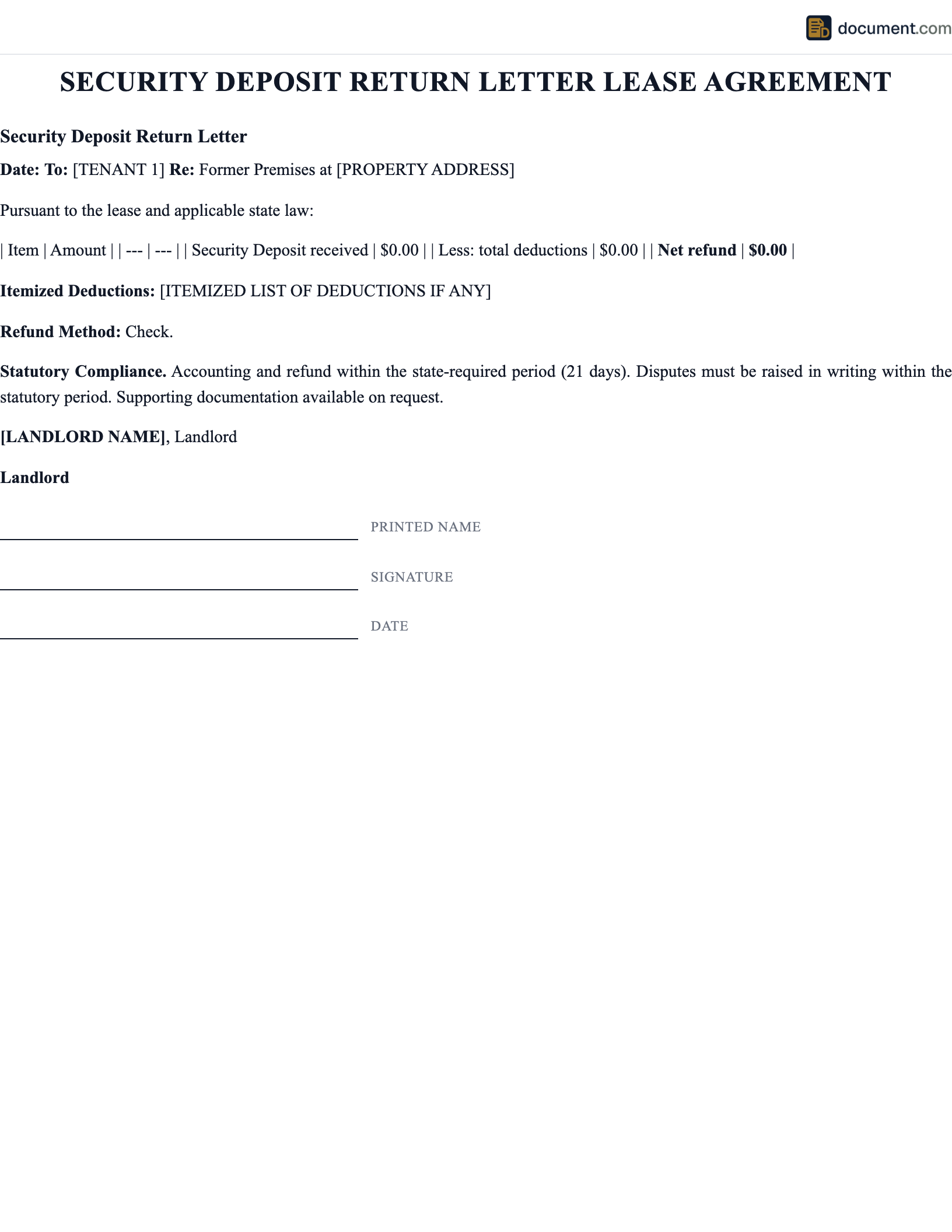
SECURITY DEPOSIT RETURN LETTER
With Itemized Statement of Deductions
To: [Tenant Name]
[Forwarding Address]
Re: Security Deposit Return for [Property Address]
Dear [Tenant Name],
This letter serves as the formal return and accounting of the security deposit you paid in connection with your tenancy at the above-referenced property. Your tenancy ended on[Move-Out Date].
DEPOSIT ACCOUNTING
ITEMIZED DEDUCTIONS
Enclosed is a check in the amount of $[Amount]representing the balance of your security deposit after the above deductions. Copies of supporting receipts and invoices are attached...
Frequently Asked Questions
Find answers to common questions about security deposit returns, deduction rules, return deadlines, and tenant remedies.
Official Resources
For additional information on security deposit return requirements, landlord-tenant law, and dispute resolution options, consult these official and reputable resources.
HUD - Tenant Rights
U.S. Department of Housing and Urban Development tenant rights information
CFPB - Housing Resources
Consumer Financial Protection Bureau housing and rental resources
Nolo - Security Deposit Limits by State
State-by-state guide to deposit limits, return deadlines, and required procedures
Nolo - Small Claims Court Limits
Dollar limits and procedures for small claims court in every state
USA.gov - Renters' Rights
Federal government overview of renter protections and dispute resolution
LawHelp.org - Free Legal Aid
Find free legal aid programs and tenant advocacy organizations in your state
Create your Security Deposit Return Letter Lease Agreement in under 10 minutes.
Answer a few questions and download a compliant, attorney-drafted document ready for your state.