



What Is a Security Deposit Receipt?
A security deposit receipt is a written acknowledgment from a landlord confirming that a tenant's security deposit has been received. It records the amount paid, the date of payment, the payment method, and — in many states — the specific bank and account where the deposit is being held. While it may seem like simple paperwork, this document carries significant legal weight. In states with strong tenant protections, failing to provide a proper receipt can cost the landlord the right to keep any portion of the deposit at all, regardless of the property's condition at move-out.
For landlords, the receipt is a first line of defense in deposit disputes. It establishes a verifiable record of when the deposit was collected, how much was collected, and where the funds are held. Without this documentation, a landlord may find it difficult to prove in court that the deposit was properly handled — especially if the tenant paid in cash. For tenants, the receipt confirms that their money was received and provides the information they need to verify that their deposit is being held in a compliant manner. If the landlord later claims the deposit was never received or attempts to withhold it improperly, the receipt is the tenant's primary evidence.
The security deposit receipt is distinct from other rental documents but closely related to several of them. It is not a substitute for a lease agreement, which governs the overall terms of the tenancy. It is not a move-in inspection report, which documents the physical condition of the property. And it is not a security deposit return letter, which itemizes deductions and accompanies the return of the deposit at the end of the lease. However, a well-drafted receipt references the lease, connects to the move-in inspection, and lays the groundwork for a clean deposit return process. Together, these documents form a cohesive paper trail that protects both parties throughout the tenancy.
Whether you are a first-time landlord renting a single property or a property manager handling hundreds of units, providing a compliant security deposit receipt is not optional in many jurisdictions — and it is always a best practice. Our templates are customized for your state's specific requirements, including mandatory bank disclosures, interest payment obligations, trust account rules, and move-in inspection references, so you can be confident your documentation meets legal standards from day one.
Proof of Payment
Creates an undeniable record that the tenant paid and the landlord received the security deposit
Legal Compliance
Satisfies state-mandated disclosure requirements for bank name, account number, and deposit location
Dispute Prevention
Eliminates ambiguity about deposit amount, payment date, and holding conditions that cause disputes
Security Deposit Receipt by State
Some states require security deposit receipts with bank account, interest, and deadline disclosures. Select your state for a receipt that satisfies local statutes.
Legal Obligation to Provide a Security Deposit Receipt
Landlord-tenant law is governed at the state level, and states differ significantly in how strictly they regulate security deposits. Some states explicitly require a written receipt, others require written notice of where the deposit is held (which functions as a receipt), and others have no specific receipt mandate but impose related disclosure obligations. Regardless of whether your state uses the word "receipt" in its statute, the underlying obligation — to acknowledge the deposit, disclose the holding institution, and provide this information in writing — is present in the majority of states.
Penalties for Noncompliance Can Be Severe
In states with strict deposit laws, the penalty for failing to provide proper documentation is not a slap on the wrist — it can mean forfeiture of the entire deposit. In Massachusetts, a landlord who fails to provide a receipt within 30 days must return the full deposit. In New Jersey, the tenant can apply the deposit as rent if the landlord fails to disclose the bank information within 30 days. In Maryland, improper handling can result in up to three times the deposit in damages. These are not theoretical risks — they are actively enforced in tenant-friendly courts.
States With Explicit Receipt or Disclosure Requirements
The following states have specific statutory requirements for written receipts, bank disclosures, or both. This is not an exhaustive list — landlords in every state should verify their local obligations, as city and county ordinances may impose additional requirements beyond state law.
Massachusetts
Landlords must provide a receipt within 30 days that includes the amount, the date received, the name of the person receiving it, a description of the unit, and the bank name, address, and account number. Failure to comply means the landlord must return the entire deposit. (Mass. Gen. Laws ch. 186, § 15B)
New Jersey
Landlords must notify tenants in writing of the name and address of the bank where the deposit is held and the type of account within 30 days. Deposits must be held in interest-bearing accounts in New Jersey banks. (N.J.S.A. 46:8-19)
Maryland
Landlords must provide a receipt at the time of payment stating the amount, the date, and the name of the banking institution where the deposit is held. The landlord must also provide a written list of existing damages before the tenant moves in. (Md. Code, Real Prop. § 8-203)
Connecticut
Landlords must place deposits in an escrow account in a Connecticut bank and notify the tenant of the account details. Interest must be paid annually or credited against rent. (Conn. Gen. Stat. § 47a-21)
New York
Landlords must deposit the security in an interest-bearing account in a New York banking institution and notify the tenant of the bank name and address. For buildings with six or more units, the account must be held in trust. (N.Y. GOL § 7-103)
Florida
Landlords must notify the tenant within 30 days of receiving the deposit, in writing, of the bank name and address where the deposit is held, whether it is interest-bearing or non-interest-bearing, and the rate of interest if applicable. (Fla. Stat. § 83.49)
Best practice: Even if your state does not explicitly require a written receipt, providing one protects you in court, demonstrates professionalism, and sets the tone for a well-documented landlord-tenant relationship. The cost of creating a receipt is negligible compared to the cost of losing a deposit dispute because you cannot prove proper handling.
What Information Must Be on a Security Deposit Receipt
A legally sufficient security deposit receipt contains more than just "received $X from tenant." The specific information required varies by state, but a comprehensive receipt that satisfies the strictest state requirements should include every element listed below. Including all of this information — even in states with less stringent rules — provides maximum protection for both parties.
Tenant's Full Legal Name
The full name of every tenant who is listed on the lease. If multiple tenants share the unit, all names should appear on the receipt even if only one person made the payment.
Rental Property Address
The complete street address of the rental property, including unit or apartment number. This identifies the specific unit the deposit applies to, which is critical for landlords managing multiple properties.
Deposit Amount Received
The exact dollar amount of the security deposit, written in both numerical and written form to prevent ambiguity (e.g., $1,500.00 — One Thousand Five Hundred Dollars).
Date of Payment
The exact date the landlord received the deposit. This date triggers various statutory deadlines, including how long the landlord has to deposit the funds in a trust account and provide written notice to the tenant.
Payment Method
How the deposit was paid — personal check (include check number), cashier's check, money order, cash, or electronic transfer. This detail is essential if there is ever a dispute over whether the payment cleared or was received.
Bank Name, Address, and Account Information
The name and address of the financial institution where the deposit will be held, and the account number or account type. Required by statute in states including Massachusetts, New Jersey, New York, Maryland, Connecticut, and Florida. Even where not required, disclosure prevents disputes.
Landlord's Name, Address, and Signature
The full legal name of the landlord or property management company, a mailing address for correspondence, and the landlord's signature. The signature confirms the landlord acknowledges receipt and accepts responsibility for the funds.
Interest and Return Terms
A statement of whether interest will be paid on the deposit (if required by state law), the applicable interest rate, and a summary of the conditions under which deductions may be made from the deposit at the end of the tenancy.
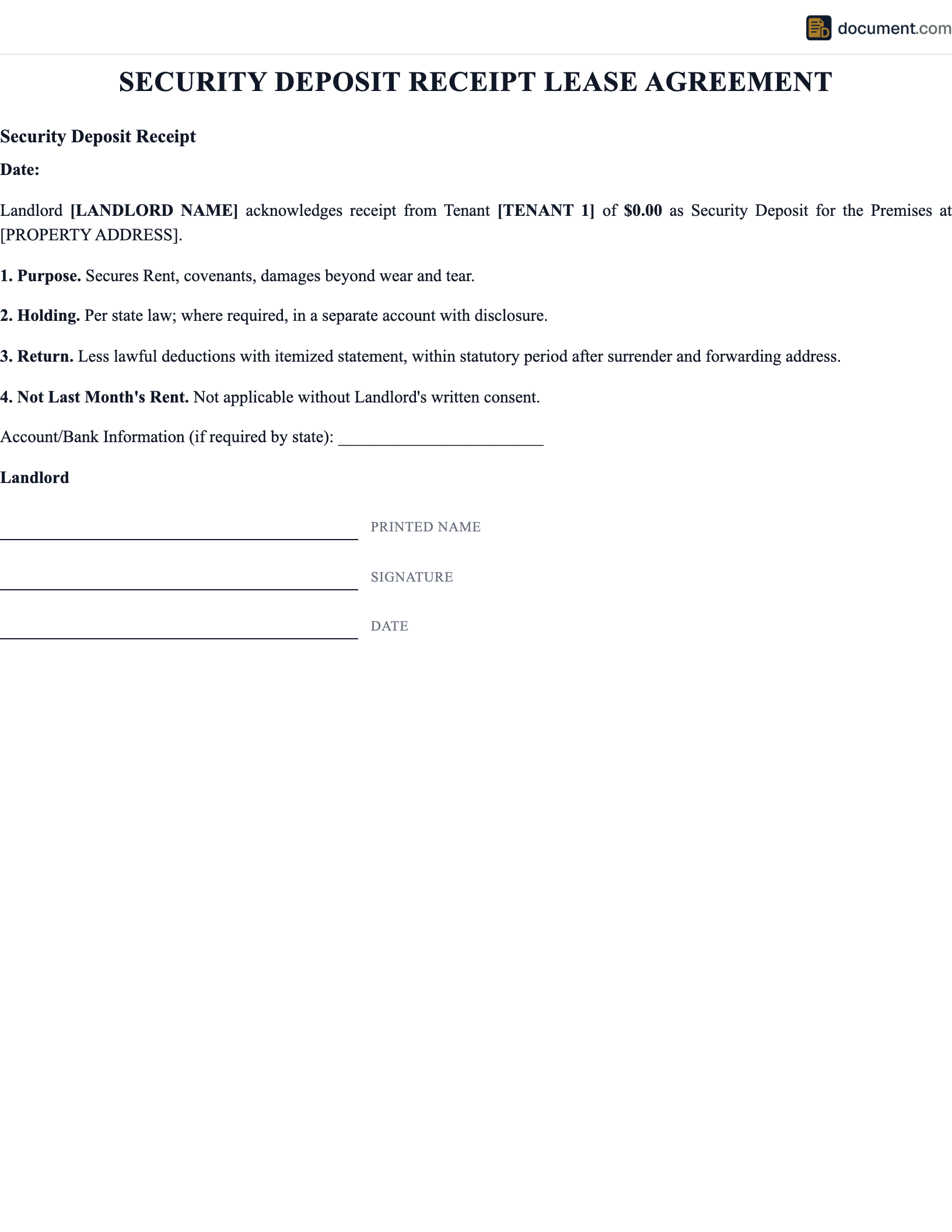
Security Deposit Receipt Form Preview
Below is a visual preview of the sections and fields included in a standard security deposit receipt form. This mockup illustrates the structure and level of detail our templates provide. Your completed document will be fully formatted and customized for your state's specific requirements.
Security Deposit Receipt
Acknowledgment of Receipt of Security Deposit
Section 1: Property & Tenant Information
Section 2: Deposit Details
Section 3: Deposit Held At
Section 4: Signatures
Move-In Condition Checklist
A move-in condition checklist (also called a move-in inspection report) is a companion document to the security deposit receipt that records the physical condition of every room, surface, fixture, and appliance in the rental unit at the time the tenant takes possession. While the deposit receipt proves the financial transaction occurred, the move-in checklist establishes the baseline condition of the property — which is the standard against which damage deductions are measured at move-out.
Many states require landlords to complete a written move-in inspection, and in states where it is required, a landlord who fails to provide one may lose the ability to deduct for damages at all. States including Arizona, Georgia, Hawaii, Kansas, Kentucky, Maryland, Michigan, Montana, Nevada, North Dakota, Utah, Virginia, Washington, and Wisconsin have specific inspection or condition report requirements. Even in states without a statutory mandate, a documented move-in inspection is the single best defense against a tenant's claim that damage was pre-existing.
What the Checklist Should Cover
Each Room
- - Walls (condition, marks, holes, paint)
- - Floors (scratches, stains, carpet condition)
- - Ceilings (stains, cracks, peeling)
- - Windows (operation, cracks, screens, locks)
- - Doors (operation, locks, damage)
- - Electrical outlets and light fixtures
Systems and Fixtures
- - Kitchen appliances (stove, refrigerator, dishwasher)
- - Plumbing fixtures (faucets, drains, toilets)
- - HVAC system operation
- - Water heater condition
- - Smoke and carbon monoxide detectors
- - Exterior areas (patio, yard, parking)
Photography tip:In addition to the written checklist, take timestamped photographs and video of every room, every appliance, and every pre-existing defect. Digital photo metadata provides objective proof of the property's condition on a specific date. Both the landlord and tenant should receive copies of the completed checklist and photos. Many property managers now use move-in inspection apps that automatically timestamp, organize, and store photos alongside the written report.
Interest on Security Deposits
Several states require landlords to pay interest on security deposits held during the tenancy. The interest rate, payment frequency, and method of payment or credit vary by state. Failing to pay required interest can result in penalties similar to failing to provide a receipt — in some states, the tenant may recover the full deposit plus statutory damages.
Massachusetts
Landlords must pay interest at 5% per year or the actual bank rate, whichever is less. Interest must be paid annually on the anniversary of the tenancy or deducted from the next month's rent. Failure to pay interest entitles the tenant to deduct the interest from their rent. (Mass. Gen. Laws ch. 186, § 15B)
Connecticut
Landlords must pay interest at the rate set by the banking commissioner or the passbook savings rate, whichever is less. Interest must be paid annually, either as a direct payment to the tenant or as a credit against the next month's rent. (Conn. Gen. Stat. § 47a-21)
Maryland
Landlords must pay simple interest at 3% per year on deposits held in an account paying less than 3%. If the deposit is held in an account that pays more than 3%, the tenant is entitled to the actual interest earned. Interest accrues every six months and must be paid when the deposit is returned. (Md. Code, Real Prop. § 8-203)
New Jersey
Landlords must pay interest annually on deposits held in interest-bearing accounts. The interest must be paid to the tenant by cash, check, or credit toward rent. The interest rate is the rate actually earned on the account. Landlords who fail to pay interest may be liable for the full deposit plus court costs and attorney fees. (N.J.S.A. 46:8-19)
Illinois (25+ units)
Landlords who own 25 or more units in a single building or complex must pay interest on deposits at the rate set by the city comptroller or published rate. The interest must be paid within 30 days after the end of each 12-month rental period. Smaller landlords are exempt from the interest requirement but must still hold deposits properly. (765 ILCS 710 — Security Deposit Interest Act)
New York
Landlords of buildings with six or more units must place deposits in interest-bearing accounts. The landlord may retain 1% per year as an administrative fee, and the remaining interest must be paid to the tenant annually, applied as a rent credit, or held in trust until the end of the tenancy. (N.Y. GOL § 7-103)
Note: Local ordinances may impose additional interest requirements. Cities including Chicago, Los Angeles, San Francisco, Seattle, and Washington D.C. have their own security deposit interest rules that may exceed state requirements. Always verify both state and local obligations.
Trust Account Requirements
One of the most important — and most frequently violated — requirements in security deposit law is the obligation to hold tenant deposits in a separate trust or escrow account rather than commingling them with the landlord's personal or business funds. The purpose of this requirement is straightforward: if the landlord's business fails, faces a lawsuit, or goes through bankruptcy, the tenant's deposit is protected because it sits in a separate, identifiable account.
The specifics of trust account requirements vary by state, but the general principle is consistent: security deposits are the tenant's money held by the landlord, not the landlord's money. The landlord acts as a custodian or fiduciary of the funds, and commingling those funds with operating capital is a breach of that duty.
Common Trust Account Rules
- Separate account required: Many states require the deposit to be held in a separate bank account that is designated as a trust or escrow account. The landlord cannot use a personal checking or savings account that also holds their own funds.
- In-state banking institution: Several states require the account to be held at a banking institution within the state. For example, New York requires a New York bank, and New Jersey requires a New Jersey bank.
- FDIC-insured institution: The bank must be federally insured so that deposits are protected up to applicable FDIC limits.
- Notification to tenant: The landlord must notify the tenant in writing of the bank name, bank address, and account type (or account number, depending on state law) within a set timeframe after receiving the deposit — typically 30 days.
- No commingling: The landlord may not mix security deposit funds with personal funds, business operating funds, or reserve funds. Some states allow multiple tenants' deposits to be held in the same trust account as long as the landlord maintains individual records for each tenant.
Consequences of Commingling
Commingling security deposits with personal funds can result in serious penalties depending on the state. In some jurisdictions, commingling alone is sufficient grounds for the tenant to recover the entire deposit regardless of property damage. In others, it triggers statutory damages of two or three times the deposit amount. Property managers and landlords with multiple units should work with their bank to set up a dedicated trust account that complies with their state's requirements and maintains a clear audit trail.
Security Deposit Caps by State
Most states limit the maximum amount a landlord can charge as a security deposit. These caps are typically expressed as a multiple of the monthly rent. Charging more than the statutory maximum is illegal and can result in penalties, even if the tenant agreed to pay the higher amount. Below is a general overview of how deposit caps work across the country.
1 Month's Rent
The strictest cap. States in this category typically have strong tenant protections overall. Examples include New York (for most residential units under rent stabilization), Massachusetts (for most units), and certain municipalities with rent control ordinances.
1.5 Months' Rent
A middle-ground cap used in several states. Examples include Connecticut (which allows up to two months for tenants 62 and older and one month for all other tenants). Some states set the cap at 1.5 months for unfurnished units and more for furnished units.
2 Months' Rent
The most common cap. A large number of states — including California, Florida, Hawaii, Iowa, Kansas, Maine, Maryland, Nevada, New Jersey, North Carolina, Pennsylvania, Rhode Island, Tennessee, Virginia, and many others — cap deposits at two months' rent.
3+ Months' Rent or No Cap
Some states allow up to three months (e.g., New Hampshire) or have no statutory cap at all, leaving the amount to the market and the parties' negotiation. States with no cap include Illinois (outside Chicago), Colorado (repealed its cap), and Texas (no statutory limit).
Important:Deposit caps may vary within a state based on the type of unit (furnished vs. unfurnished), the tenant's age (some states allow lower maximums for senior tenants), and whether the unit is subject to rent control or rent stabilization. Pet deposits, last month's rent, and non-refundable fees may or may not count toward the cap depending on your state's law. Always verify the specific rules for your jurisdiction.
How to Create a Security Deposit Receipt
Creating a compliant security deposit receipt is straightforward when you follow these three steps. Our templates handle the legal formatting and state-specific requirements automatically — you just fill in the details of the transaction.
Select Your State and Enter Property Details
Start by selecting your state so our template can include the correct disclosure requirements, trust account rules, interest obligations, and deposit cap information. Then enter the rental property address, the tenant's full legal name (matching the lease), and the lease start date. If you manage multiple properties, include the unit number to avoid confusion.
Our template automatically includes the state-required language for your jurisdiction. In states like Massachusetts, this means the receipt will include fields for the bank name, address, and account number. In states like Florida, the receipt will include the required notification language about interest-bearing versus non-interest-bearing accounts.
Record the Payment Details
Enter the exact amount of the security deposit, the date you received it, and the method of payment. If the tenant paid by check, include the check number. If paid by money order or cashier's check, include the instrument number. If paid electronically, note the transfer confirmation number. If paid in cash, the receipt should explicitly state "cash" and both parties should sign the receipt at the time of the transaction.
If your state requires you to disclose where the deposit will be held, enter the bank name, bank address, and account number or type. If you are using a dedicated trust or escrow account (required in many states), identify it as such on the receipt. Our template prompts you for this information based on your state's requirements.
Sign, Distribute, and File
Both the landlord and tenant should sign the completed receipt. The landlord's signature confirms they received the funds and accept responsibility for holding them properly. The tenant's signature confirms they received a copy of the receipt and acknowledge the amount and terms. Provide the tenant with a copy and retain a copy in your records.
In states with specific delivery deadlines (such as Massachusetts' 30-day requirement), make sure you provide the receipt within the required timeframe. If you mail the receipt, use a method that provides proof of delivery. Keep the receipt with your other lease documents for the entire duration of the tenancy and for several years afterward, as the statute of limitations for deposit disputes can extend years beyond the end of the lease.
Sample Security Deposit Receipt
Below is a condensed preview of our security deposit receipt template. This sample shows the structure, language, and sections included in our attorney-reviewed documents. Your completed receipt will be fully customized for your state's specific requirements.
SECURITY DEPOSIT RECEIPT
Acknowledgment of Receipt and Holding Conditions
This receipt confirms that the undersigned landlord has received from[Tenant Name(s)]a security deposit in the amount of $[Amount]([Amount in Words] Dollars) for the rental property located at:
Address: [Street Address, Unit #, City, State, ZIP]
PAYMENT DETAILS
Date Received: [Date]
Payment Method: [Check / Money Order / Cash / Electronic]
Check/Reference #: [Number]
DEPOSIT HELD AT
Bank Name: [Bank Name]
Bank Address: [Bank Address]
Account Type: [Trust/Escrow Account]
TERMS AND CONDITIONS
This deposit shall be held in accordance with the laws of the State of[State]. The deposit, less any lawful deductions for unpaid rent, damages beyond normal wear and tear, and other charges permitted by the lease agreement and state law, shall be returned to the tenant within[Days] days after the termination of the tenancy and surrender of the premises...
MOVE-IN INSPECTION
A separate Move-In Condition Checklist has been completed and signed by both parties on[Date]. The checklist documents the condition of the premises at the commencement of this tenancy and shall serve as the baseline for evaluating any damage claims at the time of move-out.
Frequently Asked Questions
Find answers to common questions about security deposit receipts, landlord obligations, tenant rights, and deposit handling requirements.
Official Resources
For additional information on security deposit requirements, landlord-tenant law, and tenant rights in your state, consult these official and reputable resources.
HUD - Tenant Rights
U.S. Department of Housing and Urban Development tenant rights information
CFPB - Housing Resources
Consumer Financial Protection Bureau housing and rental resources
Nolo - Security Deposit Limits by State
State-by-state guide to security deposit limits and return deadlines
FDIC - Consumer Resources
Federal Deposit Insurance Corporation information on deposit protection
USA.gov - Renters' Rights
Federal government overview of renter protections and landlord obligations
NLIHC - Rental Programs
National Low Income Housing Coalition resources on rental protections
Create your Security Deposit Receipt Lease Agreement in under 10 minutes.
Answer a few questions and download a compliant, attorney-drafted document ready for your state.