



What Is a Crime and Drug Free Addendum?
A crime and drug free lease addendum is a written supplement to a residential lease that establishes the property's zero-tolerance policy for criminal activity by tenants, household members, guests, and other persons under tenant control. The addendum identifies specific prohibited conduct (drug manufacturing, distribution, possession, violent felonies, firearms offenses), assigns tenant responsibility for the conduct of household members and guests on or off the premises, defines the consequences of violation (lease termination as a material breach), and references the federal, state, and local statutory framework that authorizes and constrains enforcement. Both parties sign and the addendum becomes part of the integrated lease.
The addendum is mandatory for federally assisted housing. Public housing leases under 42 USC §1437d(l)(6) (Anti-Drug Abuse Act of 1988) must include termination provisions for any drug-related criminal activity. Section 8 Housing Choice Voucher units under 24 CFR §982.553, project-based Section 8 under 24 CFR §247, and the HUD model lease at 24 CFR §966.4 all incorporate the same one-strike framework that the Supreme Court upheld in Department of Housing and Urban Development v. Rucker (535 U.S. 125, 2002). For private landlords the addendum is optional but is widely adopted both for risk management and as a condition of participation in city-run crime-free housing programs that often pair the addendum with property registration, police contact, and tenant screening cooperation.
Enforcement of the addendum operates within significant constitutional and statutory constraints. The Fair Housing Act (42 USC §3604) prohibits selective enforcement that produces disparate impact on protected classes, with HUD's 2016 OGC guidance restricting blanket exclusions based on criminal history. The Violence Against Women Act (34 USC §12491) prohibits eviction of tenants who are themselves victims of domestic violence, dating violence, sexual assault, or stalking. Self-help eviction is prohibited everywhere; even where the addendum is breached, the landlord must serve statutory notice and proceed through unlawful detainer or holdover.
HUD's One-Strike Framework Under the Anti-Drug Abuse Act
42 USC §1437d(l)(6) requires public housing authorities to include lease provisions allowing termination for any drug-related criminal activity, on or off the premises, by tenants, household members, guests, or other persons under tenant control. The Supreme Court in Rucker held that the framework is strict liability: tenants can be evicted for activity by others even when the tenant had no knowledge and could not reasonably have prevented the conduct. HUD discretionary guidance encourages PHAs to consider mitigating circumstances (lack of tenant knowledge, evidence of efforts to prevent recurrence, length of tenancy, severity of the conduct) but does not require it. 24 CFR §966.4(l)(2) extends the framework to non-drug criminal activity that threatens the health, safety, or right to peaceful enjoyment of other tenants.
Due-Process Limits and Section 8 Voucher Implications
Even within the one-strike framework, due process applies. Public housing tenants are entitled to grievance rights under 24 CFR §966.4 before lease termination, including written notice citing specific incidents, opportunity to examine documents in the PHA's file, opportunity to present evidence, and a hearing before an impartial decision-maker. For Section 8 voucher participants, the PHA must afford informal hearing rights under 24 CFR §982.555 before terminating assistance, separate from the landlord's state-law eviction process. Goldberg v. Kelly (397 U.S. 254, 1970) and its progeny establish that public housing benefits trigger constitutional due process. Private landlords face fewer constitutional constraints but remain bound by state unlawful detainer procedures and by the FHA's prohibition on disparate-impact discrimination.
Conduct Prohibitions
Drug, violent, and firearms criminal activity defined
HUD Compliance
Required for public housing and Section 8 units
VAWA Exception
Crime victims protected from eviction
Form Preview
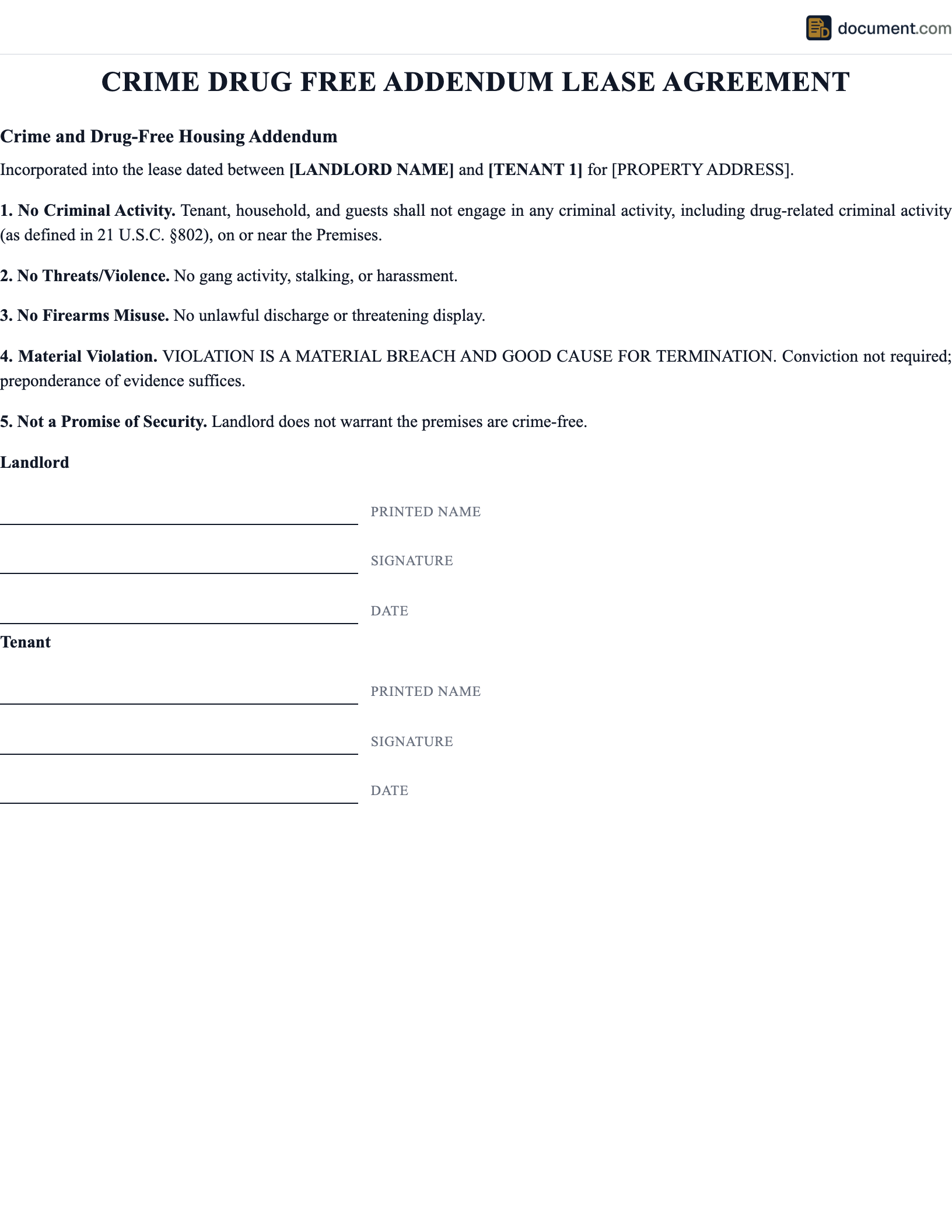
Below is a preview of the Crime and Drug Free Lease Addendum template. Your customized document will include all provisions for your specific situation.
CRIME AND DRUG FREE LEASE ADDENDUM
Zero Tolerance Policy Agreement
This document is entered into on [Date] between the parties identified below:
LANDLORD:
Name: [Landlord Name]
TENANT:
Name: [Tenant Name]
How to Use This Document
The addendum's defensibility depends on precise drafting and uniform enforcement. Vague prohibitions and selective enforcement are the two leading sources of fair-housing exposure in this category.
FHA Disparate-Impact Considerations
Under HUD's 2013 disparate-impact rule (24 CFR §100.500), affirmed by the Supreme Court in Texas Department of Housing v. Inclusive Communities Project (576 U.S. 519, 2015), policies that produce disparate impact on protected classes can violate the Fair Housing Act even without discriminatory intent. Criminal-history exclusions face heightened scrutiny because of documented racial disparities in arrest and conviction rates. HUD's 2016 OGC guidance requires individualized assessment: the nature and severity of the conviction, the time elapsed, age at the offense, evidence of rehabilitation, and the nexus between the offense and tenancy concerns. Blanket exclusions for any conviction or for arrests are presumptively unlawful. The addendum should reflect this framework by tying enforcement to specific conduct on or near the premises rather than to the tenant's status as someone with a record.
Define Prohibited Activities
List specific conduct: manufacturing, distribution, possession of controlled substances under 21 USC §812; violent felonies (assault, robbery, sexual offenses); firearms violations under 18 USC §922; and any felony activity on or in the immediate vicinity of the premises. Avoid vague terms like "disorderly conduct" that invite selective enforcement.
Establish Tenant Responsibility
Extend tenant responsibility to household members, guests, invitees, and persons under tenant control. Track 24 CFR §966.4(f)(11) language for HUD compliance. Include the express VAWA exception under 34 USC §12491 for victims of domestic violence, sexual assault, or stalking.
Include Termination Provisions
State that violation is a material lease breach. Identify the state-required notice: California 3-day cure-or-quit under CCP §1161(3), Texas 3-day under Property Code §24.005, Florida 3-day under §83.56(2), New York 14-day for material breach. Self-help eviction is prohibited everywhere.
Ensure Legal Compliance
Review against the Fair Housing Act, state fair-housing statutes, and HUD's 2016 OGC guidance. Tie enforcement to specific conduct on or near the premises, not to tenant status. Document each enforcement action with police reports, court records, or contemporaneous landlord observations.
Key Components
Each component below carries specific federal or state weight. Skipping any one creates either a HUD compliance gap or a fair-housing exposure.
VAWA Exception Required
The Violence Against Women Act protections under 34 USC §12491 apply to all HUD-covered housing including public housing, Section 8 (project-based and voucher), HOME Investment Partnerships Program, and Low-Income Housing Tax Credit properties. The statute prohibits eviction of a tenant for being a victim of domestic violence, dating violence, sexual assault, or stalking. Many states extend similar protections to private housing: California Code of Civil Procedure §1161.3, New York RPL §227-c, Massachusetts G.L. c. 186 §24, Washington RCW 59.18.580, and equivalents elsewhere. The addendum should include an express VAWA carve-out so the protection appears on the document the tenant signs, both for compliance and to defeat any tenant claim of lack of notice.
| Component | Description |
|---|---|
| Prohibited Activities | Specific list of criminal activities that violate the addendum |
| Tenant Responsibility | Liability for household members, guests, and invitees |
| Termination Rights | Landlord right to terminate lease upon violation |
| Notice Requirements | Required notice period before termination |
| HUD Provisions | Specific language required for federally assisted housing |
| Fair Housing Compliance | Non-discriminatory application of the policy |
Frequently Asked Questions
Find answers to common questions about the Crime and Drug Free Lease Addendum.
Resources
Create your Crime Drug Free Addendum Lease Agreement in under 10 minutes.
Answer a few questions and download a compliant, attorney-drafted document ready for your state.