
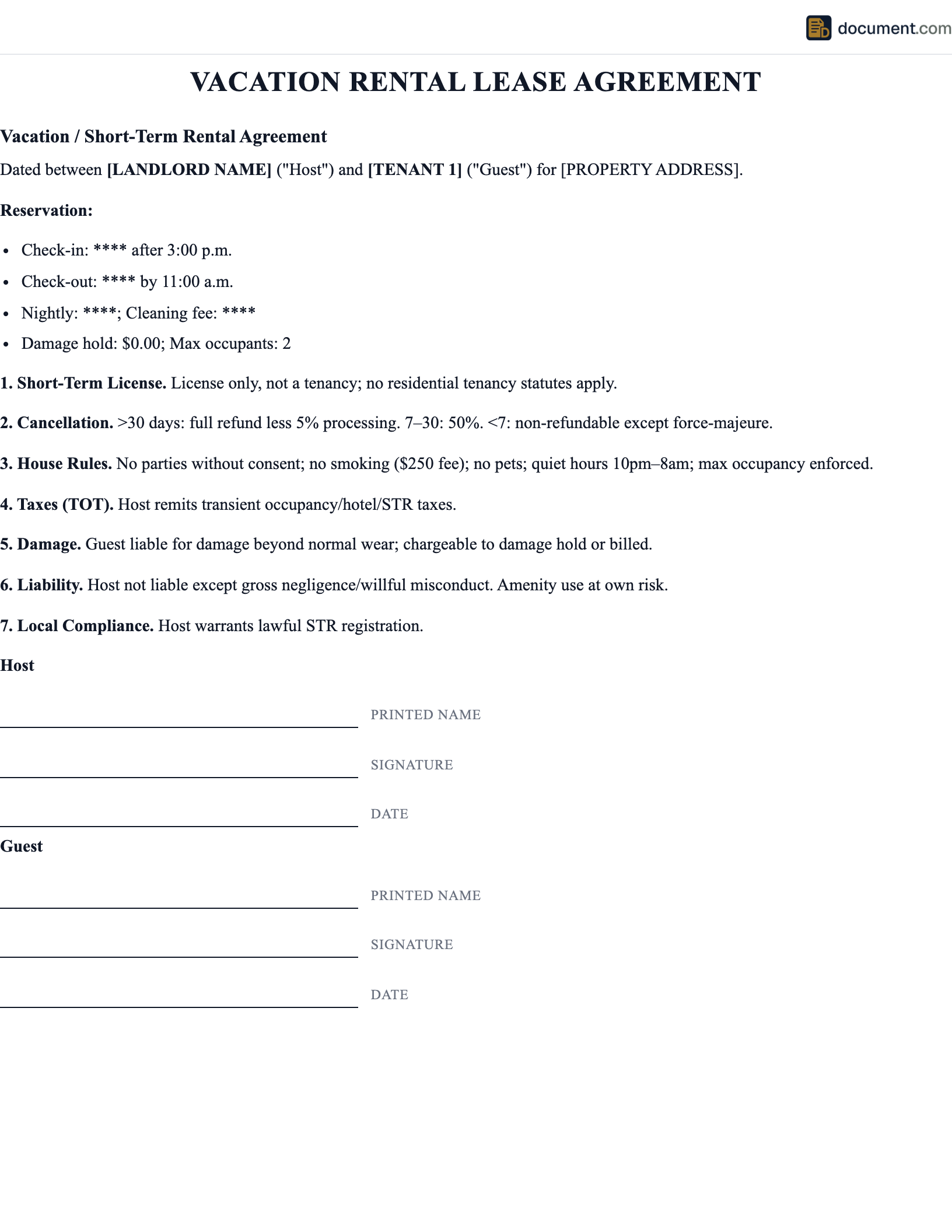



What Is a Short-Term (Vacation) Rental Agreement?
A short-term rental agreement is a license-style occupancy contract between a property owner and a guest for residential lodging of fewer than 30 days, typically booked through Airbnb, VRBO, Booking.com, or direct channels. The document governs check-in and check-out times, occupancy limits scaled to the property's bedroom count and septic capacity, house rules (no events, no smoking, quiet hours), cleaning fees, damage deposits, cancellation tiers, parking and noise restrictions, and the express classification of the guest as a transient occupant rather than a tenant. It supplements but does not replace the platform's terms of service, which govern the booking transaction itself.
The legal framework that governs short-term rentals is distinct from both residential leases (governed by state landlord-tenant acts) and hotel-room contracts (governed by state innkeeper statutes). The host operates under a hybrid regime: state innkeeper liability for guest safety, transient occupancy tax obligations under state and local revenue codes, FTC and state-AG enforcement against junk fees, the Fair Housing Act with the Mrs. Murphy exception, the ADA Title III for service-animal accommodations, and the platform-specific terms of service that incorporate AirCover, VRBO Liability, and platform dispute resolution. Add the local STR registration regime (NYC Local Law 18, San Francisco Office of Short Term Rentals, Florida DBPR Vacation Rental License) and the picture for any one property requires four to six separate compliance check-ins before the first booking.
The agreement matters most at the 30-day boundary, where a stay that crosses into the 31st day risks reclassifying the guest as a tenant with full state landlord-tenant protections including formal eviction procedure, deposit caps, habitability warranties, and rent-control coverage in some jurisdictions. California Civil Code §1940(b) and SB 644 (2023) clarify the threshold; New York Multiple Dwelling Law §4(8) and RPAPL §711 govern the New York equivalent. Limit individual bookings to 28 days, require any extension to be a separate booking, and include explicit transient-occupancy language to preserve the classification.
Local STR registration: NYC, San Francisco, Los Angeles, Florida
Most major STR markets now require operator registration before any listing goes live. New York City Local Law 18, effective September 5, 2023, requires hosts to register with the Mayor's Office of Special Enforcement and obtain an OSE registration number that platforms verify before allowing a listing; unregistered listings are removed and the host faces $1,000 to $5,000 fines per violation. San Francisco requires Short Term Residential Business Registration through the Office of Short Term Rentals with primary-residence verification and an annual cap of 90 days for un-hosted rentals. Los Angeles Home Sharing Ordinance requires Home Sharing Host Registration capped at 120 days of un-hosted rentals annually under LAMC §12.22(A)(32). Florida requires a DBPR Vacation Rental License under §509.241 plus county tourist development tax registration. Texas localities vary widely (Austin requires a license under City Code §25-2-788; Houston has none statewide). Verify registration status before listing.
Platform overlay: Airbnb and VRBO terms incorporated by reference
When the booking originates on a platform, the platform's terms of service govern the booking transaction, including payment processing, cancellation enforcement, refund handling, and dispute mediation. The host's separate rental agreement layers on top to add property-specific house rules, additional liability allocation, damage-deposit terms, and any limitations the platform does not address. The platforms permit supplemental agreements through integrations such as Jurny, Hospitable, RueBaRue, or DocuSign-based flows that present the agreement at booking confirmation. Cite the platform booking confirmation in the agreement to incorporate the platform terms by reference. Where platform consumer-protective terms (cancellation rights, antidiscrimination, refund policies) conflict with the host agreement, the platform terms control. Where host-property-specific terms (no parties, no shoes, pool rules) conflict with platform silence, the agreement controls.
Airbnb and VRBO Overlay
Platform terms govern the booking relationship but do not replace the host's rental agreement. The agreement layers atop platform terms to add property-specific rules and liability allocation, while consumer-protective platform rules cannot be waived by host contract.
- Platform TOS: Cancellation, refund, dispute resolution, communication restrictions handled through the platform; off-platform communication and payment is grounds for delisting.
- Host liability coverage: Airbnb AirCover provides up to $3 million in liability and host-damage protection per booking; VRBO Liability Insurance Program provides up to $1 million per claim. Both are supplemental and apply only to platform-booked stays.
- Host-specific rules: House rules, quiet hours, check-in process, no-event clauses, occupancy limits, parking restrictions added through the host's agreement.
- Consumer protections: Platform-mandated nondiscrimination policies, refund rules under Airbnb's Major Disruptive Events Policy, and ADA service-animal accommodation cannot be waived by host contract.
- Booking confirmation: The platform booking confirmation is the operative offer-and-acceptance under contract law; the host agreement modifies the supplemental terms only.
Occupancy Tax Registration
Transient occupancy tax (TOT, bed tax, hotel tax) applies in almost every state and most cities. Combined rates of 8 to 17 percent are typical. Airbnb collects and remits in roughly 30,000 jurisdictions through voluntary collection agreements; VRBO collects in fewer. Direct-booked stays require the host to register, collect, file, and remit on their own. Failure exposes the host to back taxes plus penalties of 10 to 25 percent and interest, plus possible suspension of the local STR license.
- Typical rate: 8 to 17 percent combined state, county, and city.
- Airbnb collection: Automatic in most jurisdictions via voluntary collection agreements; verify on Airbnb's tax-jurisdiction lookup page.
- Direct or VRBO collection: Host must register with state revenue department, county tax authority, and sometimes city tax authority; collect from guest; file monthly or quarterly; remit on time.
- Registration required: State, county, and sometimes city-level filings. Florida requires a DR-1 registration; California requires city or county TOT certificate; New York requires Certificate of Authority.
- Statutes: Texas Tax Code §156.051 (6 percent state plus local), California Revenue and Taxation Code §7280 (city or county TOT), New York Tax Law §1105 (state sales tax) and NYC Hotel Room Occupancy Tax (14.75 percent), Florida §125.0104 (county tourist development tax of 4 to 6 percent plus 6 percent state sales tax).
HOA and Zoning Restrictions
Before listing, check both layers of private and public restriction. CC&R restrictions come from the property's HOA or condominium association; zoning restrictions come from the city or county. Either layer alone can shut down a listing; both must be cleared.
HOA CC&Rs
Many condominiums and HOAs prohibit short-term rentals entirely or impose 30-day, 90-day, or 6-month minimum stays. Watts v. Oak Shores Community Association (Cal. Ct. App. 2015) upheld a 7-day minimum; California Civil Code §4741 (2021) limits some HOA STR bans for permitted operators. Violators face fines, lien enforcement, and injunctive relief.
Local zoning
Many cities zone STRs out of single-family-residential districts. NYC Local Law 18 requires registration and removes unregistered listings; San Francisco caps un-hosted nights at 90 per year; Los Angeles caps at 120 nights under LAMC §12.22(A)(32). Santa Monica, Charleston, and parts of Nashville prohibit non-owner-occupied STRs entirely.
Insurance Requirements
Standard homeowners insurance under Insurance Services Office form HO-3 excludes commercial use, which includes short-term rentals. The host needs purpose-built coverage. Three sources work in combination, with the primary STR policy carrying the load and the platform programs supplementing.
- STR-specific policies: Proper Insurance (full commercial coverage of liability, building, contents, loss of income; $500 to $2,500 annual), CBIZ Vacation Rental, Slice (per-night coverage). These are primary insurance and carry most of the risk.
- HO rider: Allstate HostAdvantage and Farmers Seasonal Home Insurance offer STR riders to existing homeowners policies; cheaper than standalone but with lower limits and more exclusions.
- Platform coverage: Airbnb AirCover ($3 million liability plus host-damage protection per booking) and VRBO Liability Insurance Program ($1 million per claim) are automatic for platform-booked stays only and supplement primary insurance.
- Commercial umbrella: For portfolios of two or more STR properties, a commercial umbrella from $1 million to $5 million from a carrier like Chubb, Travelers, or Liberty Mutual provides efficient excess coverage above the primary STR policies.
Cleaning Fee Structure
Cleaning fees should be a flat per-stay charge disclosed at booking, scaled to property size, and kept distinct from the damage deposit for tax and refund purposes. State and federal regulators have moved aggressively against junk fees in the lodging industry.
- Disclose the exact amount at booking, not at check-in. Airbnb and VRBO both require upfront disclosure under their consumer-transparency policies.
- Stay within market range of $50 to $250 depending on property size and turnover complexity.
- Do not layer multiple hidden fees. California AB 537, effective July 1, 2024, prohibits surprise resort fees and hidden charges on short-term rentals; the FTC junk-fee rule and similar laws in Connecticut, New York, and Massachusetts target identical practices.
- Keep the cleaning fee separate from the security deposit. Cleaning fees are taxable as part of rent under most TOT statutes; security deposits are not. Mixing the two creates a tax-collection error and a refund-accounting problem.
How to Use This Agreement
Six steps move the property from intended STR to a compliant, insured, taxed, and contractually documented operation.
Check HOA CC&Rs and local zoning
Confirm the CC&Rs permit short-term rentals and the zoning allows STR use in the district before listing. NYC, San Francisco, Los Angeles, Santa Monica, and Charleston all have property-by-property restrictions.
Register for licenses and taxes
Local STR registration (NYC OSE, SF Office of Short Term Rentals, LA Home Sharing, Florida DBPR), business license, and TOT account at state, county, and city as applicable.
Buy appropriate insurance
Primary STR policy (Proper, CBIZ, Slice) or HO rider (Allstate HostAdvantage, Farmers Seasonal). Platform coverage (AirCover, VRBO Liability) is supplemental and only applies to platform-booked stays.
List on platform or direct
Airbnb, VRBO, Booking.com, or direct via the host's own website. Verify TOT collection coverage by jurisdiction; Airbnb covers far more than VRBO. Direct bookings carry no platform liability coverage.
Send this agreement at booking
Guest signs before check-in via DocuSign, Hospitable, Jurny, or RueBaRue. Agreement acknowledges house rules, transient-occupant status, and damage-deposit terms.
Collect cleaning fee and deposit
Cleaning fee charged upfront and disclosed at booking. Damage deposit collected as pre-authorization hold (Airbnb and VRBO both support this), cash deposit, or via SafelyStay or Superhog damage-waiver products.
Frequently Asked Questions
Platform overlay, NYC and SF registration, transient occupancy tax, HOA and zoning, STR insurance, the 30-day tenant boundary, junk-fee rules, and Fair Housing Act application.
Official Resources
Rent your place short-term in under 7 minutes.
Pick your state, answer a few questions, and download a vacation rental agreement with tax, platform, HOA, and insurance coverage all handled.