



What Is an Early Lease Termination Letter?
An early lease termination letter is a formal written notice from a tenant to a landlord requesting or announcing the early termination of a residential lease before its scheduled expiration date. Unlike simply moving out and hoping for the best, this letter creates a legal record of your intent, the reason for your departure, and the specific date you plan to vacate the property. It is an essential step in protecting your rights and minimizing your financial exposure when you need to break a lease.
Breaking a lease is not the same as ending a month-to-month tenancy. A fixed-term lease is a binding contract, and leaving before the term expires can expose you to significant financial liability — including responsibility for rent until the unit is re-rented or the lease expires. However, both federal and state laws provide numerous situations where tenants can terminate early without penalty or with reduced liability. Understanding these protections and documenting your termination properly is the difference between a smooth transition and a costly legal battle.
The Servicemembers Civil Relief Act (SCRA) provides the strongest federal protection, allowing active-duty military members to terminate residential leases when they receive deployment or permanent change of station (PCS) orders. State laws add additional protections for domestic violence victims, tenants living in uninhabitable conditions, elderly tenants entering care facilities, and in some states, tenants who experience significant job relocations. Many leases also include early termination clauses that specify a fee (typically one to two months' rent) and notice period for voluntary early termination.
Even when you do not have a legally protected reason for termination, a well-crafted letter can set the stage for a negotiated exit. Landlords often prefer cooperative tenants who give generous notice and help find replacements over tenants who simply disappear. Your early termination letter is the first step in that negotiation, and it establishes the professional tone that can lead to a mutually acceptable resolution.
It is critical to understand that an early termination letter does not, by itself, relieve you of your contractual obligations. If your reason for termination is not protected by law and your landlord does not agree to release you from the lease, you may still be liable for rent until the landlord re-rents the unit or the lease expires. However, in states with a duty to mitigate, the landlord must make reasonable efforts to find a new tenant, and your liability is limited to the period until the unit is re-rented plus any legitimate re-leasing costs.
Military SCRA Protection
Federal law guarantees penalty-free termination for active-duty deployments and PCS orders
Domestic Violence Protections
Over 30 states allow victims to terminate leases early with proper documentation
Uninhabitable Conditions
Constructive eviction doctrine applies when landlords fail to maintain livable conditions
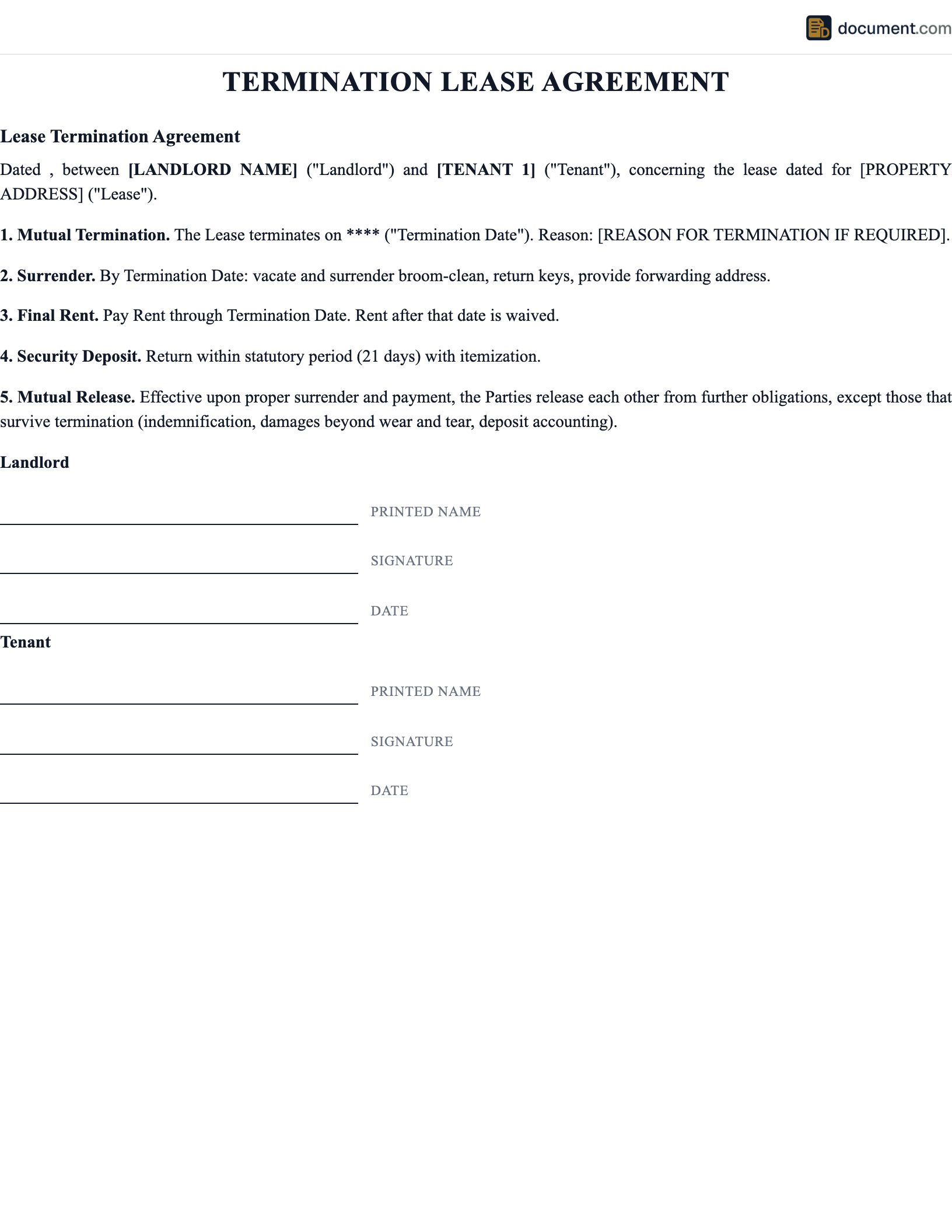
Early Lease Termination Letter Preview
Our early lease termination letter includes all the elements required for a legally effective notice. Below is a preview of the key sections. Your customized document will be tailored to your state's specific notice requirements and legal protections.
EARLY LEASE TERMINATION NOTICE
Formal Notice of Intent to Vacate Before Lease Expiration
TENANT INFORMATION
Name: [Full Legal Name]
Rental Address: [Current Address]
Lease Start Date: [Date] Lease End Date: [Date]
LANDLORD / PROPERTY MANAGER
Name: [Landlord Name]
Address: [Mailing Address]
TERMINATION DETAILS
Intended Vacate Date: [Date]
Reason for Early Termination: [Legal Reason]
Applicable Statute / Lease Clause: [Citation]
SECURITY DEPOSIT & FORWARDING ADDRESS
Forwarding Address: [New Address]
Security Deposit Amount: $[Amount]
Deposit Return Requested By: [Statutory Deadline]
Valid Reasons to Break a Lease Early
While a lease is a binding contract, both federal and state laws recognize situations where tenants should be allowed to leave early without penalty. The strength of your legal position depends entirely on which category your reason falls into and how well you document it.
Military Deployment or PCS Orders (SCRA)
The Servicemembers Civil Relief Act (50 U.S.C. Chapter 50) provides the strongest protection for early lease termination. Active-duty servicemembers who receive permanent change of station (PCS) orders, deployment orders for 90+ days, or orders to live in government quarters can terminate their lease by providing written notice and a copy of the orders. The lease ends 30 days after the next rent payment is due. No early termination fees may be charged, and the security deposit must be returned per state law. This protection extends to dependents listed on the lease and applies to leases signed before or during military service.
Domestic Violence, Sexual Assault, or Stalking
Over 30 states have enacted laws allowing victims of domestic violence, sexual assault, or stalking to terminate their lease early without penalty. Requirements typically include providing written notice along with documentation such as a protective order, police report, or certification from a qualified third party. Notice periods range from immediate termination to 30 days depending on the state. States with particularly strong protections include California (Civil Code 1946.7), Washington (RCW 59.18.575), Oregon (ORS 90.453), Illinois (765 ILCS 750), and New York (Real Property Law 227-c). In states without specific statutes, victims may still be able to terminate under general contract law or seek judicial relief.
Uninhabitable Living Conditions
Every state recognizes an implied warranty of habitability requiring landlords to maintain rental units in a condition fit for human occupancy. When a landlord fails to provide essential services — heat, running water, electricity, structural integrity, pest control — or when the unit has serious health hazards like toxic mold, lead paint, or sewage problems, tenants may invoke the doctrine of constructive eviction. This typically requires written notice to the landlord, a reasonable time for repairs (usually 14-30 days), and the landlord's failure to act. The tenant must actually vacate the premises to claim constructive eviction.
Landlord Harassment or Illegal Entry
Tenants have a right to quiet enjoyment of their rental unit. If a landlord repeatedly enters without proper notice, harasses the tenant, removes doors or windows, shuts off utilities, or otherwise interferes with the tenant's peaceful use of the property, this constitutes constructive eviction. Most states require landlords to give at least 24-48 hours notice before entering a rental unit (except in emergencies). Document every instance of harassment or illegal entry and report violations to your local housing authority before sending the termination letter.
Job Relocation
Job relocation is one of the most common reasons tenants need to break a lease, but it is generally not a legally protected reason for termination in most states. A few states (such as Georgia for certain circumstances) allow early termination for job transfers, and some leases include early termination clauses that can be invoked for any reason upon payment of a fee. If your lease does not have such a clause and your state does not protect job relocations, your best approach is to negotiate with your landlord, offer to help find a replacement tenant, or sublet the unit if your lease permits it.
Early Termination Clause in Your Lease
Many modern leases include an early termination clause that allows either party to end the lease before its expiration by paying a specified fee and providing written notice. Common terms include a fee of one to two months' rent and 30-60 days written notice. If your lease contains this clause, you can exercise it for any reason — no legal justification is required. The early termination clause takes precedence over general state law penalties, so the specified fee is typically all you owe. Review your lease carefully to identify any such clause before exploring other termination options.
Early Termination Penalties
Understanding the potential financial consequences of breaking a lease is essential for making an informed decision. Penalties vary significantly based on your lease terms, state law, and whether you have a legally protected reason for termination.
| Scenario | Typical Penalty | Notes |
|---|---|---|
| SCRA Military Termination | None | Federal law prohibits any penalties; deposit must be returned |
| Domestic Violence (protected states) | None to 1 month | Varies by state; many prohibit all penalties |
| Uninhabitable Conditions | None | Landlord breach voids tenant obligations; may recover damages |
| Early Termination Clause | 1-2 months rent | Per lease terms; typically plus 30-60 days notice |
| No Legal Reason (mitigate state) | Rent until re-rented | Landlord must make reasonable efforts to re-rent |
| No Legal Reason (no mitigation duty) | Rent through lease end | Full remaining lease term; rare in most states |
Security Deposit Forfeiture Is Not Automatic
Many tenants assume they will automatically lose their security deposit if they break a lease early. This is not necessarily true. In most states, a security deposit can only be used for unpaid rent, physical damage beyond normal wear and tear, and cleaning costs specified in the lease. The landlord cannot simply keep the deposit as a "penalty" for early termination unless the lease specifically allows it and state law does not prohibit such clauses. Always request your deposit in writing and provide a forwarding address.
Landlord's Duty to Mitigate Damages
One of the most important legal concepts when breaking a lease is the landlord's duty to mitigate damages. In the majority of states, when a tenant vacates early, the landlord cannot simply sit back and collect rent for the remaining lease term. Instead, the landlord must make reasonable efforts to re-rent the unit, and the tenant's liability is limited to the period the unit remains vacant plus any legitimate costs of re-renting.
"Reasonable efforts" generally means the landlord must advertise the unit, show it to prospective tenants, and accept qualified applicants at a market rate. The landlord is not required to rent at a below-market price or to prioritize the vacated unit over other vacancies in the same building. If the landlord makes no effort to re-rent — for example, by refusing to show the unit or listing it at an unreasonably high price — a court will likely reduce or eliminate the tenant's liability.
A small number of states do not impose a duty to mitigate on landlords. In these jurisdictions, the landlord can hold the departing tenant liable for the full remaining rent under the lease, regardless of whether the unit is re-rented. Notable exceptions include Arkansas, which has no statutory or common law duty to mitigate. Even in states without a duty to mitigate, courts increasingly disfavor landlords who make no effort to re-rent, and many judges will reduce damages to a reasonable amount.
Duty to Mitigate: State Comparison
| Category | Example States | Tenant Impact |
|---|---|---|
| Statutory Duty to Mitigate | Texas, Arizona, Iowa, Oregon, Washington | Landlord must actively re-rent; liability ends when new tenant moves in |
| Common Law Duty to Mitigate | California, New York, Illinois, Ohio | Courts require reasonable re-renting efforts; burden of proof on landlord |
| No Clear Duty to Mitigate | Arkansas, some interpretations in New York | Tenant may owe full remaining rent regardless of landlord's actions |
Negotiation Strategies for Early Termination
Even if you do not have a legally protected reason to break your lease, negotiation can often produce a favorable outcome. Most landlords would rather work with a cooperative tenant than deal with the cost and hassle of pursuing unpaid rent through the courts. Here are proven strategies that have worked for thousands of tenants.
Offer to Find a Replacement Tenant
This is often the most persuasive offer you can make. If you can present a qualified replacement tenant who is ready to sign a new lease, the landlord loses nothing — they get a new tenant without any vacancy period or advertising costs. Screen your proposed replacement carefully and ensure they meet the landlord's typical qualification criteria (credit score, income requirements, rental history).
Propose a Buyout Amount
Offer a lump sum payment in exchange for a clean release from the lease. This amount is typically less than the full early termination penalty — often equivalent to one month's rent. Frame it as a certainty versus the uncertainty and expense of pursuing you for the full amount. Many landlords will accept a guaranteed payment today over a potentially uncollectable judgment months from now.
Time Your Departure Strategically
If possible, plan to vacate during a high-demand rental season (typically spring and summer in most markets). The landlord is much more likely to agree to a favorable termination if they know the unit will be easy to re-rent. In college towns, align your departure with the academic calendar. In seasonal markets, time it for the beginning of the high season.
Give Maximum Notice
The more notice you give, the more time the landlord has to find a replacement and the more favorably they will view your request. Even if your lease only requires 30 days notice, giving 60-90 days shows good faith and dramatically improves your negotiating position. Landlords are far more likely to waive penalties for a tenant who gives three months notice than one who announces they are leaving next week.
Put Everything in Writing
Whatever agreement you reach with your landlord — whether it is a reduced fee, mutual termination, or lease assignment — get it in writing and signed by both parties. A verbal agreement is difficult to enforce and leaves both parties vulnerable. The written agreement should clearly state the termination date, any payments owed, the handling of the security deposit, and that both parties release each other from further obligations under the original lease.
Subletting as an Alternative to Breaking Your Lease
If you cannot negotiate a clean break from your lease, subletting may be the best alternative. When you sublet, you find a new occupant to take over your rental unit for all or part of the remaining lease term. You remain on the original lease as the legally responsible tenant, but the subtenant pays rent (typically to you, and you continue paying the landlord).
Subletting works best in high-demand rental markets where finding a qualified subtenant is relatively easy. Before subletting, check your lease for any subletting restrictions — many leases prohibit subletting entirely or require landlord approval. In New York, tenants in buildings with four or more units have a statutory right to sublet, and the landlord cannot unreasonably withhold consent (Real Property Law 226-b). Other states have similar protections.
A related option is lease assignment, where the new tenant takes over your lease entirely and you are released from further obligations. This is preferable to subletting because it completely ends your liability, but it requires the landlord's consent and a new agreement between the landlord and the assignee.
Subletting vs. Lease Assignment vs. Early Termination
| Feature | Subletting | Lease Assignment | Early Termination |
|---|---|---|---|
| Your Liability | Remain responsible for rent and damage | Released from lease obligations | Ends per agreement or after penalties paid |
| Landlord Approval | Usually required (some states limit refusal) | Always required | Not required if legally protected reason |
| Cost to You | Minimal if subtenant pays market rent | None or small transfer fee | 0 to 2+ months rent depending on reason |
| Best For | Temporary relocation, study abroad | Permanent departure with clean break | Legal reasons, negotiated exit, or clause in lease |
How to Write an Early Lease Termination Letter
A properly structured early termination letter protects your rights and establishes a clear record. Follow these steps to create a letter that is legally effective and professionally presented.
Include Complete Identifying Information
Start with the date, your full legal name, rental address, landlord's name and address, and the lease start and end dates. This ensures the letter is properly associated with your specific lease agreement and cannot be confused with another tenant's notice.
State Your Intent and Vacate Date Clearly
Use unambiguous language: "I am providing notice of my intent to terminate my lease early and vacate the premises on [specific date]." Avoid vague phrases like "I might be moving" or "I'm thinking about leaving." The specific vacate date starts the clock on notice periods and landlord responsibilities.
Cite Your Legal Basis
If you have a legally protected reason for termination, cite the specific statute, lease clause, or legal doctrine. For military termination, reference SCRA (50 U.S.C. 3955) and attach your orders. For domestic violence, cite your state's specific statute and attach required documentation. For habitability issues, reference the warranty of habitability and your prior written repair requests. Specific citations strengthen your position and put the landlord on notice that you know your rights.
Request Security Deposit Return
Include your forwarding address and a statement requesting return of your security deposit within the timeframe required by your state law. Security deposit return deadlines vary from 14 to 60 days depending on the state. Citing the specific state deadline shows you are aware of your rights and discourages the landlord from improperly withholding the deposit.
Send via Certified Mail
Always send your letter via certified mail with return receipt requested (USPS Form 3811). This creates a verifiable record of when the letter was sent and when it was received, which is critical for proving you met notice period requirements. Keep a copy of the letter, the certified mail receipt, and the return receipt in your records. Consider also sending a copy via email as a secondary record.
Early Lease Termination by State
Each state has different laws governing early lease termination, including notice requirements, protected reasons, duty to mitigate, domestic violence protections, and penalty limits. Select your state below for a termination letter customized to your jurisdiction's specific requirements.
Frequently Asked Questions
Find answers to common questions about breaking a lease early, including penalties, legal protections, negotiation strategies, and your rights as a tenant.
Official Resources
Use these trusted external resources for additional information about tenant rights, military protections, domestic violence resources, and housing law.
HUD — Tenant Rights & Resources
Federal tenant protections and state-by-state resources
Military.com — SCRA Overview
Servicemembers Civil Relief Act benefits and lease termination rights
CFPB — Help for Renters
Consumer Financial Protection Bureau resources for tenants
National Domestic Violence Hotline
1-800-799-7233 — confidential support and housing resources
Nolo — Tenant's Right to Break a Lease
Legal encyclopedia article on breaking a lease in every state
USA.gov — Housing Help
Government housing resources, complaint filing, and tenant assistance
Related Lease Documents
Depending on your situation, you may need additional documents alongside your early termination letter, or you may find an alternative approach more appropriate.
Lease Termination Letter
Standard end-of-lease termination notice
Sublease Agreement
Sublet your rental unit to another tenant
Lease Assignment
Transfer your entire lease to a new tenant
Month-to-Month Lease
Flexible lease with shorter termination notice
Security Deposit Return Letter
Demand return of your security deposit
Landlord Repair Notice
Demand repairs for habitability issues before terminating
Create your Termination Early Lease Agreement in under 10 minutes.
Answer a few questions and download a compliant, attorney-drafted document ready for your state.