



Florida Landlord-Tenant Act Overview
Florida's Residential Landlord and Tenant Act, codified at Florida Statutes § 83.40 through 83.682, governs residential rentals throughout the state. The Act provides a structured process for early termination that balances tenant rights with landlord protections, including specific cure periods for different types of lease violations.
Florida is one of the largest rental markets in the country, with over 4 million renter-occupied households. The state's diverse geography means rental markets vary dramatically — from the ultra-competitive South Florida market (Miami-Dade, Broward, Palm Beach) to the growing Central Florida corridor (Orlando, Tampa) to more affordable North Florida markets (Jacksonville, Tallahassee, Pensacola).
Florida does not impose a statutory limit on security deposits, which is unusual among larger states. However, FS § 83.49 imposes strict requirements on how deposits are held (in a separate Florida bank account or posted as a surety bond) and returned (within 15 days if no claim, 30 days with written notice of deductions). Failure to comply can result in the landlord forfeiting the right to make any claim on the deposit.
Florida's Duty to Mitigate (FS 83.595)
FS § 83.595 addresses the landlord's obligations when a tenant abandons the dwelling. The landlord has a duty to mitigate damages by making reasonable efforts to re-rent the unit. Florida's strong rental demand, particularly in South Florida, Orlando, and Tampa, means most units re-rent within 2-4 weeks during peak seasons.
Florida's rental market is highly seasonal. In South Florida and the Gulf Coast, "snowbird season" (November through April) creates intense demand, while summer months see reduced activity. Timing your departure for the high season can significantly reduce your financial exposure because the landlord can fill the unit more quickly.
The landlord must treat your vacated unit similarly to other vacancies and cannot set unreasonable terms for new tenants. If the landlord re-rents your unit at a higher rate than your lease, they cannot charge you for any deficit — they have been made whole. Keep records of comparable listings in your area to verify the landlord is pricing the unit fairly.
Protected Termination Reasons in Florida
Florida law recognizes several specific grounds for early termination. FS § 83.56 provides for termination when the landlord fails to maintain the premises in compliance with building, housing, and health codes. The tenant must give 7 days written notice for conditions that constitute a material noncompliance affecting health and safety.
FS § 83.682 provides comprehensive domestic violence protections. Florida also allows termination when a tenant who is 62 years or older cannot independently live safely (with 30 days notice and physician documentation). Active-duty military members are protected by federal SCRA, and Florida has additional provisions recognizing military service as grounds for lease modification.
Florida's unique weather hazards — hurricanes, tropical storms, flooding — can create sudden habitability crises. If your rental unit is rendered uninhabitable by a natural disaster and the landlord cannot or will not restore it within a reasonable time, you may terminate the lease. Florida courts have addressed this issue in numerous cases following major hurricanes.
Penalties and Security Deposit Rules
Florida does not cap early termination penalties or security deposits. Many Florida leases include early termination clauses with fees of two months' rent or more, reflecting the state's competitive rental market. The duty to mitigate limits your total exposure, but the penalty for breaking a lease without a protected reason can be substantial, especially in South Florida.
Florida's deposit return rules under FS § 83.49 are unique. The landlord must return the deposit within 15 days if no claim is made, or within 30 days if claiming deductions (with written notice by certified mail). If the landlord fails to give notice of a claim within 30 days, they forfeit the right to impose a claim. The tenant then has 15 days to object to any deductions.
Florida law requires the landlord to hold the deposit in a separate non-interest-bearing Florida bank account, an interest-bearing account (with annual interest payments to the tenant), or post a surety bond. Failure to comply with these requirements may void the landlord's right to the deposit entirely.
Domestic Violence Protections (FS 83.682)
FS § 83.682 provides robust protections for tenants who are victims of domestic violence, dating violence, sexual violence, or stalking. A qualifying tenant may terminate the lease upon providing written notice and documentation, which may include a copy of an injunction for protection, a police report, or a written statement from a certified domestic violence center.
The termination is effective 30 days after the landlord receives proper notice. The tenant is responsible for rent through the termination date. The landlord may not impose early termination fees and must follow standard deposit return procedures. Florida's statute also protects co-tenants from being penalized when a DV victim terminates.
Florida has an extensive network of certified domestic violence centers that can provide documentation and assistance. The Florida Domestic Violence Hotline can be reached at 1-800-500-1119. Florida Legal Services provides free representation for eligible DV victims at 1-800-405-1417.
Florida-Specific Habitability Issues
Florida's subtropical climate creates unique habitability challenges. Air conditioning is considered essential for habitable living conditions given that summer temperatures regularly exceed 90°F with extreme humidity. Florida courts have consistently treated AC failures as material noncompliance affecting health and safety, particularly for elderly and medically vulnerable tenants.
Hurricane damage is a major habitability concern. Florida law does not specifically address hurricane damage lease termination, but the implied warranty of habitability applies. If your unit is rendered uninhabitable by hurricane damage (roof damage, flooding, structural compromise) and the landlord cannot restore habitability within a reasonable time, you may terminate. Document all damage and obtain building department inspection reports.
Other Florida-specific concerns include mold growth from persistent humidity, termite damage (Florida is in a very high termite risk zone), Chinese drywall issues in some properties built during the 2004-2007 construction boom, and radon gas exposure. Contact your county health department or the Florida Department of Health for inspections and documentation.
Military & SCRA Protections in Florida
Florida hosts more military installations than almost any other state, including MacDill AFB (Tampa), Naval Station Mayport (Jacksonville), NAS Pensacola, NAS Jacksonville, Patrick SFB (Cape Canaveral), Eglin AFB, Hurlburt Field, Tyndall AFB, Homestead ARB, and many more. The massive military presence means SCRA terminations are extremely common across the state.
Most large property management companies in Florida have standardized SCRA procedures. If your landlord is unfamiliar with SCRA, contact your base legal assistance office. Florida courts have been consistently supportive of SCRA rights, and several Florida cases have resulted in significant penalties for landlords who refused to honor SCRA terminations.
Florida Military and Veterans Code § 250.5201 provides additional protections for Florida National Guard members called to state active duty. These state-level protections supplement but do not replace federal SCRA rights. Contact the Florida Department of Veterans' Affairs at 727-319-7400 for assistance.
Notice Requirements in Florida
Florida's notice requirements are specific and must be followed precisely. For noncompliance affecting health and safety, FS § 83.56(1) requires 7 days written notice. For other material lease violations, 7 days notice with a cure period applies. For month-to-month tenancies, 15 days written notice is required (not 30 as in most states).
Florida requires notices to be delivered by mail, personal delivery, or leaving at the residence. For deposit-related notices, certified mail is specifically required by FS § 83.49. Using certified mail for all notices provides the strongest documentation. Keep copies of everything.
Sample Florida Early Termination Letter
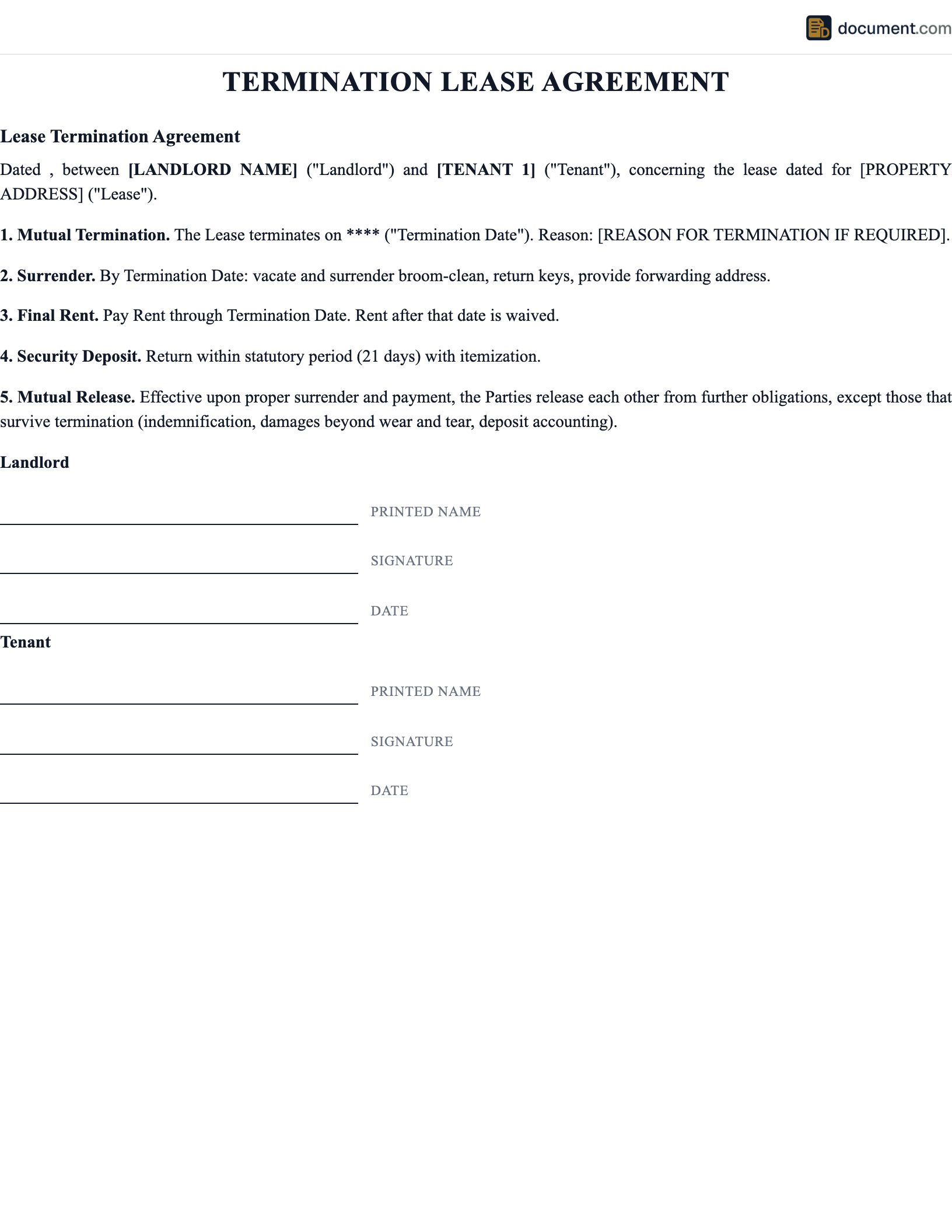
Below is a preview of our Florida-specific early lease termination letter with proper statutory references for FL law.
EARLY LEASE TERMINATION NOTICE
STATE OF FLORIDA
TENANT:
Name: [Full Legal Name]
Address: [Florida Rental Address]
LANDLORD:
Name: [Landlord Name]
Address: [Mailing Address]
TERMINATION DETAILS:
Vacate Date: [Date]
Reason: [Legal Reason]
Florida Early Lease Termination FAQ
Answers to common questions about breaking a lease early in Florida.
Official Florida Resources
Verified resources for Florida-specific tenant rights and legal assistance.
Create your Florida Termination Early Lease Agreement in under 5 minutes.
Answer a few questions and download a Florida-compliant document, ready for the state agency.