



Connecticut Tenant Protection Framework
Connecticut's General Statutes Title 47a provides a comprehensive framework for landlord-tenant relations, including specific provisions for early lease termination. The state's courts have consistently held that landlords have a duty to mitigate damages, meaning they must make reasonable efforts to re-rent a vacated unit rather than holding the departing tenant liable for the full remaining lease term.
Connecticut's security deposit law (CGS § 47a-21) limits deposits to two months' rent and requires return within 30 days with an itemized statement. Interest must be paid on deposits held for more than one year. If the landlord fails to return the deposit timely, the tenant may recover double the deposit amount. These strict rules provide significant leverage for tenants negotiating early termination.
Connecticut's proximity to New York City means the southwestern portion of the state (Stamford, Greenwich, Norwalk) has extremely competitive rental markets where units re-rent rapidly. The Hartford and New Haven metro areas also have robust rental markets, while more rural areas in eastern Connecticut may have slower re-rental timelines.
Habitability and Repair Rights in Connecticut
CGS § 47a-7 establishes the landlord's obligation to maintain rental premises in a fit and habitable condition. Connecticut courts have applied the implied warranty of habitability strictly, finding violations for conditions including lack of heat, pest infestations, lead paint hazards (a significant concern in Connecticut's older housing stock), mold, plumbing failures, and structural deficiencies.
Connecticut has a robust "rent escrow" process under CGS § 47a-14h, allowing tenants to deposit rent with the court when habitability violations exist. This is an alternative to termination that can force the landlord to make repairs. However, if the landlord fails to remedy the violation, the court may authorize the tenant to terminate the lease.
Lead paint is a particular concern in Connecticut, where many rental units were built before 1978. CGS § 47a-54f requires landlords to disclose known lead hazards and take remediation steps. Failure to address lead paint hazards, especially in units occupied by children, can be grounds for termination and may also trigger enforcement action by the Connecticut Department of Public Health.
Domestic Violence Protections (CGS 47a-11e)
CGS § 47a-11e provides strong protections for Connecticut tenants who are victims of family violence. A tenant may terminate the lease upon providing written notice and a copy of a valid restraining or protective order, or a police report documenting a family violence incident. The termination is effective 30 days after notice or at the end of the current rental period, whichever comes first.
Connecticut's statute also requires landlords to allow early termination for victims of sexual assault and stalking, not just domestic violence between household members. The landlord may not impose penalties and must return the security deposit per standard rules. Connecticut also allows DV victims to request lock changes at the landlord's expense.
The Connecticut Coalition Against Domestic Violence (CCADV) can be reached at 888-774-2900 for referrals to local shelters and legal assistance. Connecticut Legal Services provides free representation to eligible DV victims for housing matters.
Penalty Structure in Connecticut
Connecticut does not cap early termination fees by statute, but the duty to mitigate limits total exposure. Many Connecticut leases include termination clauses with fees of one to two months' rent. The state's strong deposit protections (double damages for late return) provide leverage in negotiations.
Connecticut's relatively expensive rental market — median rents in Fairfield County rival those in New York City suburbs — means early termination penalties can be substantial in dollar terms. However, the same market dynamics mean units typically re-rent quickly, reducing your actual exposure when the landlord properly mitigates.
Military Protections in Connecticut
Connecticut's primary military installation is the Naval Submarine Base New London (Groton), one of the two major submarine bases in the country. The Coast Guard Academy in New London also generates military housing demand. Federal SCRA protections apply fully, and the legal assistance office at the sub base provides free SCRA guidance.
Connecticut also hosts the Connecticut National Guard, and state military members called to state active duty may have additional protections under state law. Contact the Connecticut Department of Veterans Affairs at 860-616-3600 for guidance on state-specific military protections.
Notice Requirements in Connecticut
Connecticut requires written notice for lease termination. For month-to-month tenancies, CGS § 47a-23 requires notification before the end of the rental period. For habitability issues, written notice to the landlord with a reasonable cure period is required. For DV terminations, 30 days written notice with documentation is standard.
All notices should be sent via certified mail, return receipt requested, or delivered personally with a signed receipt. Connecticut law also permits electronic notice if the lease specifically authorizes it. Keep copies of all correspondence as evidence.
Sample Connecticut Early Termination Letter
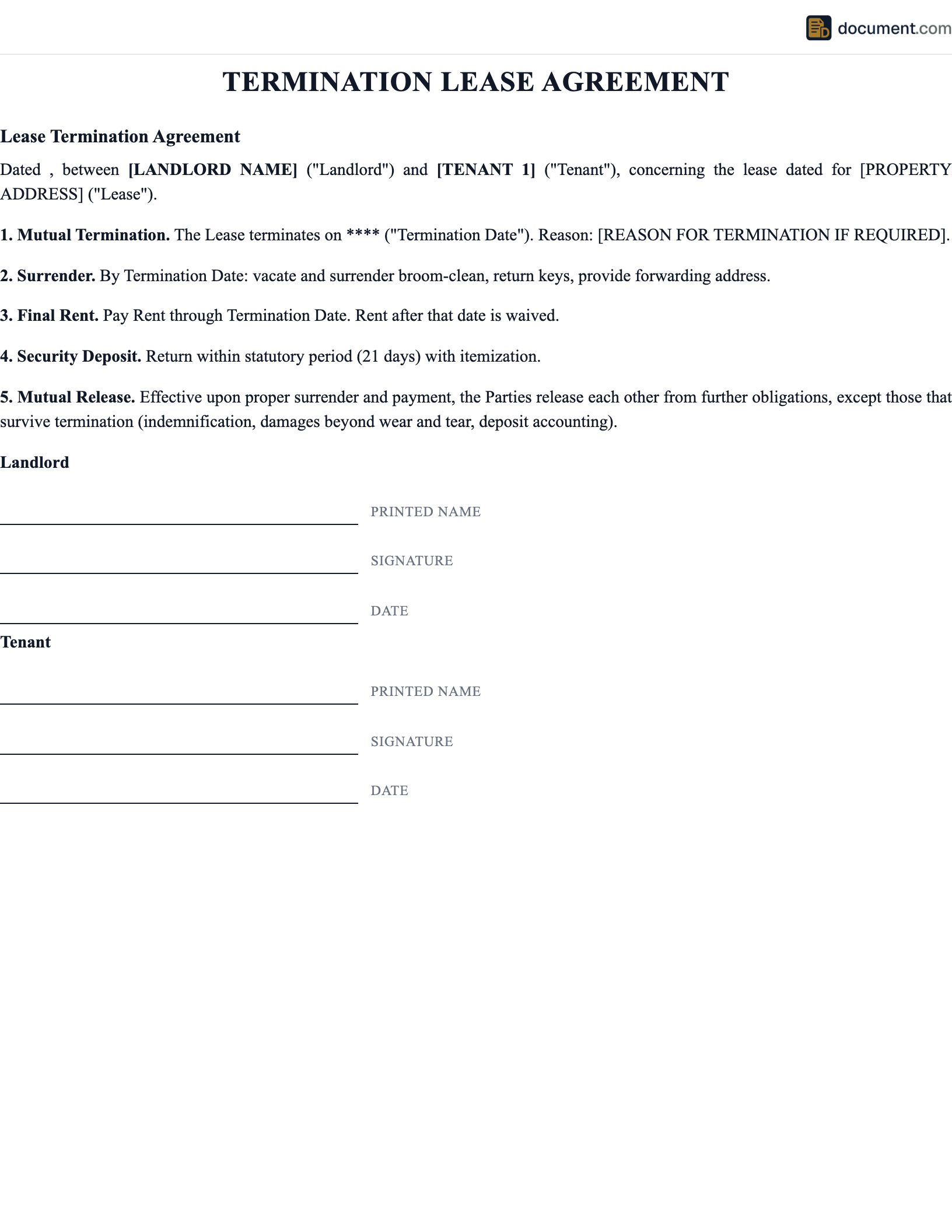
Below is a preview of our Connecticut-specific early lease termination letter with proper statutory references for CT law.
EARLY LEASE TERMINATION NOTICE
STATE OF CONNECTICUT
TENANT:
Name: [Full Legal Name]
Address: [Connecticut Rental Address]
LANDLORD:
Name: [Landlord Name]
Address: [Mailing Address]
TERMINATION DETAILS:
Vacate Date: [Date]
Reason: [Legal Reason]
Connecticut Early Lease Termination FAQ
Answers to common questions about breaking a lease early in Connecticut.
Official Connecticut Resources
Verified resources for Connecticut-specific tenant rights and legal assistance.
Create your Connecticut Termination Early Lease Agreement in under 5 minutes.
Answer a few questions and download a Connecticut-compliant document, ready for the state agency.